Unknown's avatar

About Matt Meinke

Presbyterian minister | Presbytery Leader @MaumeeVP | MSN Candidate & Aspiring RN | Adjunct professor | Leadership consultant | Organizational Development | OU, Thunder, Packer fan

I Wanna Be First!

gold-bear-318359_960_720Exod. 4:10-20(21-26)27-31; 1 Cor. 14:1-19; Mark 9:30-41

The disciples argue over who should be first today.  It is a natural thing to do.  All one has to do is watch a class of third graders line up at the door.  Being first in line is important.  This aspiration carries to the playground, where one strives to be “king of the hill”.  And not much changes as one moves into adulthood.  The games look a little different, but for the most part, many strive to get ahead of everyone else professionally and emotionally.  People drive certain cars, wear certain clothes, have the fanciest mobile device (“King of the Cell Phone Hill”).

Jesus’ words, then, are not the most popular: “Whoever wants to be first must be last of all and servant of all.”

To be “church” we are told that we will be the world’s servant, or each other’s servants.  It is a world upside-down.  Jesus then took a little child and put it among the disciples, and taking it in his arms, he said to them, “Whoever welcomes one such child in my name welcomes me, and whoever welcomes me welcomes not me but the one who sent me.”

Servanthood is something we talk about with the new Stephen Ministers in training.  We talk about what it means to be servant leaders.  It carries authority with it, but it also requires one doesn’t get bloated with that authority, and remains humble, thankful, and caring.

In Jesus’ ministry he continually lifts up those who have been put down.  The blind, the widowed, the children, the sick in body and spirit, the divorced.  He preaches egalitarianism and fairness.  And while, on the surface that may not seem like a radical thought, it still is.  It is radical because it means the poor become rich – and this is still a hot button today.

Most of the time I encounter fights in the church or the nation it has to do with money.  Taxes, money, and power are of central importance in our secular culture.  And Jesus steps into the midst of this argument with his thoughts about servant ministry.  The goal is not to accumulate more money but give it away, to not gather more power but to serve those under you.

It truly is a world upside-down.

-Matt

P.S. Be praying for our very own Jim Borgstadt, who is completing his Stephen Ministry training soon.  We are partnering with All Soul’s Episcopal Church, where we will have a commission service soon.

Drawn From Water

drops-of-water-578897_960_720Exod. 2:1-22; 1 Cor. 12:27-13:3; Mark 9:2-13

There is so much in a name.  Remember Moses?  You know, the guy who gets the 10 Commandments?  Leads the people through the desert?  Let my people go!  You remember now, right?

Our scripture today ties us to his birth but also his name.  Because of the Pharaoh’s edict that every Hebrew boy be thrown into the river while every girl lives, Moses’ mother makes a papyrus basket for him and puts him in the reeds on the bank of the river.  Someone else draws him out of the water to  save him.

Did you know his name wasn’t really Moses.  That’s just English.  In Hebrew the name that is given to him is Moshe, which means “I drew him out of the water.”

Do you remember who scooped him up from the Nile?  It was Pharaoh’s daughter who decided to save him and raise him.  In a story that is all too reminiscent of Joseph being shown grace by the Egyptians, this story stands as a reminder that God can work even through the most unlikely people.

This story reminds us of the powerful place of women, and the ironic salvation of foreigner women, in order for God’s good purposes to move forward.

Pharaoh had decided all boys were to be killed.  But that edict was outwitted by Moses’ mother, who strategically places Moses among the reeds.  This is not like leaving a child to die, abandoning them to isolation, left out in the middle of nowhere until he dies of starvation.  This was the edge of the Nile, the life-blood of the community.  Many will come by here, to get water and to bathe.  But who gets water in this culture?  Women.

Moses’ mother stacked the deck in the sense that she was passing Moses’ fate onto the women of the land.  And while Pharaoh’s heart was hard, I believe she knew God’s grace would shine brightly if it was placed in the hands of women, even Egyptian women.

Water plays central roles in the Bible, not the least of which is new life in baptism.  Water is the life-blood of the community.  From droughts to plagues, from watering crops to changing water into wine, to be drawn out of the water is to be drawn from the source of life itself.  Here is someone, Moshe, who has come from vigor and vitality, and will become one of the strongest leader of the Biblical record.  From water…not just the Red Sea parting, but from that basket in the Nile, salvation comes from the water.

This is the power of the water of baptism when Jesus rises from the Jordan after his own baptism.  Or when we come from the water.  It is not merely a cleansing.  It ties us to the Creation story, to Moshe, to the Nile, to the Red Sea too.  Out of the chaos comes hope.  Out of the depths, new life and new possibility breaks forth.  Water is a sign of salvation, and that the drought of our lives has ended, flooded with newness, vitality, health, and wholeness.

We have all been drawn from the water, wrapped into God’s magnificent handiwork, and called forth into daring new adventures.

-Matt

Who Do You Say That I Am?

cube-844266_960_720Exod. 1:6-22; 1 Cor. 12:12-26; Mark 8:27-9:1

Jesus asked them, “But who do you say that I am?”  Peter answered, “You are the Messiah.”  And he sternly ordered them not to tell anyone about him.

Some days I wonder, do we really believe what Peter believed?  Do we truly believe Jesus to be the Messiah?  That is not just a fancy saying.  It means that we believe Jesus to be the Anointed One who saves the world.  Sometimes I worry that we have fallen short of that belief, declaring instead that Jesus is a “nice guy” but no more.  If Jesus is truly the Messiah, should not our lives radically change?

When are we going to leave our lives behind to follow this newly anointed king?  When are we going to leave the world behind?  Do we really believe that Messiah coming is “good news”?  Or is it disrupting and terrifying?

These are questions to ponder, and not ones that can be adequately addressed in one Morning Reflection.  But it is worthy of reflection.  To say “I believe Jesus is Lord” is a common thing to hear in our world.  So much so, it is almost a trite saying.  To confess this is radical.  It uproots a life.  What does it mean to say that God is the center of your universe and the Lord of your life?

How are our lives to change if we are going to follow Christ, the one who died on a cross because of the world’s standards?

I have a feeling the answer will start with reading Scripture, but God help us that it doesn’t stop there.

-Matt

Time to Grow Up

tomatoes-1220774_960_720Gen. 50:15-26; 1 Cor. 12:1-11; Mark 8:11-26

“Now there are varieties of gifts, but the same Spirit; and there are varieties of services, but the same Lord; and there are varieties of activities, but it is the same God who activates all of them in everyone.”

As we move into our postmodern future as the church, you may have noticed a lot of changes already.  Gone are the days when the focus is on “great preachers” and their theological sermons, like we focused on in the second half of the 20th Century.  “Next Church” focuses more on spiritual gifts of all the members, participation, spiritual renewal, and mission.

This has created anxiety – but mainly this is leftover anxiety about the decline of the Church in North America.  Folks are often surprised to discover how little I care about shrinking numbers.  Some get upset that my anxiety doesn’t match theirs.  My token phrase: “It’s all fine.  I would rather have 100 people who really care about Christ and his mission in the world, than a 1,000,000 people who don’t give a hoot about Christ.”

And in many ways, I am serious.  The last thing we need is a rebirth of the “country club” mentality – that church was somehow a club for fun rather than a radical place assisting Christ as he changes the world.  They were “consumers of fun” rather than “doers of good.”  Thankfully that “church” has been in decline.

This mentality is what Paul is taking on with the people in Corinth.  He is saying, “No.  This is no country club.  This is serious work.  And you are part of that work.  Furthermore, that work all filters in to one goal – the goal of Christ.  Your spiritual gifts matter in building up the one Spirit, even though you individually have different gifts.”

And so, to those in the Church who are still counting membership rolls, or worship attendance, I say this: let’s start counting the number of people who are exploring and discovering their spiritual gifts.  That will be a much more accurate thermometer for Church life and spiritual health.   It will also assist us in growing up.

OK, time to get off my soap box.

-Matt

Rituals

team-386673_960_720Gen. 49:29-50:14; 1 Cor. 11:17-34; Mark 8:1-10

One of my New Year’s resolutions was to party more.  I suppose what I mean is to have more opportunities to come together with friends and family.  Our culture is increasingly disconnect, probably due to the way technology has transformed the way we communicate.  But yet we have not come to a new equilibrium of how to “do togetherness” in enough ways.  We are increasingly connected, yet disconnect at the same time.

The power of ritual is seen in Genesis today.  And while it is a death and a burial, a sad occasion, it is a ritual of coming together.  Jacob has given his final words to each of his sons.  The legacy of God’s double promise of land and progeny is expanded greatly as he passes it off to the next generation.  Now we recount his death and burial in Canaan at the Machpelah cave.

Mourning and lamentation fill this passage.  Joseph throws himself over his father’s face and wept over him and kissed him.  He instructed his physicians to have his father’s body embalmed.

All of the passages today involve the ritual of coming together.  Here  in Genesis it is not for miraculous food or heavenly togetherness (like the 1 Cor and Mark passages), but it is close!  To embalm the body is thoroughly Egyptian, not an Israelite practice, and yet it becomes an opportunity for all these different people to come together – the servants of Pharaoh, Pharaoh’s family, the elders of Joseph’s household, the elders of the land of Egypt, as well as all of Joseph’s brothers and their household.

In a strange encounter that foreshadows Moses’ repeated requests to depart to Israel, Joseph goes to Pharaoh to ask for permission to ritually bury Jacob all the way back in his homeland.  In their grief and loss, the community is able to come together.

Not surprisingly, after this time, Joseph is able to purge his own soul and forgive his brothers.

The power of ritual should not be overlooked.  It has the power to capture imagination and transform perspectives.  It allows God to work in our lives and knit together a new story for our future.

Whether it is the feeding of many thousands, the mystical union of the Lord’s Supper, or the burial of a loved one, it gives us time with one another and with God.  It is where the mystery of faith and the reality of God’s presence become more real.

Think about that for a minute.  It is not just the occasional birthday party that provides togetherness, but all sorts of rituals in our day.  There are many reasons to party, and I intend to take em.  Speaking of, Thunder Up!  Tomorrow will be a big night, playing the Clippers again.  Look at that, rituals of togetherness abound!  We all just need to create them, seek them out, and nurture them in our family lives.

-Matt

Let’s Eat!

1010206_844454755568721_2592168126321263084_n

Gen. 49:1-28; 1 Cor. 10:14-11:1; Mark 7:24-37

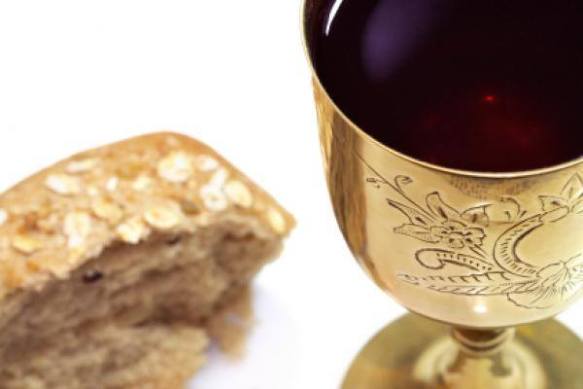
Yesterday we had our monthly celebration of Communion at First Presbyterian.  Then I turned to our scripture for today and fell deeply into the mystery of our 1 Corinthians passage.  “The cup of blessing that we bless, is it not a sharing in the blood of Christ?  The bread that we break, is it not a sharing in the body of Christ?  Because there is one bread, we who are many are one body, for we all partake of one bread.”

Paul refers to the mystical union of the Lord’s Supper.  Here Paul develops the image of the Lord’s Supper as the church as one body.  It is an event shared with Christ and with other believers.

It also becomes a way to separate oneself from the world’s struggles and enter into a community of faith – “You cannot drink the cup of the Lord and the cup of demons.”  For Paul, these demons are the gods of the pagan idols.

For us, our “gods” become the secular world and its pull.  Money, power, ego, and greed are our modern day demons.  To see the table as a radical departure from the world, and an entrance into an agape feast of nourishment and oneness is a radical concept.

Unfortunately, many churches have almost entirely lost the celebration of the Lord’s Supper, doing it once a year or once a quarter in hopes that by not doing it much, it will be “more special”.  To me this makes no sense.  Perhaps we should only sing hymns or have someone preach once a year so that it can still be “special”.  Perhaps I should only tell my spouse “I love you” once a year so it can truly be special.  Or not!  There is something about regular nourishment that fits in with Jesus’ ministry.

Frankly, sharing in the Body and Blood of Christ only once a year, to me, is the devil at work, literally starving the Body of Christ.

For Paul and the early church, much of Christianity focused on feeding and nourishment, on togetherness and building each other up in the body of Christ.  This occurred as they met in homes and ate together.  The mystical bond of the table was not something they did once a year, but something they encountered daily.

We need to reclaim this!  We follow a God who came to earth and fed 1,000s, only to end his earthly ministry with another meal, even in the midst of betrayal.

Eating is an essential link to the Christian community. Glory be!!  Those of you that know me, know I love to eat.  And I love table fellowship.

Talk about Good News!!  OK, let’s eat!  (Can you imagine better words?)

-Matt

Life in the Boat

DSC01230.JPGGen. 47:1-26; 1 Cor. 9:16-27; Mark 6:47-56

Our Mark passage today is Jesus walking on the water.  You can see that, beautifully portrayed in one of our Miracle Windows at First Presbyterian Church in Oklahoma City.

As a teen I was uncomfortable with this story.  I remember going to my pastor about it.  Is this simply a story showing Jesus’ power, or did he actually  have command over the natural elements: air, water, fire, earth?  This never made sense from a scientific-method standpoint, which every good high school student is steeped in.  Could any of this really happen?

Now as a minister and Bible scholar I realize that is the wrong question! Mark’s version of the gospel to the rescue!  The sequence of events is telling.  Jesus has just lived through a good bit of trauma: he was rejected at Nazareth, practically run off, his good friend is murdered and his head ends up on a plate, so the disciples go get his body and I assume they have a funeral, then Jesus feeds the 5,000.  I am imagining if this guy is an introvert, just the feeding of the 5,000 is “people overdose.”  So he retreats.  He escapes from the world for a moment.

The disciples get in the boat while Jesus dismissed the crowd.  Then after saying farewell he goes up on a mountain to pray.  We are told “Jesus was alone on the land when he saw that they were straining.”

I have spoken before about how I am fascinated with Mark’s themes of messianic secret and the suffering servant.  Another aspect I love about Mark is his flow of story.  Perhaps my pastor’s answer was unsatisfactory is because we had not read the Marcan version.  Here there are no details about Peter or anyone else walking on the water out to Jesus.  The focus is not on the water walking at all.  That is merely a miscellaneous detail.  It is the tension between alone and togetherness.

And if you are used to Old Testament stories with fantastical language and goings-on, you are used to things that are extraordinary (i.e. things beyond our senses).  So to someone of this time, they might not have titled this story “Jesus Walks on the Water” but “Peter Dares to Trust the Almighty” or “God Calls Us to Not Be Afraid”.

Jesus sees they are in trouble, and realizes it is easier to encounter things together.  They saw him walking out there and thought he was a ghost; they cried out; he spoke to them and said “Don’t be afraid.”  And that is the end of it.  He got into the boat with them and the wind ceased.

But there is another aspect of this we simply MUST address.  The church today has its fears too.  Some worry only of division.  Others worry only about the past, trying to reclaim the 1960s.  Others worry only about purity.  These groups want to wave a magic wand and have people magically come together in peace and harmony.

Some of us in the church spend all of our time sleeping in the bow of the boat.  Others of us spend all our energy trying to throw one another out of the boat.

Jesus calls us to togetherness.  To trust.  Jesus enters the story right in the midst of chaos and confusion, and that was precisely the time to get in the boat with them.  It was not the time to bail, but the opposite.  Right when our instincts say it is time to bail, Jesus comes along and points to a different reality.

Remember that Final Discourse in the gospel of John?  Some of Jesus parting words to the disciples, knowing that in the future they would face adversity and dissension, was to remind them to abide in him, love one another, and pray for unity.

We follow a savior who demands that we think clearly, not panic, and stay in the boat.

-Matt