The Power of the Pilgrim’s Way: The 3 Stages of Pilgrimage

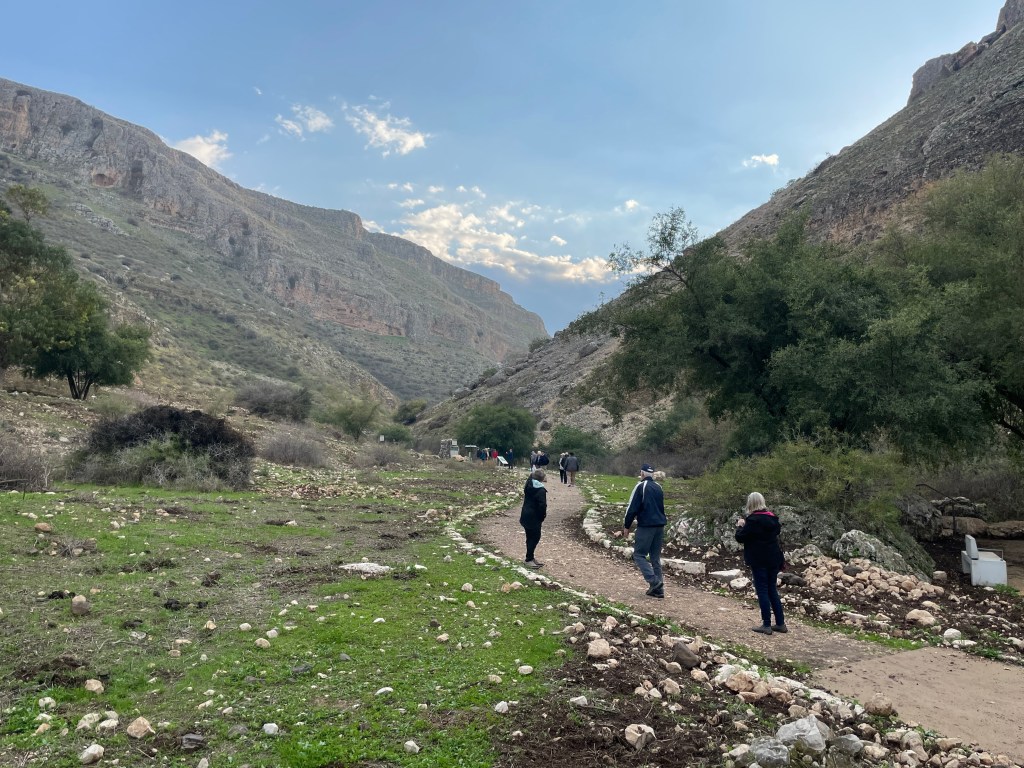
Following in the Way of the Rabbi Jesus, my group of 18 disciples, most of which are part of the life of Maumee Valley Presbytery, ventured off to the Holy Land about 11 days ago to begin the “Journey with Jesus” trip that began in Bethlehem, through the Galilee, and ending in Jerusalem. It has been hard to find time and space to write and reflect on our time there, especially as I was also asked to serve as bus captain for the Orange Bus, and so the added responsibilities of melding my 18 into a group of 4 from Virginia and 5 from South Dakota.

But here I sit, nearing the end of these 11 days, in the same dusty clothes I was wearing 36 hours ago when I walked the Via Dolorosa – the Way of the Cross – and pondering in my heart the power of this year’s pilgrimage.

This trip was different – on both a personal level, but also in the way it was structured. So it both felt different and was different, partly because this is my 8th trip to the Holy Land and I wanted it to feel fresh and new for me personally and the others who were going on their second or third pilgrimage, but also because of a deeper, personal desire. I had a great need in my heart to retrace my own previous footprints, and discover new paths as I follow the Way that has been laid out for me by the Great Rabbi I call Lord. And I invited others to join me on this path, that retraced not only my previous steps, but steps that followed the timeline of the life of the Rabbi Jesus, who was born in Bethlehem, grew up in Nazareth, taught around the Sea of Galilee, visited Samaria and the Woman at the Well, and eating and praying and teaching during his last days on earth in Jerusalem. This retracing, this trip, has filled my heart – on so many levels. But more on that in coming reflections. Let’s back up and talk about the process of pilgrimage for every Christian.

Our Journey to the Holy Land may be coming to an end, but the power of this pilgrimage is just beginning.

Every Pilgrimage has 3 stages. First, there is the PREPARATION for the journey. This is at the very least a MINDFULNESS, but more often for a Christian includes some sense of CALL. In some there is a deep desire – a yearning. Others only have a mild itch. Yet others are not certain of their motives or desires, and that is OK too. Certainly my first pilgrimage I was more filled with WONDER and CURIOUSITY but knew little about my call.

But whatever the motivations, for everyone there is a definite sense of preparing for the journey, from packing bags, to requesting time off work, etc.

This preparation stage is key for an effective pilgrimage. Without it, there does not come a SEPARATION from regular routines, from family, from community. In order to open oneself to a spiritual pilgrimage it is essential to leave behind much of our daily obligations, especially in our world of technological bombardment. It is only when we separate, and move to the desert (literal or figurative), that God can reveal new paths.

The second stage in every pilgrimage is the JOURNEY/VOYAGE itself. For me, the key of this stage is recognizing that the Journey is an entity in and of itself. This means embracing the experience, whatever it is.

For us it was embracing this new community we had just become a part of – the Orange Bus. Who were these other pilgrims? Some of them I knew very well. Some I knew but only because of our Zoom classes we had beforehand, or had only spoken to on the phone and only knew their voices. Others I was meeting for the first time.

Obviously there is an element of FRIENDSHIP and COMPANIONSHIP along the way. This is a key piece for every Christian Pilgrimage, because our religion is primarily a “WE” religion and not an “I”. As we become AWARE of the others traveling with us, there is an opportunity to EXPLORE and UNDERSTAND their hopes and dreams, their excitement or reservations, their struggles or tensions. We also begin meeting others along the way. They can become powerful instruments of God’s grace along the Way. To this journey – this pilgrimage – we each bring our story. These friendships and companions we encounter on the Way can help illumine, articulate, and understand the story that brought us there to begin with.

For many of us we found that in Leo, our Palestinian Christian guide. He shared abundantly from his faith, and guided us down streets he had grown up on and knew very well, welcoming us into his story, introducing us to his friends, and opening his heart. He had a gift for helping us feel safe. This makes it easy to open one’s heart and engage in the key piece of every pilgrimage: IMMERSION

There is a rhythm or a shift within every journey that must occur if it is to become a pilgrimage. And it relates to this immersion. At some point one goes from being a mere OBSERVER of this new landscape to becoming a part of the landscape itself. In fact we lose our role as an observer and we become part of the landscape. We begin to become a part of someone else’s story.

For some of us, that “someone else” is Jesus. For others it is the Palestinians or the Israelis and their story. For others it can be the stories of so many pilgrims that have come before us, also taking similar paths and following the same Way. This is again where Leo shined. With him it was easy to become part of someone else’s story.

It is in this new community we are invited to DISCOVER this new landscape, this new land and people. It is in the midst of this time of discovery we are invited to be absorbed in someone else’s story and discover new parts of our own. It can be a place of OPEN DOORS and planting of new desires we may not have even known we had. It can also be a place of new DISCOVERY about ourselves

The third stage of every pilgrimage is the RETURN/TRANSFORMATION. As we return from every pilgrimage the reality is we are a different person than when we set out. Often it takes time to process or understand what has even happened. The transformation may be more like a slow metamorphosis that takes time to fully grasp what God has been up to in your life. This was certainly the case for me. I don’t think I grasped the impact of my first journey to the Holy Land until a few months after I had been there. In some ways I am still working out its implications and impact in my life, over 25 years later.

But we need to trust that with our intention to be pilgrim, the Pilgrim’s Way is set in motion.

There is a great Negro spiritual I sang when we were down on the Lithostrotos, the courtyard of the Antonia Fortress, and the ancient paved road during the Roman times, where Jesus was most likely stripped and whipped and tortured by the Roman guards.

I want Jesus to walk with me. I want Jesus to walk with me.

All along my Pilgrim Journey. Lord, I want Jesus to walk with me.

In the desire is the reality that he will.

This is what I hope to explore as I seek to unpack this most recent trip. I will offer a series of Morning Reflections tracing these Footsteps of the Great Rabbi Jesus, and the ways in which we have walked and desire to walk with Jesus, as we seek that Return and that Transformation.

-Matt

Happy New Year!

It was not too long ago in the Presbyterian Church that the celebration of New Year’s was a bigger deal than Christmas. It’s true!

The liturgical traditions of Advent and Christmas were more popular in Roman Catholic and Lutheran congregations. Presbyterians were not so bound to a liturgical calendar as we are today, and instead we found ways, particularly in America, to frame secular holidays with sacred meaning. While others celebrated New Year’s with extravagant parties, many of us Christians were choosing to usher in the New Year by going to church, and gathering around the Lord’s Table to celebrate communion. They were known as Watch Night Services, and were particularly popular in our African-American congregations.

Watch Nights have a strong theological vision, and I wish we celebrated it more robustly in our churches these days. These services give us a foundation in time that stresses the sovereignty of God – starting all new things with God at the heart of our time. Beyond that, it is a chance to turn the page, put the past behind us, confess, re-form. How Presbyterian!

It was our African-American congregations, who couldn’t imagine celebrating New Year’s Eve without their church family, and who brought a history of plenty of uplifting joyful music and long prayers, that really helped us blaze a tradition of Watch Night services. The tradition goes back quite a ways further, but the fuel for Presbyterian congregations in America probably got its start all the way back on December 31, 1862, when blacks were holding vigil for the Emancipation Proclamation to go into effect on Jan 1, 1863.  It was “Freedom’s Eve”.

As the tradition developed there were often candlelight Watch services, with candelabras with 12 candles, one for each month of the year, and Presbyterians would recount the major events in the life of the congregation for that month.  Baptisms, marriages, deaths, mission trips, confirmations – these were all fair game.

As the New Year came, with the bells tolling at midnight, the congregation would be gathered around the Lord’s Table, celebrating freedom and new life.  It was a time to renew their covenant with God.

Often on New Year Day one of the readings ties us to the covenant and the beginning of Hebraic identity.  Abram is given the instructions, details, and signs of the covenant: “I will establish my covenant between me and you, and your offspring after you throughout their generations, for an everlasting covenant, to be God to you and to your offspring after you.”

I am struck by the PROMISE. Into our world full of broken promises, God speaks words that never erode. Today promises are thrown around as more of a convenience to the one making them. 

God does not run away from the promises he has made.  No matter what we do, nothing can undo what was done at the cross on our behalf.

What I love about baptism is that you can’t undo it.  God’s YES is stronger than any NO we muster. God has claimed us as his own, and that is final.  We live with a promise that will never be ripped away from us.

What a way to start the year off.  So take a moment to pause and look back to our roots in Abraham and Sarah, but also our roots in baptism, and to the beginning of God’s love affair with us, a love that will never die.

May your New Year be bright!   And may the Light of Christmas continue to surround and fill you.

-Matt

All Saints’ Day (and All Hallow’s Eve too)

All Saints’ Day has to be one of my favorite Christian holidays. Always November 1, All Saints’ Day (aka All Hallows’ Day or Hallomas) along with its corresponding eve before, All Hallow’s Eve (aka Halloween), has a deep history in Christianity going back 1600 years. This is the day when we literally laugh in the face of death and declare that death did not get the last word. We do this by remembering those restless spirits of the saints, who live on in us echoing into ours, and who continue to move in us, inspire us, and guide us.

I am sure you have people in your lives who you remember like this, and who continue to move in you, guiding you. Perhaps it was a grandmother who taught you to cook, or how to love family. Perhaps it was an influential teacher. Perhaps it was a historic saint of the church who has had a powerful influence on you.

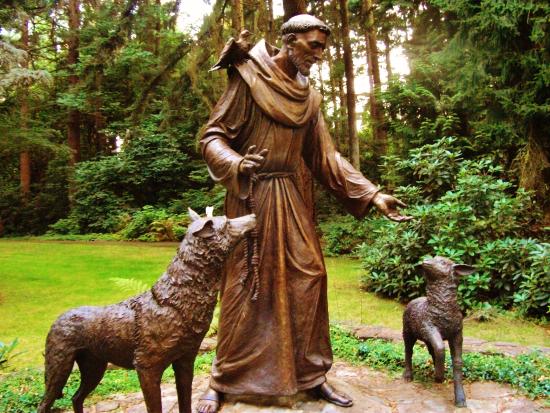
Today I remember St. Francis. Many of you may know a bit about Francis because of his special connection to nature and animals. There are a lot of statues of him in gardens, usually with birds or bunnies or other animals resting on him. While a lot of the stories that have been told of him are mere legends, his deep connection with nature abides and inspires, especially in this 21st Century where we yearn for climate justice and a closer connection with the earth entrusted to our care.

But let me back up and say a bit about how I came to fall in love with this saint of the Church.

I have been enrolled in classes to become a Spiritual Director. It is a rigorous three-year program that I am about half-way through, and it has been opening up a whole new world to me, not just of the inner life, but also equipping me to do my job in profound new ways. Many of you know I am a Labyrinth Facilitator and it turns out I have been on this path for a long time. These Morning Reflections too, which were a staple of my work for years, have shaped this path too.

As part of the trajectory of the Spiritual Director Practicum, Sister Nancy Brousseau (who is an awesome trainer by the way!) has encouraged us to explore who our Spiritual Giant is. This Spiritual Giant or Spiritual Teacher is someone who continues to shape and guide and inspire us. Having already explored many of these mystics for the last year or so, from Hildegard of Bingen, to Ignatius of Loyola, Julian of Norwich, Teresa of Avila, Evelyn Underhill, Pierre Teilhard de Chardin, Howard Thurman, etc., this should be an easier choice. Immediately I zoned in on St. Francis.

I remember St. Francis as someone who calls me out of myself to a more extroverted spirituality than I previously had. It is not just his connection to nature but to communities in need, and to really live into that life of Jesus. His prayer life was on the move too, demanding he take up his cross and follow Christ.

Some of you may have noticed the lack of Morning Reflections. Part of this is due to St Francis’ influence. That rhythm of contemplative prayer each morning, digesting scripture, and rising out of the silence to produce a Morning Reflection, which I had come to know and love and which had served me for over 10 years of my ministry, needed a freshening up. And so I allowed God to lead me to new discoveries of prayer and engagement.

Back to St. Francis of Assisi. One of the ways I see his influence is my adoption of a similar practice as his, talking to animals as if they are brothers and sisters. I find my interactions with my dog has changed. I now speak to “Brother Bentley” as if he were an equal partner, leading and guiding me with his curiosity or unconditional love for me. My continued hope and prayer is that this simple adoption of a new language of connection will continue to grow and shape me, perhaps birth a better understanding and solidarity with other life forms.

My prayer for you on this All Saints’ Day is that you too will remember a saint that has gone before us, who inspired to you imitate Christ in deeper ways, and give thanks for their life and the way they have shaped you, and that your life may be a reflection of theirs today.

May those restless spirits come alive in us today!

-Matt

Journey Toward Wholeness

Advent begins in just a few days. If you are looking for a fresh, new devotional to guide you through Advent, let me lift up Journey to Wholeness.

My former colleague from John Calvin Presbytery, Susan Rosenbaum, put together an Advent devotional written by women clergy and CLPs from around the country. There is a link to the PDF below.  I have permission to share this with you! What a gift Susan and many of our women clergy have provided us.

2021 Advent Devotional – JOURNEY TO WHOLENESS – PDF

Blessings!

-Matt

Halloween – Part 2

All Saints’:
AM: Psalm 111, 112; 2 Esdras 2:42-47; Hebrews 11:32-12:2
PM: Psalm 148, 150; Wisdom 5:1-5,14-16; Revelation 21:1-4,22-22:5

Today is All Saint’s Day, or Halloween, Part 2 as I like to think of it. As I mentioned in my last post, last evening was All Hallow’s Eve, and just like Christmas Eve/Christmas, today is a continuation of the celebration that started at sundown last night. Just like Halloween, today we remind ourselves that Death does not have hold of our lives, but new life. We remember those who have gone before us. But more importantly we remember that Death is not the end of their story. In many ways yesterday and today are Christians laughing in the face of death and saying “That is not the end of our story! Death does not scare us. It doesn’t define us. New Life does!”

One of the readings for this All Saints’ Day is one of my favorite passages from Revelation.  “Then I saw a new heaven and a new earth; for the first heaven and the first earth had passed away, and the sea was no more.  And I saw the holy city, the new Jerusalem, coming down out of heaven from God…God himself will be with them; he will wipe every tear from their eyes.  Death will be no more.”

It is quite the “rounding out” of the biblical narrative.  What began in Genesis with the creation of the world, we end with a new creation.  It is almost a mirror of events.  But instead of going backward, the events are transformed anew.  

It is a breathtaking vision or restoration and new life.  It is the ultimate blessing, when all will come into harmony with the Almighty.  No mourning.  No crying.  No pain.

Today marks a time when the church has historically celebrated the dead, the communion of saints, those who have gone before us.  (Does it shock you that Halloween has as many Christian roots as this??? Most are shocked.) 

Many of the saints of the church went through enormous torment and pain, and Revelation speaks into that pain.  Many saints were martyrs, who literally bled for the cause of Christ.  Christ, himself, was a part of the violent deaths.  Many of our modern day “saints” like Dr. Martin Luther King, Jr. and Gandhi were assassinated. 

It is hard to make sense of violence and needless acts of hatred.  I tend to chalk it up to what I call the convulsions of the world, uneasy and ill-equipped to deal with Christ’s message of reconciliation.  And so the world revolts.  It is birth pangs of a new peace, a peace which Revelation looks toward.

On this day, not only do we look back and remember the important people of our lives who influenced our faith, but we also look forward to the day when God’s “YES” will overcome everyone of our “NOs”. 

So let us continue the Halloween celebrations and literally laugh in the face of death, for death does not define our story in the slightest.

-Matt

All Hallow’s Eve

Eve of All Saints:
PM: Psalm 34; Wisdom 3:1-9; Revelation 21:1-4,22-22:5

Today is the Eve of All Saint’s Day, also known as Halloween, or All Hallow’s Eve. It has a surprising amount of Christian roots, despite what the supposed evangelical “Christians” will tell you. Frankly I wish they would do their homework more before they post on social media. 

Despite the stories you have heard (and may have mistakenly believed), Halloween is not all about vampires, goblins, and carved pumpkins.  It is however about ghosts: for Halloween, or All Hallow’s Eve, is the beginning of the Festival of All Saint’s Day, which begins tomorrow, Nov. 1.  Tradition holds that feast days, in following the Jewish understanding of time, begin the Eve before the day – hence Christmas Eve often has the same function of Christmas Day.

Halloween is not a veneration of the dead as much as it is a commemoration of the faithfully departed who have seen the beatific vision of heaven.  Those who have died before us wait, like we do, to enter the new heaven and the new earth, which is the vision of our Revelation 21 passage today.

Then I saw a new heaven and a new earth; for the first heaven and the first earth had passed away, and the sea was no more.”

The vision of the end of time includes a wondrous re-creation – a time when God retools the cosmos into a place where crying and death and pain will be no more.  It is quite the vision.  We all wait, living and dead, for this final consummation of the earth.  It is the renewal of all renewals. 

When I first heard this passage expounded upon I was in class with Dr. Peter Macky, my mentor and inspiration at Westminster College.  It is Dr. Macky that led me to seriously consider the ministry.  He also got me thinking about biblical metaphors.  This was his prime example.  It was this passage that led him to know that God spoke to us, not always literally, but often in metaphors.

Peter grew up in Bermuda.  The vision in his head of what heaven would be like was just like Horseshoe Bay in Bermuda.  Sand like white powder.  The gentle ocean waves caressing the shore.  The sunlight playing off the water.  And in heaven there will be NO MORE SEA??  Peter had decided, if that was the case, he didn’t want to go!

To speak of the sea being “no more” meant for this biblical writer that the chaos of life would be over.  No more Leviathan.  No more shipwrecks and heartache.  No more hurricanes and chaos at all.  The peace and tranquility of the next life would take over.  But the point being, this is when Dr. Macky understood the power of metaphor in biblical writing, and not taking everything so literal. In his mind, heaven required there to be a beach.

I can relate as well – as a scuba diver, fisherman, and sea lover, there is no way heaven is a place where “the sea is no more”.  My vision of heaven is of a vast ocean – of endless Red Snapper, endless coral reefs to explore, endless feasts of shrimp and lobster tail.

And this awaits our future.  And on that day I will be reunited with Dr. Macky, who died of cancer some years ago.  And I will see all the saints who have gone before me, and we will sit down at a feast beyond anyone’s imagination.

So remember those who have gone before you this day, this All Hallow’s Eve.  And when a little ghost in a white sheet comes looking for candy tonight, give her an extra piece, and be reminded that a greater feast is coming.

 -Matt

Sunday School is Dead – FINALLY

Many of us are emerging from COVID-life discovering our churches are much different than they once were. Worship feels different. For many churches, young families are not coming back. Giving is different. Mission work has changed.

It is challenging, yet oddly exciting. Many of us as leaders had been praying for change, unable to discover how. The pandemic shook us and melted our ice. It is also exhausting, with little clarity on how to refreeze the melted ice of changed church systems.

One of the things I hear most often (and actually I heard this a lot before the pandemic) is that Christian Education isn’t what it used to be. It appears the Sunday School movement, which started at the beginning of the 1900s, is finally dead. The pandemic has put the final nail in its coffin.

Sunday School is dead. And I say GOOD. It is about time. It was never something Calvin would have approved of. Christian formation is WAY TOO IMPORTANT to be relegated to just Sunday morning. There is far too much material to cover than an hour slot on Sunday is going to provide.

Some people mistakenly think Sunday School has been around forever. It is actually a pretty new invention. It has only been around since Robert Raikes introduced it in the late 1790s to some churches in England, and even then its focus was not religious in nature. It involved rudimentary education for children – how to brush your teeth, do laundry, cook, how to write, read, or do arithmetic. By the 1920s it shifted into Catechesis, then into religious education, and finally to what we have today which is a haphazard Christian formation program that rarely “forms” anyone into a mature Christian.

I mentioned my first objection to Sunday School already, that it is way too important to be relegated to Sunday. Like Calvin, I am in favor of teaching the Bible throughout the week, preferably daily. This can happen in private Christian schools. It can happen in the home. It could happen at church, if our churches were built for comprehensive religious education.

I have other objections to the Sunday School movement. For another reason, Sunday School can be (and is often) a desecration of the Sabbath. Interestingly, these were what some of Raikes critics said back in the early years of the Sunday School movement. They believed Sunday School, or “Raikes’ Ragged Schools” as the critics called them, would weaken home-based religious education, that it could easily be a desecration of the Sabbath, and that Christians should not be employed on Sundays.

Another main objection is that Sunday School has historically divided the Body of Christ. I am an educator, and so I know all about the advantages and disadvantages of age-based learning, early childhood development, developmental stages, and all that. And I also know of learning theories like connectivism and as a church leader helped cultivate in my churches intergenerational events where new ways of learning could flourish. I am also a pastor with my finger on the pulse of the Body of Christ, who sees the level of commitment of congregants in this post-pandemic world, and the reality of tight schedules which stretch families thin these days (ranging from job responsibilities on Sunday, to soccer tournaments, to every other thing under the sun).

I know some of you are saying “Hey Matt, my Sunday School class is doing just fine!” That’s great. And I am not advocating its dissolution. But I would suspect that a fair amount of the reason you like the class is the relationships you have gained. It is probably more a small-group ministry, with a little learning peppered in along the way. I am arguing that those relationships should be more expansive and inclusive. Arbitrarily dividing classes into age-based learning, especially when there is only one person in that age range seems like a moderately ridiculous use of our time. I think our small group ministry needs to be big enough to absorb the death of Sunday School as we knew it.

Let me say a few more words about the Body of Christ divisions and the desecration of Sabbath. When I hold those two objections of mine together, what I am saying is that time is precious, and that the sacred time we do have with congregants these days must be approached with care. We need to focus on keeping the Sabbath HOLY, and that involves worship, community, and food. I believe it should be primarily worship, and not the artificial expectation that children need to learn the Bible that day and that somehow can happen in a 40 minute slot on Sunday morning DURING worship. Our children also need to learn the importance of WORSHIP! Or did we forget?

By and large people today are committed to their church, but they are not coming back to worship in ways they used to before the pandemic. They have discovered new priorities, and new ways to plug into their faith communities. And trying to go back to “business as usual” as church leaders is not even a thought. I take a lot of this as opportunity, not a problem.

We have been looking for ways to let go of things that have not worked in the church for 40 years. So instead of going back, let’s move forward.

Let’s use Sunday as a way to bring families together around food and around each other, and bring communities together. That can happen without them coming “back” to church as it once looked like. It can happen in new ways, if we as church leaders will just let go.

I talk to my Rabbi friends, and hear how they approach Jewish education, and I am filled with envy. In so many ways, education and Jewish identity is the responsibility of the FAMILY. It is not the synagogue or the Rabbi who provides a comprehensive program of learning, but the parents. The synagogue is there to equip. The Rabbi is there to teach, but often it is teaching teachers to teach or think in new ways. Yes, there are opportunities for Hebrew immersion classes, but it is the FAMILY unit who carries these learnings forward observing the traditions from week to week.

Jewish communities have discovered what we Christians are slow to discover – that there is too much to learn to be relegated to just one day of the week. If we are to be faithful to one’s tradition, a more comprehensive approach to education is needed. The Jewish day school movement, once limited to the Orthodox community has grown by leaps and bounds over the last 25 years. According to the Partnership for Excellence in Jewish Education (PEJE), an organization in North America dedicated to strengthening day school education, there are currently 700 Jewish day schools in North America with an enrollment close to 200,000 students. (https://www.myjewishlearning.com/article/jewish-educational-trends/) I also see an explosion of private Christian schools and I am encouraged (although right now I see very limited Christian teaching and much more opportunism or exclusivism).

My hope and prayer is that we can reclaim Sunday. And that means letting some old things die away, so that God’s new things can emerge in our midst. Let’s embrace that our children (and that WE too) need to re-learn what community looks and feels like. We also need to learn that Sunday can be a day when the church is at worship and that worship doesn’t need to look like it once did. We don’t ALL always need to be at the church on Sunday morning. There are other ways to worship God.

We also need to discover new options for using Sunday time. Sunday morning can become Sunday evening. For some churches, Sunday can become a time when the pastor does not LEAD in worship, but EQUIPS families for worship. Or Sunday morning can refocus on the whole community in worship and the Sunday School hour can fall away.

We also need to learn that the world will not fall apart if this happens. Calvin lived his whole life without Sunday School. It hadn’t been invented yet. And he did just fine.

We need to learn how to worship God in new ways, and be equipped to pray to God and worship God in our homes, daily. Not just on Sunday morning.

This is when the North American Church will truly experience revitalization, transformation, and dare I say resurrection.