The Order of the Phoenix

phoenix-1292958_960_720

1 Samuel 17:17-30Acts 10:34-48Mark 1:1-13

I love Harry Potter.  Love the series…loved most of the books…the movies too.  And although it was a while back I still remember going to the theater to see the last few movies, but especially the Order of the Phoenix.  I love how it jumped right into the action with no explanation, somewhat discombobulating yet exciting.  Talk about hooking an audience!  Even folks who have not read the book and don’t know what all is going on were in.  The story was dark and shifty, brilliantly put together for the movie, and just an all around good story and good series.

Many of you know this – my favorite gospel is Mark.  It is short, sweet, and to the point.  He is selective, yet colorful and persuasive.  Mark is a great writer.  Mark tells a good story!

Our journey through Luke ended yesterday, and we begin the gospel of Mark.  What does Mark begin with?  What is important to him?  Certainly not the birth narrative, for there isn’t one.

Mark jumps right into the action, like that Harry Potter movie.  Mark knows how to hook a reader.  Mark begins with “The beginning of the good news of Jesus Christ….”  And that beginning is John the Baptist proclamation of Isaiah’s prophecy that a messenger is being sent ahead to prepare the way of the Lord.

Then, after colorfully painting John the Baptist with camel’s hair, a leather belt, eating locusts and honey, we immediately segue to the baptism of Jesus.  It is brief.  It is without incident.  Then we move to the temptation in the wilderness.

I am curious about the brevity and the fact that two of the four gospels don’t even find it important enough to mention the birth narrative.  What does that mean?  For Mark, I suspect he means to emphasize that God is on the move.  By not beginning with “A long time ago, in a place far, far away…,” he is giving urgency to the story.

Mark also understands that you may have already heard some stories about this Jesus.  He doesn’t go into background information of who he is, his Jewishness, or such.  There is an assumption you already know who the players are, and if you don’t there is no time to explain.

This sets the tone for what I believe Mark’s true message is: “What’s next?”

Just as his gospel ends, he leaves us hanging, wondering what happens next.  We are called, in Mark’s gospel, to the mystery of the gospel, the partial details.  We are called to embrace the confusion.  Mark is articulating that he is OK with the confusion, and so should we.  He brilliantly creates a page turner!

Just like Harry Potter’s The Order of the Phoenix, I suspect Mark was telling a story that he felt was in process.  It too is discombobulating and dark.  It ain’t all fun and games.  And at story’s end we are left wondering what is next.  More specifically in the gospel of Mark, we are left wondering, “What is so ‘good’ about this news, and how do we fit in with this story?  How does this impact me?”  

And that is the story for all of us to answer.  For every Christian.  To really digest the gospel and answer, “What is God’s good news for me?  Here.  Now.”

The answer to that question impacts your “today.”  It impacts every moment of the rest of your life.

-Matt

P.S.  Did you know the Phoenix was used as an ancient Christian symbol?  That mythical bird that dies in old age and rises out of its own ashes after three days…sound familiar?  Friends, if you are a Christian, you too have joined the Order of the Phoenix.  It’s a secret society that carries some pretty powerful news.  😉

Standing Unafraid

universe-1044107_960_720

1 Samuel 16:14-17:11Acts 10:17-33Luke 24:36-53

Today there is a picture of David, the new King, standing before Goliath.

You remember the story of David and Goliath, right?  With just a sling and a few stone, the mighty warrior Goliath is toppled.

Today is the beginning of that story.  The remarkable contrast is Saul, who is dismayed and greatly afraid.  David is not.

The Spirit of the Lord has rested on us now – as inheritors of the Light.  We too stand unafraid in the midst of adversity.

Our politics may swirl and perplex.  Our churches may be filled with dissolution.  Our personal lives may be filled with heartbreak, or the loss of a loved one, or whatever personal tragedy.

But our God remains the King of the Universe and the Lover of Souls.  We will never be lost, with right on our side.

Fear not, the Lord is with you.  This day and always.

-Matt

Walk to Emmaus

black-jesus-sacred-heart-velvet-painting

1 Samuel 16:1-13Acts 10:1-16Luke 24:12-35

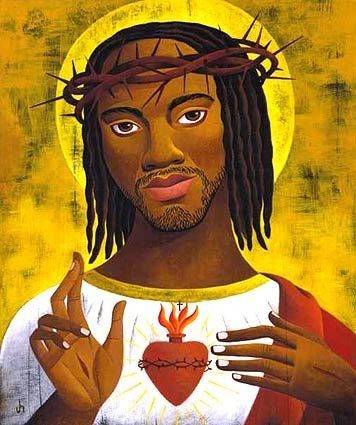
The walk to Emmaus is our gospel reading today.  This has always been one of my favorite post-resurrection appearances.

You probably know the story – two men are walking along the road from Jerusalem out to the coast.  Along the way is a small village called Emmaus.  Jesus joins up with them, but they do not recognize him.  They tell the story of what had happened – that this great prophet, Jesus, had been handed over to the priests and leaders and condemned him to death.  They knew also of the empty tomb, and the vision of angels that told them he was alive.  But they were skeptical.

Jesus interprets what has happened.  They still do not recognize him.  Then he walks on ahead, as if he was going on, but they urge him to stay.  As he breaks bread with them, “their eyes were opened and they recognized him.”

There is one small detail of this story that often goes unnoticed.  It is at the beginning: “Now on that same day…”  This was Easter Sunday!  The day of the resurrection.

News had traveled fast!!!  Fast indeed!  Emmaus is a good distance away, a full day’s walk.  They must have started fairly early in the morning.  So news had truly traveled fast, and these two were somehow connected to Jesus’ ministry.

By the end, their encounter with the risen Lord had transformed them to the truth of the good news: “Were not our hearts burning within us while he was talking to us on the road, while he was opening the scriptures to us?”

The next day all sorts of apostles are declaring, “The Lord has risen indeed, and has appeared to Simon!”

I love this nameless second person in the story.  The first is called Cleopas.  The second we don’t know about.  For me, that is meant to signal this person’s connection to “every person.”  It could be you or me next!  Prepare to meet the risen Christ in your life!  Perhaps you already have!

Prepare to meet the risen Christ – today or any day.  Perhaps even in your home tonight as you break bread at table.

This story marks the beginning of the secret society of Christians.  Previous to the resurrection, they were a band of followers of a really amazing prophet.  Now they are coming to understand the depth and mystery of his coming.  He was more than a prophet.  He was the Son of Man.  And there are things that can only be understood in the experience of the risen Christ – things like baptism and the Lord’s Supper that take on new meaning, and bring the mystery of the risen Christ home.

Welcome home, my brothers and sisters.  This story brings it home.  Literally.

-Matt

The Winsomeness of the Gospel

my-son-1208707_960_720

1 Samuel 15:24-35Acts 9:32-43Luke 23:56b-24:11

Today in Luke we encounter the resurrection of Jesus.  Mary Magdalene, Joanna, Mary the mother of James, and the other women discover this, and they can’t sit still!  The Spirit had set them on fire.

Then Peter catches the bug – unable to believe “the women” he runs to the tomb “stooping and looking in, he saw the linen cloths by themselves; then he went home, amazed at what had happened.”

Three things:

1) I am thankful the message of the good news was entrusted to women.  How fitting for a story that turns the world’s expectations on its head.

2) I can’t imagine the energy and chaos after the resurrection.  I am tempted to think that questions would have flooded my mind.  What happened?  How can I be sure?  What does all this mean?  What next?  How do I fit in?

3) I love the winsomeness of the Bible.  Most people miss this.  It is with a childlike curiosity we peer into the tomb with the women.  What are we expecting to find?  It is with childlike wonder we need to approach the text, lest we miss its point completely.

When the terror had settled down, and the reality of the situation sunk in, and when the resurrection appearances started getting more plentiful, the future would probably overwhelm me.

But God doesn’t call us to that, does he?  We are told not to worry about tomorrow, but for tomorrow to worry about itself.  And for me that is the downside of “Long Range Planning Committees”.  The question is not what should we be doing as an organization 10 years from now, but what is it about who we are that leads us into action today?

The worst thing for the disciples to have done after the resurrection would have been to sit down and come up with a 5 and 10 year plan.  Those plans would have been thrown out the window within 6 months, because so much would have changed.  Who would have thought that things would grow so fast and so virulently?

This doesn’t mean we treat our Christianity with any less seriousness.  It doesn’t mean we head into it without a plan completely.  It means we need to approach our faith with childlike wonder and exuberance.  We need to get caught up in the story, and be equally excited and playful as those first disciples were, venturing into new and exciting adventures.

When we come with that kind of innocence to the story, we come without our agendas and presuppositions.  We come open and ready for God to move us.

We are called, as a Gospel people, to not worry about today.  Oh, we can dream, and we can know some things about the future.  But we cannot know the future, only who holds it.  With that in mind, let us leave the tomb and share what we have seen and heard.

-Matt

Saul, Saul, Saul

nigella-1472274_960_720

1 Samuel 15:1-3,7-23Acts 9:19b-31Luke 23:44-56a

In our Old Testament reading today we witness the complete and utter rejection of Saul as king.  “I regret that I made Saul king, for he has turned back from following me, and has not carried out my commands,” said God.  Even Samuel was angry.

In Acts we deal with another Saul – the one who becomes Paul.  It is here we come to understand the power of the gospel message.  Now Saul has been converted, and is preaching in Damascus.  “Damascus” is code word for expansion.  If the good news can get to Damascus, a hub of trade, politics, and culture, then it can get to Antioch, to Rome, and to any corner of the earth.

The other power is in Saul’s story itself.  Here was a man who persecuted Christians.  He never met the earthly Jesus, who lived and walked in Galilee.  He was not one of the original disciples.  And now he is hanging out with the disciples, and increasing in power and “confounding the Jews who lived in Damascus by proving that Jesus was the Messiah.”

If the good news has that kind of effect of Saul, certainly the “Jesus factor” is high enough to affect distant lands.  We as the readers bring the power of this home.  Here we are, 2000 years later, in a distant land on a distant shore, and we are reading of the tale of the one they called Messiah, following him too.

The evangelization of the four corners of the earth continues.  The questions still come: “And who am I called to spread the good news to?”  What words from God will fill me?  What will I say?  And in our postmodern context professing Christ as Lord has unique challenges.  Radiating the love of God to others is as challenging as ever.  Or is it?

We radiate the same love of God in Christ as Saul did 2000 years ago.  We do our part and watch the miraculous power of God move.

-Matt

Disrupting History

1 Samuel 12:1-6,16-25Acts 8:14-25Luke 23:1-12

Jesus stands before Pilate in our readings today.  “Are you the  king of the Jews?”  “You say so.”  Then he is passed to Herod.  He gives no answer.

It is a sad state of affairs when the establishment chews up and spits out its leaders, its prophets, or in this case its Messiah.  Jealousy abounds.

I am sure you have been on the short end of this stick, or close to someone who has had this happen.  Perhaps they weren’t crucified, but I am guessing fired from a job unjustly or tossed out like the garbage with regards to friendship or what have you.

Jesus stood before Herod and gave no answer to the charges.  They crucified him – not because of what he had done or said – but because they couldn’t handle what he had done.  It threatened their power.  He threatened the establishment.

Often this is what happens in our churches.  Our pastors illuminate something we don’t like in ourselves.  They help push us into the Gospel light.  Systems sometimes kick back.  People don’t like change.

Jesus demanded that the people wake up.  We don’t like to be awakened.  Let us sleep.  Leave us alone.  Don’t change us.  Don’t make us move, or think.

This is what is wrong with our political system.  Ultimately it comes back to us.  We are too lazy to do anything about it.  So most of us casually sit back and allow the dysfunction to continue to manifest itself.  This is what happens in our churches – we get sick of trying to help people change and we give up and it goes back to the way it was.

I have been the pastor of churches like this – churches that are very much like the Titanic – too big of a boat and too small of a rudder, unable to significantly move in any new directions, dragging over 100 years of history behind it.  Sometimes that history can help.  Other times that history is exactly what ends up holding them back.  Sometimes it is both (a “both/and,” so common in our postmodern world).

At times the dysfunction that manifests are things like radial injustice, powers that are so great, getting so much steam behind them, that they become the Titanics of our lives.  We fight, but it is only as others join the fight that we can get anywhere.

Are you familiar with Titus Kaphar?  He is one of the artistic voices of our day, with some of his work at the Museum of Modern Art in NYC.  He is painting, cutting, and sculpting images of our criminal justice system that you need to see.  He is disrupting history.  He is looking through the lens of history and helping us see our sin.  He is helping us to remember.

Titus is also helping us to critically look at ourselves, and do that “both/and” with history I talked about previous.  Sometimes history can help, other times it is holding us back.  Titus can help us do both.  Most recently he took on Ferguson.  You should check him out if you aren’t familiar (pictured above).  http://kapharstudio.com/

Prophets like Titus often show us the way.  They help us to wrestle with our past and chart out new futures.

Jesus shows us the way.  His way is even more radical.  Are we willing to lose our life in order for new life to take root?  He died to this end.  But remember that was not the end of the story.  We follow the one who vanquished death forever, and who lives eternally.  He will not let us falter.  New life will find a way.  The question is how and when and how will you choose to be a part.

-Matt

Freedom (corrected version)

usa-2108027_960_720

1 Samuel 11:1-15Acts 8:1-13Luke 22:63-71

My entire life the 4th of July has arrived and I have been 100% confident that the next year our country will still be in existence.  This year is different.  With the very foundation of our democracy under attack, there is that nagging feeling in the back of my mind that says “What if this is our last 4th?”

With the November 2016 election, I thought things couldn’t get worse.  And then they did.  2017 has been a trainwreck.  From personal tragedies, to family deaths, to dysfunctional churches shooting themselves in the foot, to the political circus that is Oklahoma and the US, it is hard to imagine 2017 getting any worse.

And yet we pause.  We pause today and give thanks for the breathtaking splendor of our United States.  I am thankful for the US Constitution and the Constitutions of all of our states, which demands that the rule of law trump over the tRump (most recently our state election officials saying NO to Big Government/Big Brother).

We live in a great country where no one person can hold captive our liberty.

Oh, that will not stop politicians from trying.  Human nature is to grab for power.  But the checks and balances of our country finally win out. Don’t they?

Our Acts reading is remarkable today.  Saul persecutes the church in a dramatic way, breaking into house after house and dragging Christians, both men and women, to prison.  Freedom is in jeopardy and the church is scattered throughout the countryside.  But the pivotal question comes: Is this a dark day for the church, or its most glorious day?

It turns out, the irony of scattering is precisely what the church needed – the impetus for growth, forcing the church into new territory.  Irony is a common theme for the New Testament.  In Luke, Jesus seals his fate by acknowledging he is the Son of God.  His crucifixion is the most glorious of days ironically for God’s kingdom.

And that is the irony of our country today and the July 4th celebrations.  Despite the threats to our democracy, the seeming erosion of freedom and liberty will probably lead to more freedom and more liberty.  That is how it has always gone.

Think about marriage equality.  Who would have thought 10 years ago that our country would be years ahead of Germany on the issue of marriage equality?  Germany has always beaten the pants off of us when it comes to infrastructure and jobs and energy and healthcare and social policies.  How on earth did we leapfrog them on marriage equality?

Well, because of states rights.  So today I give thanks for these United States of ours.  Here is the deal with freedom.  Once you give freedom it is hard to take it away.  So one or two states declared same-sex marriage legal, and it became difficult to take away those rights as people moved across state lines – or the rights of their children more aptly.

The same principle of freedom in Christ and Christ’s will has molded and shaped the church.  Once the Holy Spirit has moved us to be more loving or inclusive, it is hard to take that away.  Women in ministry.  Or backing up to the 1st Century, the Jewish/Gentile question.

Change in churches have caused anxiety.  It is natural.  But in a similar ironic twist in church work, that anxiety has not always been a bad thing.  It wasn’t too long ago that integrated churches were illegal, especially in the South.  Anxiety over women in ministry or gays in ministry has led to the Church in North America generally being more inclusive, loving, and healthy in my eyes.  (People always want to talk about how the Presbyterian Church is in decline.  Have they looked at Southern Baptists churches?  Their decline is much more rapid.  Part of it is simply a large generational population dying off, coupled with the secularization of society.  I am not so much interested in overall numbers.  I am interested in overall health.  Like I said in my last reflection, I would rather have 1000 people who want to follow Jesus, than a million that don’t give a darn.)  

Much like pruning a vine, God is making us a stronger church.  A more inclusive church, more loving, more set on the ideals that Christ held close.

Those churches of exclusion are gasping their last gasp.

Our challenge is to trust that our anxiety can ultimately lead to health and success and a stronger church.

And so whether you are part of a church struggling to have a healthy survival instinct, or whether you are struggling over using wine for communion or having a common cup, or having people of different color come in the door, trust that God can use your anxiety.  Just don’t let it become a pathological fear that can dangerously steer the agenda of the church into more fear.  Remember, the early church had much anxiety.  There was constant stress, even churches being blown apart by radical extremists like Saul.   And yet, the church thrived.  So will our country.

Do we believe our theology or not?  Do we trust that God is in charge or not?

Nothing can shake the foundation of who we are.  And as we claim that, we will find ourselves overcoming the anxieties in the churches or our country – but we must face them head on.  We must trust that Christ is at the center of who we are, and we must act accordingly.

May freedom ring!

-Matt