Freedom

usa-2108027_960_720

1 Samuel 11:1-15Acts 8:1-13Luke 22:63-71

My entire life the 4th of July has arrived and I have been 100% confident that the next year our country will still be in existence.  This year is different.  With the very foundation of our democracy under attack, there is that nagging feeling in the back of my mind that says “What if this is our last 4th?”

With the November 2016 election, I thought things couldn’t get worse.  And then they did.  2017 has been a trainwreck.  From personal tragedies, to family deaths, to dysfunctional churches shooting themselves in the foot, to the political circus that is Oklahoma and the US, it is hard to imagine 2017 getting any worse.

And yet we pause.  We pause today and give thanks for the breathtaking splendor of our United States.  I am thankful for the US Constitution and the Constitutions of all of our states, which demands that the rule of law trump over the tRump (most recently our state election officials saying NO to Big Government/Big Brother).

We live in a great country where no one person can hold captive our liberty.

Oh, that will not stop politicians from trying.  Human nature is to grab for power.  But the checks and balances of our country finally win out. Don’t they?

Our Acts reading is remarkable today.  Saul persecutes the church in a dramatic way, breaking into house after house and dragging Christians, both men and women, to prison.  Freedom is in jeopardy and the church is scattered throughout the countryside.  But the pivotal question comes: Is this a dark day for the church, or its most glorious day?

It turns out, the irony of scattering is precisely what the church needed – the impetus for growth, forcing the church into new territory.  Irony is a common theme for the New Testament.  In Luke, Jesus seals his fate by acknowledging he is the Son of God.  His crucifixion is the most glorious of days ironically for God’s kingdom.

And that is the irony of our country today and the July 4th celebrations.  Despite the threats to our democracy, the seeming erosion of freedom and liberty will probably lead to more freedom and more liberty.  That is how it has always gone.

Think about marriage equality.  Who would have thought 10 years ago that our country would be years ahead of Germany on the issue of marriage equality?  Germany has always beaten the pants off of us when it comes to infrastructure and jobs and energy and healthcare and social policies.  How on earth did we leapfrog them on marriage equality?

Well, because of states rights.  So today I give thanks for these United States of ours.  Here is the deal with freedom.  Once you give freedom it is hard to take it away.  So one or two states declared same-sex marriage legal, and it became difficult to take away those rights as people moved across state lines – or the rights of their children more aptly.

The same principle of freedom in Christ and Christ’s will has molded and shaped the church.  Once the Holy Spirit has moved us to be more loving or inclusive, it is hard to take that away.  Women in ministry.  Or backing up to the 1st Century, the Jewish/Gentile question.

Change in churches have caused anxiety.  It is natural.  But in a similar ironic twist in church work, that anxiety has not always been a bad thing.  It wasn’t too long ago that integrated churches were illegal, especially in the South.  Anxiety over women in ministry or gays in ministry has led to the Church in North America generally being more inclusive, loving, and healthy in my eyes.  (People always want to talk about how the Presbyterian Church is in decline.  Have they looked at Southern Baptists churches?  Their decline is much more rapid.  Part of it is simply a large generational population dying off, coupled with the secularization of society.  I am not so much interested in overall numbers.  I am interested in overall health.  Like I said in my last reflection, I would rather have 1000 people who want to follow Jesus, than a million that don’t give a darn.)  

Much like pruning a vine, God is making us a stronger church.  A more inclusive church, more loving, more set on the ideals that Christ held close.

Those churches of exclusion are gasping their last gasp.

Our challenge is to trust that our anxiety can ultimately lead to health and success and a stronger church.

And so whether you are part of a church struggling to have a healthy survival instinct, or whether you are struggling over using wine for communion or having a common cup, or having people of different color come in the door, trust that God can use your anxiety.  Just don’t let it become a pathological fear that can dangerously steer the agenda of the church into more fear.  Remember, the early church had much anxiety.  There was constant stress, even churches being blown apart by radical extremists like Saul.   And yet, the church thrived.  So will our country.

Do we believe our theology or not?  Do we trust that God is in charge or not?

Nothing can shake the foundation of who we are.  And as we claim that, we will find ourselves overcoming the anxieties in the churches or our country – but we must face them head on.  We must trust that Christ is at the center of who we are, and we must act accordingly.

May freedom ring!

-Matt

Get To It, Y’all

birch-1593725_960_720

1 Samuel 10:17-27; Acts 7:44-8:1a; Luke 22:52-62


I audibly laughed this morning when I read 1 Samuel today.  OK, let me back up and give you some context.  Saul has just been anointed by Samuel and selected as king.  There is a very brief celebration, as the sweep of the Old Testament narrative is laid before the people – how they were brought up from Israel of out Egypt, rescued, and set up as a people.  They have finally made it.  They are now a kingdom, complete with a leader.

I laughed because I thought “They are now a kingdom, complete with a leader…..wait, what does that make us?”  It appears we are without a leader.  Instead he has been replaced with a baby, who has a Twitter account, and worse yet has access to his smartphone.  Word to his staff: Treat him like a teenager, and take it away.

With Saul dissension begins almost immediately.  He is unfit for office and God’s judgment reigns.  I pray that we in this country have the courage to call out those who are clearly guilty – so many of which are impeachable offenses.  We seem to have less of a spine than our “leader,” acquiescing to mediocrity and infantile rants.  When are we going to learn our lesson?  It doesn’t need to get “Old Testament bad” for us to wake up, does it?

It is not time to “Speak Out!”  I keep hearing this.  What does that mean?  It is time for us to move to action.  That could mean with our pocketbooks.  It could mean rallying in our churches, synagogues, and mosques.  It could mean a number of things that could mean taking back our country without an armed uprising.  It starts with VOTES.

LOVE must win.  LOVE will win.  If I know the Gospel to be true, love will stamp out hate.  This starts in us.

In Luke, Jesus is betrayed and arrested.  The denial of his identity and a rejection of the Lord is soon to follow.

My doctorate, my work at the Church Development Institute in Seattle, my consultant work have all looked critically at church systems, learning processes and models, in order to help churches identify themselves more realistically and move forward in faith.

I find it interesting that 1 Samuel and Luke are Utopian visions shattered by unfulfilled expectations.  “Having a king” was going to save us.  In both stories, it turns out, the “savior” cannot live up to expectations, because each person seems to have a different way by which to deliver the goods.  False hopes.

Often churches do this too, don’t we?  “If we could just discover the next miraculous program to start, it will save us.”  “That new pastor will save us.”  Or worse yet, “Her VBS ideas will bring in the children and that will save us.”

It turns out, God does not call us to the Utopia of the church, but to action through faithful service.  We are called to follow the King (as in THE KING), knowing full well that the church is not the kingdom itself, but a reflection of God’s grace here.  Not everything will be perfect.  And knowing that, we can move to a place in which the world is better with us, and in which we can reflect the gospel light.

It is as the Great Ends of the Church declare, our job as Christians is the exhibition of the kingdom of heaven on earth.

-Matt

Making America Great, Part II

doctor-1015624_960_720

1 Samuel 9:1-14; Acts 7:17-29; Luke 22:31-38

I got a lot of feedback yesterday about my Morning Reflection about healthcare and “making America great again.”  Overwhelming positive and supportive.  But to the few naysayers that may still be out there, I say this:

I am sorry that I am experiencing “politics fatigue” (as a recent article called it).  I am flabbergasted and flustered, because I did not learn in seminary how to explain to someone why they should care about other people.

And further, if there is just one person in America that declares bankruptcy because of medical bills, I say that is too much.  The days are over for us treating healthcare as a commodity.  It is too important.  It is a BASIC HUMAN NEED.  It is necessary to thrive.  It is like air, and water, and shelter.  You need adequate care for all to have a healthy society.  And if you don’t understand that, then frankly I feel sorry for you.

If we are truly going to celebrate the 4th of July and the principles on which this country was built, then we are going to have to shelve the talk of tinkering with healthcare delivery, and start talking about actually having better HEALTHCARE.  You heard me right!  We are going to have to talk about what it means to believe in liberty – because I see part of that “state of being free” as being free from the oppressive restriction of medical bankruptcy.  There is no self-autonomy in that, for me or the person declaring bankruptcy.

And no, we do not have the best healthcare in the world.  We used to.  But in the last 30 years or so, we have slide to the bottom of industrialized countries in almost every healthcare outcome that exists.  So yes, we used to have the greatest healthcare system in the world.  But have you looked at it in the last 20 years?  Actually looked at it?  Or have you just been spouting this same mantra because its what you said 20 years ago, and what your parents said to you.  Have you talked to any doctors or nurses lately?  Because what I am hearing from my doctor friends is that this system is broken.

It is time for Christians to claim what is rightly ours – the plight of the poor and afflicted.  If it was good enough for Jesus, it is good enough for me.  It is my duty to stand up for the most vulnerable among us.  I will lend them my voice.  I suggest you join in the fight.  And if that means taking on the big prescription drug companies or the big insurance companies, then so be it.

“I wish Matt would stay out of politics.”  Oops, sorry.  That’s not what Jesus did.  Neither will I.  Sorry if your sugar-coated religion doesn’t match what the Holy Spirit is demanding of the Church today: action.  I’m sorry if you want to be a part-time Christian on Sundays only.  So I’m not sorry if I offended you saying that; I’m sorry for you.

Our disagreement is not one of politics.  It is a fundamental divide on what it means to be a Christian, and on what it means to live in a society as a Christian, and how to stand up for our principles.  Frankly it might even be deeper than that.  Perhaps our divide is on what it means to be a good person.

I’m not sorry if this offends you.  

Perhaps it needs to offend you.

Christianity has been in decline in this country for decades.  And I believe one reason is because so many “Christians” were looking for a country club, not a radical organization that is out to reorganize all of life, complete with a radical leader like Jesus who came to upend the political equilibrium.

We raised a generation of lazy Christians, and now we are paying the price.

When the slugging got too hard, many fled for an easier religion, where entertainment or “feeling good” are the standards.  We Christians remain, fighting, speaking out, demanding to take seriously EVERYTHING Jesus did, and not cherry picking a few ideals to make us feel like we are doing our part.  We need Christians who are ready to follow the One who healed the Gerasene and went out of his way to reach out to the afflicted and outcast.

Passing an empty soup can on Sunday morning raising a few cents for hungry children is not Church.  Church is a radical way of living our faith, where we lose our life in order to gain it.  It means giving ALL to Jesus, so that others may experience the freedom of the gospel.  Church is not an opportunity for you to feel good or get “refueled” for the week, but a place where you are reminded to lose yourself in order for Christ to win it all.

Church is about changing lives.  Church is about following Jesus.

And at this point in our church’s life and in our country’s life, it is time for us to change our broken healthcare system.  It is also time for us to change the lackadaisical way we have gone about being Christian.  Gone are the days of singing a lovely little Sunday hymn and going home for the week.  Jesus demands we follow him 24/7.

If you are uncomfortable good.

If you are questioning whether this “Christian thing” is really for you, good.  I would rather have 1000 people who want to follow Jesus, than 1,000,000 people who don’t give a darn.

-Matt


Making America Great Again

trump-1822121_960_720

1 Samuel 8:1-22; Acts 6:15-7:16; Luke 22:24-30

Jesus sums up his ministry and his preaching today.  The heart of his message began with sayings such as “Blessed are the meek, for they shall inherit the earth” and now ends with the same ideology.  “The greatest among you must become like the youngest, and the leader like one who serves….I am among you as one who serves.”

Jesus preaches an upside-down world, where the weak are powerful, the poor are rich, and the sinful are made clean.

This all comes on the heels of the disciples fighting over which was the greatest.  Jesus is reminding them that greatness will not come from hypocrisy, judgment, or puffing oneself up.  Greatness will come from service and self-emptying. 

This is what I wish our politicians understood.  If they want to fix healthcare, perhaps the first step is for them to give up all their money and federal health benefits.  Perhaps then they could at least relate to the plight of others.

There are many who wanted Jesus to claim his power as the Messiah – to ride into Rome with armies, and take over.  Frankly I wish this.  I want him to come and boot these idiots out of power and take over.

Back then they wanted him to crush the Romans.  Did he do it?  No.  He laid his life down, so that others could live.  He became the sacrificial Lamb.

As I see one politician after another splashed on my computer screen – one blowhard after another telling us why they still haven’t gotten anything done with regard to fixing Obamacare – I wonder if we still haven’t gotten it.  It appears we are still looking for another King David – another person to rise above the rest and save us all.  Some were hoping Trump would be that.  Well, trust me, all these folks will fall short of our expectations, just like Barack Obama fell short of the expectations of his base.

We need to wake up to the reality that the Messiah already came.  And he did not live up expectations either.  Of course, he wasn’t looking to live up to our expectations.  He was here to show us a new way – one that included self-sacrifice, humility, patience, and fortitude.

Making America great, it turns out, has nothing to do with that veiled racist slogan, but reclaiming the selfless sacrifice of the One who paid it all.  This is what our current Administration knows nothing about.  It doesn’t have to do with seeking to be great, but seeking to serve one another, lift one another up, and be a slave to all.

When you take a stance of humility, I’m not sure how you don’t come to the conclusion we need universal healthcare for all.  When you truly seek to serve the other, it becomes hard to look at healthcare as anything other than a basic human need, and not the commodity it is being treated as.  When you truly seek to serve, you put a cork in all the blowhard, empty talk about prices or exchanges or premiums, and you start talking about HEALTHCARE.  CARE.  MEDICINE!  GETTING WELL.  Not access to doctors.  Better healthcare!

Jesus was the True Leader, on whom we hang it all.  Wouldn’t it be great if we could all remember that a bit more?

Living into that is a big jump though.  Are you ready?

-Matt

PREPARING & The Lord’s Supper

1010206_844454755568721_2592168126321263084_n

1 Samuel 6:1-16; Acts 5:27-42; Luke 21:37-22:13

In our readings today, it is a day of making preparations.  In our world of instant gratification and instant information, have we lost the art of preparation?  When the 2 minutes in the Braum’s Drive up is too long and when we buy tickets for the play online only a few hours before curtain, I wonder how on earth we prepare at all – prepare for marriage…prepare for the SAT…prepare our hearts for God to use us and change us.

In scripture today, groundwork is laid – both good and bad.  In Luke, the work of plotting against Jesus got a boost with the help of Judas Iscariot.  It was his “work” that allowed the dreams of the chief priests and officers of the temple to carry out their plan.  Meanwhile, the other disciples are busy preparing in another way – preparing for the Passover meal.

While on the surface these two preparations may seem like night and day, good and bad, remember what the Passover meal represented!  It was a celebration of the misery of exile, the oppression, the eventual visit from the Angel of Death, and a release from captivity.  It is a story of eventual release, but it is not all celebratory.

I think it is interesting that both of our “preparations” are for plots that begin with heartache and turmoil.  Of course, we know how the Passover story ends.  And remember how the story that involves Judas Iscariot ends?  It does not end in the Garden with a kiss.  It does not end when Judas hangs himself.  In fact, that story doesn’t end.  It is still going.

I remember being a part of a Passover meal in Israel.  It was eye-opening.  Many of you have heard me reminisce about the reality of that day, in that small apartment in the Jewish Quarter of Jerusalem, play acting so much of the Exodus story I felt wrapped up in the story itself, complete with stopping up the sink until it was overflowing on the tile floor, just to represent the Red Sea.  Talk about parting the waters! (Or was it the neighbors in the apartment below us?)  I remember mostly how these devout Jews celebrated this meal as if their story of redemption and hope was still playing out.

I thought to myself, IT SHOULD BE THIS WAY ALWAYS!  To be caught up in the story.  To create the story anew.

We Christians must capture that same feeling – at the Table, in fellowship with one another.  Our story does not end at the foot of the cross, or with Judas’ suicide.  The story blazes on.  It passed from generation to generation, and it has made it to our doorstep.

And we must prepare – prepare our hearts for the this sheer gift of grace, prepare for the coming of the Savior of the World into our lives, our homes, our daily walk.  We must prepare in understanding the foundation that way laid.

By arousing the imagination and the senses – this is creating the story anew.  Often this means getting the kids involved.  This is where we have much to learn from our Jewish brothers and sisters.  At the Seder meal, the children read the questions and play hide and seek with the Afikomen.  At Purim there is the building of tents.  There are shofars on Rosh Hashanah.  Prior to the Passover, there is the rambunctious cleaning of the house for any speck of leaven.  Of course the kids remember!  They have been active participants, creating new memories, and grafting themselves with the story.

And so let’s do some real preparations here.  Of course, guess what…this takes PREPARATION!

Perhaps we create the Last Supper anew by talking about what Jesus would have eaten and not eaten.  There was no McDonald’s, kids.  Let’s talk about dates, or figs, or goat milk.  Salads with strange vinegar-like dressing.  Let’s build out this meal.

And then let’s put the bread and the wine as central symbols around a glorious feast that involves EVERYONE, where everyone has a speaking part.  Who is going to be Judas this year?  Oh, we don’t have to get gruesome about it, but it sure would be nice for someone to sneak out of the room with 30 pieces of silver, only for us to hear them drop in the temple offering plate in another room.  Maybe Judas hides something along the way – some stolen “grace” that gets found once again before the meal can end.

This would energize the meal.  It would get the kids truly involved.  It would certainly get the adults involved too, asking why we are doing these things.

This is how we truly remember.  By becoming part of the story.

And this is when the story truly begins.  For if we do not understand the past, how are we to move into God’s future for us?  How are we to be guided?  God, where do you want me to go?

It is only in our past reflections that we will be able to focus on the present with eagle eyes, and move swiftly into our new lives of hope and joy and peace.

-Matt

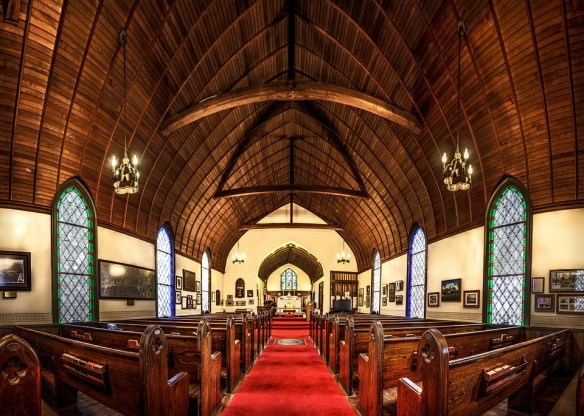
God’s Church

church-581061_960_720

1 Samuel 5:1-12; Acts 5:12-26; Luke 21:29-36

Holy Stewardship Sermon!  I’m not sure this would preach in our pulpit today!  The story of Ananias and Sapphira comes to us today in our Acts passage.  It has much to teach us about the place that God holds in our community of faith.

This husband and wife team conspire to deceive Peter and the community with their partial tithe.  They owned a piece of land, sold it, but instead of giving all their proceeds to the church (as was the new Christian “tithe”) they decided to hold some back for themselves.  The husband lies to Peter.  Peter sees through the lie and declares, “You did not lie to us but to God!”  He falls dead.

Three hours pass, and his wife, Sapphira, not knowing her husband is dead yet, arrives.  Peter asks her why she is putting the Spirit to the test.  She also falls dead.

Could you imagine the new Stewardship Campaign?  Give all to God, or he will strike you dead!

This is not a story of Peter’s power, or God’s judgment, or even a story about tithing.  I’m not even sure it is a story about Ananias and Sapphira.  It is a framing of the new Christian order.  Who was leading this group of misfits?  Not Peter – but God.  God is calling together this community of believers, and God is in charge.  Peter makes it clear that their violation was not against the people, but against God.

This is also the first time we hear a new word: “church”.  Not a common word in the gospels, this is the first time it is used in Luke-Acts.  Already though, we are getting a flavor of what this new “church” is all about, how it functions, and who is in charge.

The Holy Spirit directs and guides us.  And from among us we chose leaders who guide us and represent us, but it is God who we call Lord.

This is of great comfort to me, especially when I think of the brokenness of people – our sin and folly.  There is no church that is perfect, because there are no people that are without sin.  And when we look to God for leadership, we are on safer ground – in fact, the safest ground we can be on.

-Matt

Why the Prosperity Gospel is Dead Wrong

noble-789501_960_720

1 Samuel 2:27-36; Acts 2:22-36; Luke 20:41-21:4

Let’s talk about the prosperity gospel.  Some of you know what I’m talking about.  Its theology has inculcated our churches.  One of the poster children for this stream of thought is Joel Olsteen.  This doctrine is one of personal empowerment – a health and wealth gospel – a religious belief among some “Christians” who hold that financial success and physical well-being are always the will of God.

The problem?  It is anti-Biblical.  1 Samuel today flies directly in the face of that whole school of thought, which I could argue is not Christian.  It is a lovely self-help trajectory.  But it has nothing to do with the Bible.

This is why I put Christian in quotes up there.  This is certainly not a Christian concept.  And while Joel Olsteen is very encouraging, positive, and uplifting, and while Joel may in fact be a Christian, he certainly doesn’t look like one from what I have seen and read.  True prophets don’t always tell you what you want to hear to feel good.  True prophets sometimes challenge, afflict, and correct.  Joel needs to turn from his wicked ways, repent of his sin, and embrace something other than the devil of the greedy eye.  He might also want to pick up the Bible and read it from time to time.

And no, this “verse” isn’t in the Bible: “God helps those who help themselves.”  (Did you know there are tons of USAmericans who actually believe that it’s in there?)

What we learn from Scripture is that there are days of plenty and there are days of want.  The rhythms of life come.  Harvest comes.  So does famine.  And when famine comes, is our faith secure?  What we learn in 1 Samuel is that prosperity has come for some, and not for others – that buried in the mysteries of God and the mysteries of this life, God’s goodness will ultimately endure.  The oracle against the House of Eli is devastating.  Early death.  Tragedy.  Yet we as readers are invited into the grand sweep of the goodness of God only as we turn the page and encounter the call of Samuel.  What was an omen for one meant a new day for another family.

As random tragedies strike and cancer afflicts, sometimes these kinds of questions come: Why me?  I have always asked Why Not Me?  There is enough brokenness in the world to go around and each of us at some point bears the curse of pain.  So it is to be human.

This flies in the face of the prosperity gospel and those who would like to have you believe you can pray your way to success, happiness, and wealth.  That is not how our God works.  We do not believe in the Genie in the Lamp, but the God of the Universe

The story of the Gospel is pretty clear.  Blessing comes only as we open our hands in sharing, not as we hold tight and horde wealth.  The Sermon on the Mount, the Parables, the cross itself – these all grow out out of the grand narrative of God’s ultimate blessing.  That through thick and thin, God will provide, most readily through the body of Christ, hands of sharing, wealth in generous spirits, success despite our momentary afflictions, because Christ’s love has power over death and pain.  It is as we respond that God’s goodness comes, and God’s Kingdom reigns.

God’s Kingdom is not built on wealth – but on justice, freedom, dignity, respect, love, equality, and peace.

So…why me?  Wrong question.  The question is “What do I do next?”  How is the community going to respond?  How is the community going to respond to the evil around us every day?  The question is why aren’t we doing more to correct the evils around us?  Why are we so lazy to think God is going to deal with everything when we should be the hands and feet of Christ caring for one another better

May God bless you this day.  And may you come to know more deeply the love of God in the eyes of the other.  And may God’s kingdom reign.  Today and always.

-Matt

OK, rant over.