God Chose Us!

image-2274250_960_720

Wisdom 3:1-9; Col 1:15-23; Luke 6:12-26

The supremacy of Christ is explored in today’s reading in Colossians.  The righteous and the unrighteous are compared in the Wisdom of Solomon, and reassurance is given to those who stand with God, very much like many of the Psalms.  Both readings spend much time focusing on differences, and the divides between humanity and God or humanity and humanity – a fitting reading in this time of hyper-egotistical world leaders who spend so much time lying and being full  of themselves they forget who it is they are here to serve.

The gospel reading seems on the outside to be different.  It is the choosing of the twelve disciples.  Luke’s version is probably the least known and most neglected of the different accounts of choosing disciples.  It doesn’t really mesh with the other versions.  Its take is unique and worth reading.

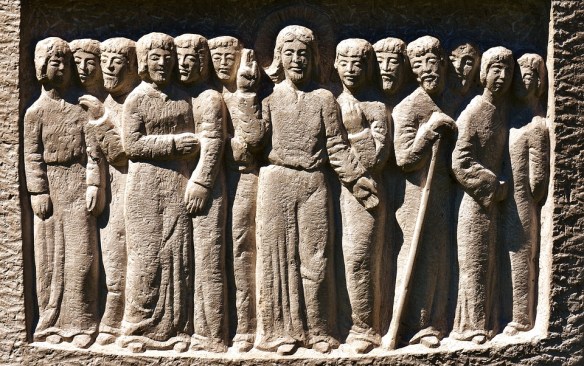
In Luke, Jesus goes to the mountain to pray, spending the whole night in prayer.  When day breaks, he calls all the disciples together and chooses from among them twelve, and he names those twelve apostles.

I wonder what God is telling us here.  God is picky?  Many are called but few are chosen?

I think it is deeper.

He spends all night in prayer – seeking guidance – needing spiritual wisdom.  And then we notice an altering of the name from disciple to apostle.  It becomes clear that those who are “apostles” have special spiritual gifts, perhaps for leadership.  One can still be a disciple!  There is no “NO” in this selection.  Yes to some, and a double Yes to others.

Another curious element of this passage is its reliance on the sovereign judgment of God.  This passage is very Presbyterian!  Much of the preaching these days in Oklahoma pulpits focuses on how we have to “choose Jesus”.  Time and time again, scripture attests to God choosing us.  Being a Jew wasn’t something one chose, but something one was born with.  “These are my people…this is my story.”  So it is with us.

Here Jesus chooses.  There is no indication of how or why, but we come to know why.  They do not possess amazing integrity or character.  They are not rich and do not particularly have deep connections in top places, able to get good underwriters for their ventures.  No, they were ordinary men.  They were much like you and me.

But God saw something special in them.  Mass appeal.  Future leadership potential.  Ordinary folk from ordinary walks of life who could reach out to others.  Whatever you want to call it.  Heck, it could have been you and me.  Oh my goodness….it is!  This story is about us!

-Matt

Wisdom

owl-1705112_960_720

Wisdom 1:16-2:11,21-24; Col. 1:1-14; Luke 6:1-11

Julian of Norwich

Many of you have found these last couple weeks unsettling.  Trust me, I feel ya!

As we turn our hearts to scripture, it is unsettling as well.  Much of scripture is a jolt – a disruption – an upsetting of norms and ideals.

Jesus is not just breaking social norms today, but is violating one of the 10 Commandments.  It is quite difficult to understand what is going on when Jesus himself breaks the Sabbath commandment.  Jesus cures on the Sabbath.  He teaches on the Sabbath.  He allows his disciples to pluck heads of grain and eat the grain.  All this is considered work.

How are we to understand what is going on?

Jesus ends one of the conversations with: “The Son of Man is lord of the Sabbath.”  That is certainly one answer, that God doesn’t have to follow God’s own laws.

Another answer is that Jesus is reinterpreting the entirety of the Law.  No longer is the Law meant to restrict, but to set free.  It is not that the Law is obsolete, but must always be read through the lens of love.  And so, in that respect, we are not to focus on the fact that these heads of grain are being plucked (i.e. work) and that they are most probably stolen from a field that is not theirs.  Instead we are to focus on their hunger, and God’s desire to provide for us in times of need.

It is with this spirit that Colossians begins.  “We have not ceased praying for you and asking that you may be filled with the knowledge of God’s will in all spiritual wisdom and understanding, so that you may lead lives worthy of the Lord.”

This is something that many in churches today want to ignore: wisdom.  Coming to a knowledge of God’s will and cultivating wisdom are lifelong endeavors.  We are not asked to pick up our Bibles and check our minds at the door, but to wrestle with the struggles of the Law and love.  We are meant to breathe it in deeply and come to wisdom and understanding.

This is not an easy endeavor, but one that requires patience and fortitude.

-Matt

Daniel’s Courage

painting-754831_960_720

Dan. 5:13-30; 1 John 5:13-20(21); Luke 5:1-11

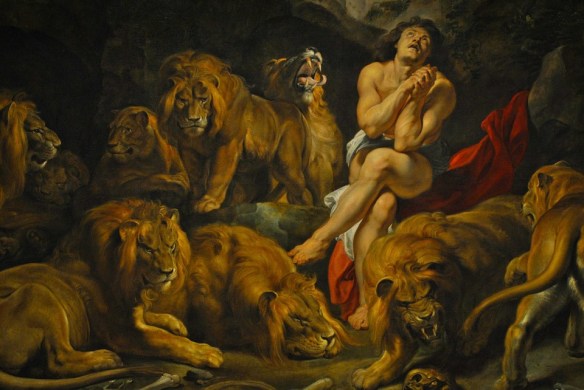
The story of Daniel hits its apex today with the mysterious hand writing on the wall, and Daniel being brought in to interpret the strange words.

MENE, MENE, TEKEL, and PARSIN.

This passage is so wrought with allegory, double meanings, and puns that it is almost impossible to tackle those things in a Morning Reflection.  I remember how we studied this in Thursday Noon Bible Study a while back, and needed many weeks to fully unpack all the implications of chapter 5.

What I know of Daniel, as I step back from the story and meditate on Daniel, is of his courage and fortitude. 

He speaks daring words to a man who has a lot of power over him.  He is rewarded for his honest assessment.  I wish I could say the same for the king, whose punishment is swift and sever – that night he was killed.

Before this happens, Daniel has been put 3rd in command.  It is a story that is somewhat reminiscent of Joseph and the Pharaoh.  As I think back on Joseph, what I realize is that it was not his specific words that were remembered either, but his actions, and his way of being.  It was the example he set and the decisions he followed that people remember.

Daniel has a lot of preliminary words to his interpretation.  And they almost fade into the background of the story of his life.  Perhaps that is part of the point.  Preachers are rarely remembered for the content of their sermons, but how they interacted with the congregation, and what they did, and how they said it.  The same is true in so many of our lives.  The DOING almost seems to trump the SAYING.

Daniel’s message to us is, in many ways, just that – make sure what you do and say match.  Be an instrument of God, not of yourselves.  Don’t be full of hot air about following God but do nothing about it.

It’s a daily challenge.  But it’s a good one.

-Matt

Coming and Going

shoes-2216498_960_720

Dan. 5:1-12; 1 John 5:1-12; Luke 4:38-44

In the midst of Luke we see Jesus healing so many.  Not surprisingly, Luke, most likely a physician, zoned in on Jesus’ command of the physical world.  His earthly ministry is seen in such color and vibrancy in Luke’s gospel.

But it is here we also see Jesus isolating himself.  We get a sense that there is a time to be in community and a time to remove oneself from the mix.  “At daybreak he departed and went into a deserted place.  And the crowds were looking for him….”

Jesus reminds us that there is a rhythm to life.  There is a time to be with people, and a time to be by oneself.  This is the spiritual life cycle of any believer, introvert or extrovert.  God speaks to us in different ways when we are alone, or when we are engaged in community.

Finding spiritual maturity means finding a balance between these two.

One of the joys of being Presbyterian is seeing the Holy Spirit REFORMING the Church at all times.  Our polity changes as our needs as a church change.  Some see this as Jesus finally showing up, touching the church, and healing it.  Others feel like Jesus has deserted us and view certain changes within the church as evil.

I trust in the process, and the speaking of the Holy Spirit through the voice of God’s people.  I mean, are we going to believe God is real, or aren’t we!?

The rhythm of our life together means that sometimes this becomes a push and pull, for systems don’t like change.  It also means God is going to speak to us in different ways at different times in history, and we best be OK with that.

Our new lives together mean that we will need to reach out to God in new ways, and seek continued guidance from the Holy Spirit.

May God bless us in our coming and our going, in our struggles and in our celebrations.

-Matt

Above It All

swan-2166037_960_720

Dan. 4:28-37; 1 John 4:7-21; Luke 4:31-37

Jesus breaks one of the 10 Commandments today, which becomes a serious signal that something important is up with this “Jesus of Nazareth”.  Jesus heals on the Sabbath, a clear violation of the command of God.  A man possessed with an unclean spirit declares Jesus to be the Holy One of God, but is silenced, rebuked, and called out of the man.

Three possibilities: 1) Jesus is in fact who the spirit says he is, “the Holy One of God” and is therefore above and beyond human law.  2) Jesus is radically reinterpreting the Law, or 3) Both.

I believe it is “both.”  This kind of authority and power is dealt with by Luke in a curious and shocking way.  He tells the story very plainly and without emotion, almost like a good news reporter, as if it is not a big deal.  Of course it is a big deal, and a shocking one, to any good Jew.  “He did WHAT??  He HEALED on the Sabbath??  Is he MAD?”  Instead Luke remains calm in telling the story.

Luke also focuses on the amazement of the crowd.  He ends with “And a report about him began reach every place in the region.”  What we discover about this Jesus of Nazareth is that he is no ordinary rabbi – he is more than an astounding teacher – more than a rabble-rouser going around stirring up the authorities.  Instead, we discover a man who seems to above the law – divine – who cares for the people in a deep and profound way.

Of course Luke takes it a step further than that even.  For Luke, he portrays Jesus as more than a man who heals the lepers or paralytics, the unclean spirits and the blind.  Jesus also comes to save those on the fringes in a different way – the prostitutes, the foreigners, the non-Jews, the folks struggling to follow the Law.

In this way, we see the Holy One of God at work.  We see someone who has authority over the sin itself, and who is saying “It is OK.  I am here to lend a hand.  You too can be blessed by God.”

Jesus turns out to be an enormous comfort to the lost, the poor, and the helpless.  The only people he really comes down hard on are those misusing their power and authority, like the Sadducees and Pharisees.  It all culminates in a darn good story – pure GOOD news!

-Matt

Difficulties

magic-cube-232276_960_720

Dan.4:19-27; 1 John 3:19-4:6; Luke 4:14-30

Following God is a difficult thing.

And in today’s scriptures we see how the difficulties of life play out.

Daniel interprets King Nebuchadnezzar’s second dream.  What he saw terrified him, because sharing it might put his life in jeopardy!  He had bad news.  Not only did he see a great tree, allegedly representing the king, but he saw that tree being cut down.  He delivers news that potentially may lose him his job, or worse yet, his head.  Nevertheless, he moves forward with truth, declaring that self-glorification is not the goal, but God’s message of truth – even if it is a prediction of affliction and call for restoration.

The letter of 1 John continues his central theme of love.  “And this is his commandment, that we should believe in the name of his Son Jesus Christ and love one another, just as he has commanded us.”  Those who obey see that God abides in them.  He helps the people discern between a spirit of error and a spirit of truth.  “Every Spirit that does not confess Jesus is not from God.”

Time and again in scripture, God delivers difficult news.  Witnessing to that which is right or true inevitably means that lines are being drawn.  If there is a “truth” then there is a “non-truth.”  It doesn’t mean the world is black and white, but it certainly means there are sheep and goats.

What I learn from Daniel is that sometimes we are entrusted with harsh or difficult news.  We are compelled to break the news as well.  This could be breaking it to ourselves – confronting selfish or destructive behaviors.  It could be calling others to accountability.

In all of this, we are told to do this in love.  John is very clear.  Even in breaking bad news, or calling someone’s hand, we are to do it in love.  So is the challenge with Christian accountability.

I have to be honest – the more I walk down this path, the more I realize what a challenge the Christian life is.  Anyone who thinks this is easy is out of their mind.

-Matt

Time For A Little Change

molten-metal-571823_960_720

Dan. 2:31-49; 1 John 2:18-29; Luke 3:1-14

The last couple weeks has felt like a fog, but I finally feel like myself again.  It is amazing what a good night’s rest can do.  Many of you know the church is wrestling with budget constraints and the painful recommendation to scale back to one pastor.  It has not been fun for anyone.  But alas, we turn to Scripture for hope and guidance this morning:

Daniel interprets Nebechadnezzar’s dream.  He sees a statue of fine gold, but with feet of clay.  God enters the picture, as one who after the divided kingdom, “will set up a kingdom that shall never be destroyed.”  The king is impressed and promotes Daniel, for he has been the only one able to reveal the mystery of the dream.

1 John speaks of antichrists, those opponents of the gospel who had deceitful ideas about Christ.  And John’s definition is pretty intense: “Who is the liar but the one who denies that Jesus is the Christ?  This is the antichrist, anyone who denies the Father and the Son.”

What does it mean to deny Jesus as the Christ?  Depending on how you define this, the argument could be made that some of my minister friends deny Christ.  They would disagree.  But an outsider’s perspective on their radical beliefs looks like denial to some.

Perhaps a better question to ask is: What does it mean to abide in Christ?  For I see these friends of mine abiding in Christ.  They show Christ’s love, and bring others to Christ.  Why then would anyone put them in the “deny” category?

The natural human response is to try to put people in categories…to put people in boxes.  We like to define ourselves by what other are (or are not).

I wish the Church would grow up.  What is important is not what I think, or my narrow theological definition of this or that, but Christ’s work in all of us.

Luke comes to our aid.  It is the story of John the Baptist – the one crying out in the wilderness.  “Bear fruits worthy of repentance,” he says.  “Prepare the way of the Lord.”  There is reassurance and hope that our job is simply to clear the way.  The Lord will lay the road.

John gives good advice – hard advice – but he reminds us that someone after him comes with fire.  Think about those images: water versus fire.  Water purifies by cleansing.  Fire purifies by smelting rock!  Things are changed!  Destroyed!  Altered forever in order to get a little purification.

The Church needs a little changing – and by change I mean smelting rock kinda of change.

John is letting us know that the road to repentance (and the road to a better life) is one that we will be unable to fulfill.  Luckily we can ride the wave of the Messiah, the one in whom we all abide in our baptism.  Smelt away!

-Matt