
In God We Trust

trump-1822121_960_720.jpg

Jer. 10:11-24; Rom. 5:12-21; John 8:21-32

Today Jeremiah paints a dramatic picture of the upcoming exile.  It is despair that eclipses even news of Russian/campaign ties, London attacks, or the healthcare debacles of our day.  To Jeremiah that would be small potatoes.

He speaks to a people whose very homeland is in the balance.  Jeremiah is blunt and to the point, even calling the people “stupid” twice.  He understands this is not just a time of affliction, but an age where self-centeredness leaves no room for repentance.

HE MUST BE ALIVE AND PREACHING IN 2017!!!  The arrogance and self-centeredness with which I see our politicians leading is beyond belief.  Oh how I wish Jeremiah would come  and stand in front of our Congress today and speak with the same power and authority.  Oh how I wish the ears of our leaders would be opened.

From out of the doom and gloom, his call is to action.  As Zion laments over the loss of her children, Jeremiah speaks of this time period as one of lamenting over the wound itself, calling the people a lair of jackals, and demanding that they acknowledge God’s all-encompassing power, who made the heavens and the earth, and pointing to God’s infinite wisdom.

In the face of sure despair, he still turns to God in trust.  We have something to learn from him.  Ultimately this whole grand shenanigan surrounding healthcare seems a rouse.  There is no hope of passing the Senate.  So why all the hub-bub?  I suppose we have to fill the news outlets with some story of drama.

I wonder what would happen if all the cameras would disappear, and the media would only report on healthcare when something actually changed.  I suspect things would actually get done much faster.  We are a people who crave attention.

Instead of looking to the next poll, or how many Twitter likes he has, Jeremiah descends into prayer, asking, “Correct me, O Lord, but in just measure; not in your anger, or you will bring me to nothing.  Pour out your wrath on the nations that do not know you, and on all the people that do not call on your name.”

In the midst of utter desolation, Jeremiah clings to hope.  It is not hope in the people, but in appeal to God’s mercy.  If you know the story, you know that despite the broken covenant, God does not destroy the people, but simply sends them into exile.

Jeremiah understands the true exile would be to not know God.  He understands that the current physical afflictions are minor hiccups, but that they are also birth pangs.

We as the Church need to take our cues from Jeremiah.  We are in exile – wrapped up in ourselves, our egos and needs.  And we need to snap out of it and realize God is the captain of this ship, not us.

In whom did we put our trust?  I think I forgot.

The focus has become on ourselves.  We have tried to convince ourselves that the church must be fought for, when in reality, the Church needs to be discovered.  We try harder, only to realize that God was in control all along.

We can rest in the words of Jeremiah today, knowing that once we were in exile, but now we have been found – found in a way that is beyond our comprehension.  God found us in our baptism, and as we died in those waters, God took us as his own and fulfilled the words of John’s Gospel for today, “Where I am going, you cannot come.”

Indeed that is true.  So God came to us instead.  And he pointed the way.  Are we listening?

-Matt
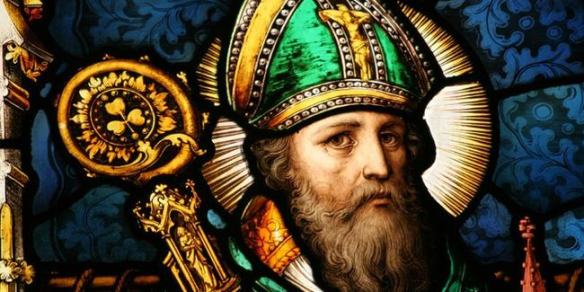
St Patrick’s – corrected

Some of you are saying the video did not embed in the emails sent.  Please view the direct link to the page:

Happy St. Patrick’s Day


Happy St. Patrick’s Day

stpatrick

Jer. 5:1-9; Rom. 2:25-3:18; John 5:30-47

Happy St. Patrick’s Day!

I share with you today one of my favorite hymns, St. Patrick’s Breastplate:


THE LORICA, OR, ST PATRICK’S BREASTPLATE

I bind unto myself today
the strong Name of the Trinity,
by invocation of the same,
the Three in One, and One in Three.

I bind this day to me forever,
by power of faith, Christ’s Incarnation;
his baptism in the Jordan river;
his death on cross for my salvation;
his bursting from the spiced tomb;
his riding up the heavenly way;
his coming at the day of doom:
I bind unto myself today.

I bind unto myself the power
of the great love of cherubim;
the sweet “Well done” in judgement hour;
the service of the seraphim;
confessors’ faith, apostles’ word,
the patriarchs’ prayers, the prophets’ scrolls;
all good deeds done unto the Lord,
and purity of virgin souls.

I bind unto myself today
the virtues of the starlit heaven,
the glorious sun’s life-giving ray,
the whiteness of the moon at even,
the flashing of the  lightning free,
the whirling wind’s tempestuous shocks,
the stable earth, the deep salt sea,
around the old eternal rocks.

I bind unto myself today
the power of God to hold and lead,
his eye to watch, his might to stay,
his ear to hearken to my need;
the wisdom of my God to teach,
his hand to guide, his shield to ward;
the word of God to give me speech,
his heavenly host to be my guard.

[Against the demon snares of sin,
the vice that gives temptation force,
the natural lusts that war within,
the hostile men that mar my course;
of few or many, far or nigh,
in every place, and in all hours
against their fierce hostility,
I bind to me these holy powers.

Against all Satan’s spells and wiles,
against false words of heresy,
against the knowledge that defiles
against the heart’s idolatry,
against the wizard’s evil craft,
against the death-wound and the burning
the choking wave and poisoned shaft,
protect me, Christ, till thy returning.]

Christ be with me, Christ within me,
Christ behind me, Christ before me,
Christ beside me, Christ to win me,
Christ to comfort and restore me,
Christ beneath me, Christ above me,
Christ in quiet, Christ in danger,
Christ in hearts of all that love me,
Christ in mouth of friend and stranger.

I bind unto myself the Name,
the strong Name of the Trinity,
by invocation of the same,
the Three in One, and One in Three.
Of whom all nature hath creation,
eternal Father, Spirit, Word:
praise to the Lord of my salvation,
salvation is of Christ the Lord.


Isolation

grid-2088884_960_720

Jer. 4:9-10,19-28; Rom. 2:12-24; John 5:19-29

I look with sad eyes upon our Jeremiah passage today.  He paints a picture of a barren wasteland –  no one in it,  cities in ruin.  He carries the burden and sorrow of a doomed nation.  It reminded me of the hopelessness, isolation, and withdrawal that some feel – to those who have contemplated suicide.

I have been a pastor long enough to see suicide touch our communities far more times than any of us would like.  Sometimes we don’t even know.  Or it goes unspoken.

Suicide can be so devastating, with questions left unanswered, pain, grief, and often secret tears, sometimes years in the making.  Trauma and distress are all around – and not just our community, but the whole world – suffering and isolation seems to abound.

How do we reach out to each other in love?  How do we reach out to hopelessness, either within us or within others?  The plot thickens when we see the stigma that our society holds around mental illness, and the quiet longing for confidentiality and gentleness.

Little comfort was drawn from the other passages for today, which speak of judgment and authority.  (A lot of the readings in Lent can be pretty heavy.)

As always, I am tempted to sit back, soak it in, and spend my time listening – not to turn away from the pain, but to gently embrace it – listening to God, listening to others, listening for hope.  This is a great thing to do on days like today, Spring break for many, enjoying a day off of work or school.

I think one of the greatest gifts we can give ourselves, and give God, is the gift of listening.  It is then we come in tune with the needs around us, and begin to sense a way forward.

May your day be filled with quiet understanding.  May the hope of the Gospel of Christ reign in your hearts – for in God you have purpose.  May the hope of a better life wash over you, and may you all know that your lives are bound up in Christ Jesus our Lord, the hope for this desperate world.

-Matt

Limitless Grace – Part 2

fountain-1948946_960_720

Jer. 3:6-18; Rom. 1:28-2:11; John 5:1-18

Jesus heals on the Sabbath in today’s Gospel lesson.  This story is somewhat unfamiliar to many – it only appears in one gospel, the Gospel of John, and doesn’t get much attention from the Sunday lectionary cycle.

Here’s the short version: Jesus went up to Jerusalem, by the Sheep Gate, to the pool named Beth-zatha.  The blind, the lame, and the paralyzed lie there, hoping to be made well.  Although the pool is mainly drinking water for flocks of sheep who come in the Sheep Gate, there is evidently some mystery surrounding the healing properties of the water, especially when the waters are stirred up.

Jesus, who would have had to pick him up and put him in the water, a clear violation of Sabbath rules, chooses to simply say, “Stand up, take your mat and walk.”  Even before the water is stirred up, the man is healed.  He takes his mat and began to walk.

So why do people get in such an uproar?  Sounds good, right?  Carrying his mat is a violation of the Sabbath, and the Jewish authorities point this out.  He responds, “The man who made me well said to me, ‘Take up your mat and walk.’”  They want to know the identity of the man who healed, but Jesus had disappeared in the crowd.

Later Jesus found him in the temple, and the man told the authorities about Jesus’ identity.  The Jews started persecuting Jesus and he responds, “My Father is still working, and I also am working.”

This convoluted story about Sabbath breaking is challenging.  Of course one of the first things to point out is that all this laboring – this performing of a miracle too – is breaking the Sabbath.  And I don’t know about you, but I thought this would end differently.  That Jesus would weasel out of it by saying, “My Father is still working….and he can do whatever he wants!”  Instead, he feeds their rage, pleading guilty to the charge, saying, “My Father is still working, and I also am working.”

Jesus is not concerned about breaking the Sabbath, instead he is interested in clarifying his role.  By claiming God as his Father, he claims to be equal to God.  He is revealing his Messiahship.

It is easy to understand why all this gets him in trouble.  But the story reveals even more.  Why was Jesus hanging out at the dirty, smelly Pool of Beth-zatha?  What do the disciples have to do with herding sheep?  Did they come for the medicinal properties of the water?  Perhaps he came especially to see the people there.

Jesus seems to be playing with fire when it comes to the Jewish authorities.  He is taking the role of Judge and Advocate.  By performing these miracles, especially in the most unlikely of places, he is sending a clear message to the Jewish authorities: “God is not playing by the rules of the temple here.  And there is no stopping it.”

This bold, abrasive message gets him killed.  And yet, all the while, revealing the Word made Flesh.  The Gospel of John is a unique picture of Jesus, but one that I see as essential.

May God reveal to you the healing waters you need this day, and may you rejoice that we follow a God who breaks the rules to err on the side of mercy, grace, and healing – for you and me.

-Matt

Limitless Grace

match-1100912_960_720

Jer. 2:1-13; Rom. 1:16-25; John 4:43-54

What does it mean to be the Light of the World?

In John, Jesus returns to the scene of his first miracle – Cana, where he changed water into wine.  This time it is not a party that draws Jesus’ attention, but a royal official, whose son lay ill in a neighboring town about 20 miles away.

The news of Jesus must have gotten out, because this royal official heard that Jesus had come to the Galilee region and set out to find him.  He begs Jesus to heal his son.  “Unless you see signs and wonders you will not believe,” Jesus says.  The official said to him, “Sir, come down before my little boy dies.”  Jesus said to him, “Go; your son will live.”

The next day, as he was heading back, his slaves met him on the road to declare that his son had been healed.  Think about that for a minute!  He doesn’t even lay a hand on this kid, and he is healed!  His power is growing!  Healing now is taking place even without meeting the one doing the healing.  Extraordinary.

There is a series of stories in John that help identify Jesus as the “light of the world.”  It is a light that is shining on those whose worth is questionable in the eyes of many.  Previous to today’s reading Jesus has a remarkable conversation with a Samaritan woman (which is one strike against him, in the eyes of his critics).  Today it is a government official (i.e. a Roman), another strike.  Next, he heals on the Sabbath.

Grace is spilling out all over, and the laws of the Pharisees and of the temple guard are being challenged.  We are setting the stage, not only for the cross, but for the revelation of God’s light to the world.

We also witness the growth of power.  Jesus’ power is not limited to those he meets face to face anymore.  This story, like that of the feeding of the five thousand, witnesses to a grace that is almost limitless, spilling out beyond boundaries of the familiar or even of knowledge.

And the Word became flesh, and dwelt among us, and we have seen his glory…full of grace and truth.

Hang on.  It’s a bumpy ride to the cross.  Being the Light of the World means more than spreading light, but attracting attention, and critics of the Light.  This is a journey sure to keep us on the edge of our chairs.

-Matt

Slow Down!

road-sign-1210038_960_720

Jer. 1:11-19; Rom. 1:1-15; John 4:27-42

Lent is about us slowing down to read the signs.  Today they come to us in scripture.

The dramatic call of Jeremiah is given today, appointing Jeremiah with oversight of the kingdoms.  The Lord puts his words in Jeremiah’s mouth and tells him he as the ability to “pluck up and to pull down, to destroy and to overthrow, to build and to plant.”

With a little Hebrew wordplay, God shows Jeremiah a vision of an almond tree and a boiling pot, and assures us that God not only watches over us, but will follow through with the prophet’s words.  It is, in many ways, a foreshadowing.  It gives us glimpses of how Jeremiah’s ministry will be.

We begin reading Paul’s Letter to the Romans as well.  He begins with “guns a blazin’”.  Paul lets us know the issue at hand just in introducing himself, giving us glimpses of the summary of the gospel and the reasons for his being so upset with the Corinthians.

Sometimes my Lenten walk has felt very much like these passages – with too much going on.  Often I have felt swallowed up in all the Lenten disciplines, programs, and creative ministries at First Presbyterian.  It can be hard to say “No” to certain things in order to say YES to God and stay spiritually in tune with God.  We must wait patiently and find the time to prioritize God in our relationships.

And that is what Lent is about isn’t it?  The world sometimes seems all too eager.  But we Christians wait.  We take things slowly and deliberately – continually focusing on the cross and what it has done and is doing for us.

Have you ever driven down the road too fast only to think “Now, what did that sign back there say?”  Lent is about us slowing down to read the signs.

-Matt