John 3:16, no wait 3:17!

heart-1811310_960_720

Deut. 9:23-10:5; Heb: 4:1-10; John 3:16-21

Perhaps one of the most quoted scripture, John 3:16.  I cannot begin to count the “John 3:16” signs I have seen at NFL football games and other sporting events. “For God so loved the world that he gave his only Son, so that everyone who believes in him may not perish but may have eternal life.”

The problem is not the verse itself, but often the way it is used.  Taken out of context, it is often used to beat non-believers over the head, attempting to use the fear tactic in changing their non-belief.

Often I am tempted to hold up a sign that says “John 3:17”.  (You have heard me say it before, and I will say it again: Read on!)  It is amazing how scripture appears to change when rather than taking it out of context, we read scripture in the context of the story, or the book in which it appears.

In this case, John 3:17 declares “Indeed, God did not send the Son into the world to condemn the world, but in order that the world might be saved through him.”  The passage goes on to talk about judgment as if it is something for God alone, and not for us to be deciding.  Our focus in on good deeds and staying in “the light.”

It turns out that John 3 warns against the very thing that people intentionally or unintentionally do with their “3:16” signs.  By casting judgment on people, we miss the point of God’s purposes for us.

For John, everything seems to stem back to the premise that he laid out at the beginning: “And the Word became flesh and lived among us, and we have seen his glory, the glory as of a father’s only son, full of grace and truth.”  Everything that follows is an explanation and expansion of that main thought.

And where does that leave us as believers?

It means that our lives’ focus have changed.  We are to revel in the wisdom that is all around us.  We are to enjoy God, celebrate God, and feast on the goodness of God, sharing that feast with others.  We are not to disrespect God by taking on the position of judgment or condemnation.

We are to seek love in everything we do – in every relationship – in every place we go.

-Matt
Perpetua & Felicity

svete_perpetua_i_felicita4.jpg

Deut. 9:4-12; Heb. 3:1-11; John 2:13-22

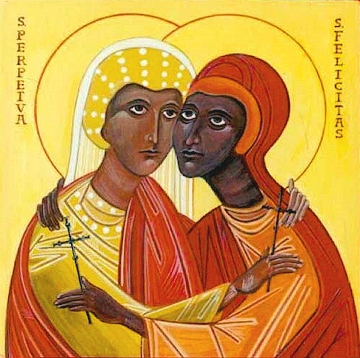
Perpetua & Her Companions – Martyrs at Carthage (March 7, 202)

Today is the traditional feast day of Perpetua and Felicity, two of my favorite martyrs of all time.   Check them out!  It’s an early church history day.


The Real Rule of Law

christian-1316187_960_720

Deut. 8:11-20; Heb. 2:11-18; John 2:1-12

Today, in Deuteronomy, we see a vision of following the commandments cast in a new light.  Here it is all built around remembrance.  Keeping God’s commandments, his ordinances and his statues is a way of remembering God.

The last couple years there has been a lot of political hub-bub about the 10 Commandments.  There are monuments erected at so many state capitols it is hard to keep up.  Legislation to keep it.  Orders to remove it.  Legislation to put it back.  And in the midst of it all, there is an implication that the 10 commandments somehow have to do with the moral fiber of a community.  Yet, other than not murdering and not stealing, it is hard to find any of this on “the books” at the court house.  Instead, most of them have to do with not coveting, or honoring God in appropriate ways.

It turns out, the commandments are driven not by “moral fiber” but by theological fiber.  Here in Deuteronomy, the fullness of the commandments intent and impact are made known – that we “do not forget the Lord your God.”

It turns out we are doing more than remembering the Sabbath Day – instead these are all a vehicle to remember God’s place in our lives.  And by treating one another with respect, we remember where God has placed us in his eyes.

In many ways, the 10 Commandments are simply an expansion of commandment number one: Love God.  In another sense, the entire canon of the law is an expansion of that one principle.  Jesus adds to it: Love God and love neighbor.  (This is another way to summarize the 10 Commandments).

So the 10 Commandments are to put us in our place, in a theological sense.  They are not for legislation, but for ways we can honor each other in relationships and in life.

I think the reason legislator fight over 10-Commandment statues is the same reason people angrily Tweet during the night about fake news items – to distract us from the real issues and the Real Law, God’s Law.  For, when we fight over trivial matters and completely made up issues, it becomes easier to ignore God and neighbor.

Most of this comes back to idolatry – a violation of the first commandment.

The trajectory that God’s law lays forth is clear: “When you have eaten your fill and have built find houses and live in them, and when your herds and flocks have multiplied, and your silver and gold is multiplied, and all that you have is multiplied, then do not exalt yourself, forgetting the Lord your God.”

For me, this is where the 10 Commandments really start to hit home.  If in our observance, we fail to keep ourselves in check, vaulting ourselves above God, we have missed the point of them completely.  We have traded in the truth of God for a lie.  When we turn to greed and self-centeredness, we lose the ability to see clear theologically.  We begin to see ourselves as gods.

“If you do forget the Lord your God and follow other gods to serve and worship them, I solemnly warn you today that you shall surely perish.”  I pray that our country turn and follow God’s way once again.

-Matt

Radiating the Love of X

cross-1448946_960_720

Deut. 7:6-11; Titus 1:1-16; John 1:29-34

It is a natural question while reading scripture: “Will I ever measure up like these people?”  While scripture is filled with those who fall short of God’s desires, I hardly think I could even come close to the kind of humility and service they often portray.

As we turn our hearts to Lent, and disciplines like fasting and praying, I ask you to ponder this question: What does God expect of me today?  What difference could I make in God’s creation that would prompt others to write stories about me?

We are called to lose ourselves in the midst of following Christ.  What a task!  What an endeavor of faith and trust.

As we are called forth from the story of Scripture, to use our talents, called to specific roles in the church, my joy comes in knowing that I am on track.  I feel like I am in a place that I am finally able to use my gifts.

I encourage you to also inwardly reflect on these things, and begin discussions with those in your family or in your church about what your gifts are and how you can best realize the talents that God has entrusted in you.

May this Lent be one of humility and service, of purging and examining, of repentance and renewal.  May the dawn of mercy break upon you.  And may your love radiate forth this day…to all the world.

-Matt

Turning Around

16939617_10154562988924613_4194048591944617102_n

Jonah 3:1-4:11; Heb. 12:1-14; Luke 18:9-14

As we turn the calendars to March, Ash Wednesday can surprise many.  It certainly sneaks up and surprises many in New Orleans as Mardi Gras comes to a sudden and crashing halt, when the bars close and the street cleaners come through Bourbon Street right at midnight, with loud speakers glaring – “CLEAR THE STREETS….MARDI GRAS IS OVER.”  Indeed, the sudden shift to a more spiritual, disciplined life has begun.

Ash Wednesday: our readings not surprisingly take a sudden turn and we find ourselves in Jonah, one of my favorite books.  Jonah is almost comical when you understand how he grudgingly goes to Nineveh, and with only a few half-hearted words becomes an agent of transformation for that town.  It is a powerful story.  The king, and the town, follow this up with action, including sitting in ashes.  Outward rites reflect the inward reality.

I will talk more about ashes and their connection to Lent tonight at our service.  5:30 dinner, 6:30 Imposition of Ashes and Communion.  All are welcome.

I promise to not be a goofball and make your cross like one of the ones above, but instead to help usher you into this time of spiritual discipline and “turning.”  Because the serious questions of life come: Where do you turn for hope and renewal?

Luke’s passage is of Jesus telling the story of the Pharisee and tax collector, one who stands where all can see him saying, “God, thank you that I am not like other people….”  The tax collector was standing far off, not even looking up to heaven, beating his breast and saying, “Have mercy on me a sinner.”

Repentance and humility are key themes for Lent.  That’s what I mean by “turning” – to turn around from the old patterns.  It is clear that God wants us to take seriously our actions and do the best we can.  Yes, grace abounds, but that does not exempt us from serious introspection and a genuine turnaround in the areas of our lives that need it.  Outward rites to assist the inward desires.

This is the essence of Ash Wednesday.  And so as we take this day to seriously consider any Lenten discipline that may aid us in repentance and humility, self-sacrifice and introspection, may we look to the people of Nineveh or to the tax collector, both who come to understand inwardly and outwardly that change for them is important.

It is a time to turn to God and follow in new and hope-filled ways.

-Matt

This is on YOU

index-315754_960_720

Gen. 3:1-24; Heb 2:1-10; John 1:19-28

When Adam and Eve meet up with the serpent, we get more than talking snakes and fig leaves.  We hear of Adam and Eve hiding from God.

Of course, that’s not it.  There is also a lot of passing the buck.  “The SNAKE, he made me do it.”  Then Adam, “The WOMAN, she made me do it.”  How typically human.  Instead of admitting we have done wrong, we blame another.  Who is at fault?  Certainly not me!  If my kid is failing at school it must be the school system’s fault.  It certainly isn’t mine or my perfect child.

What we learn in scripture is that SIN pervades everything we do.  What we learn in the Garden is that everyone is at fault.

Today is Mardi Gras.  And I don’t mean to rain on everyone’s parade with talk of sin and falling short of God’s glory.  There is always a time for joy and celebration, for God has been good to us, and there is much to celebrate.

Think with me though how we hide from God and how we pass the buck.

Ultimately, this story in the Garden is a story of grace amidst our being ourselves.  Despite the stupidity and sinful nature of humans, God continues to not give up on us, working grace and mending brokenness.

But much is required of us.  Taking responsibility is a good start.  Knowing that we cannot hide from God, and facing the music is part of being an adult.

Our church budget is way out of wack.  We are staring at a $285,000 deficit.  And there are some who might be tempted – thinking the answer is “slash, slash, slash.”  I am sorry, but God has mighty tasks for us ahead.  Now is not the time to circle the wagons and start shrinking our ministry.  Enough hiding from God and passing the buck.  What God demands is that we step up and step out in faith.

It is time to seriously consider raising your pledge at church.

Generations of saints came before us.  They knew the secret to life was not passing the buck to the next generation, but stepping out in faith and action.

I also think about this little garden in which we now live – our planet.  We have been given dominion over the birds of the air, and the fish of the sea, and over all that God has made.  There are some who would like to hide from God and ignore the problem completely.  There are others who get myopic, thinking that if they can just do their little part and recycle, all the world’s problems will go away.  Between polar ice caps melting and forests disappearing, I am here to tell you, recycling your drink can is not the answer.  Enough hiding from God and passing the buck.  God demands that we step out in faith, and step up in action.

It is time to seriously consider stepping out in faith and action and demanding justice, demanding action from the companies we work for, and the governments who serve us (not the other way around, btw…we don’t serve them…they serve US!)

If God came walking by us right now, I wonder if we would hide from view, ashamed of our own failures.  What does it mean to be good stewards of the earth?  I get out my big green recycle bin and I proudly think, “Well, I am doing my part.”  Am I really?  What more is required?

All of us are called to action, called to take responsibility, called to step up – to be a good gardener during my stay here – in our churches, in our lives.

-Matt

Word/Flesh

SecondComing2

Deut. 6:10-15; Heb 1:1-14; John 1:1-18

In the beginning was the Word, and the Word was with God, and the Word was God.  These words have echoed through the naves of our churches for two millennia now.  And they still carry as much mystery and depth of profundity as they used to.

This passage also serves to stand as a prologue to the whole book.  The great theologian Karl Barth used to teach a class on the Gospel of John and the entire semester was spent focusing on the first 20 verses or so.  That is because so much of the Gospel is simply an expansion on this initial philosophical stance.

The Word became flesh, and dwelt among us – full of grace and truth.

What do these words say to our church today – churches who are struggling to share the gospel?  John is anything but simple, and yet, the images are often rooted in simplicity.  The Word was with God.  Logic, rational, understanding.  These things are with God.

And the Word became flesh, and dwelt among us.  Jesus is the Word.  Ergo – Jesus is all that is logic and understanding.  Later John takes up these concepts of grace and truth and expands them into light and sharing the light.

From time to time I lead a discussion about the “I AM” statements in John.  Since our narthex windows in the chapel are I AM windows, I often get this opportunity.  It is interesting to see the depth of those “I AM” statements come to life in the midst of a community of disciples.  We all relate to or see different things: living water, I am the good shepherd, I am from above, light of the world, I and my Father are one.

Every time I think I have grasped the depth of John’s gospel, I am set back by the mystery of it all.  It is far more complex and mystical than I ever thought.  The centrality of the mystery comes at the cross, of course, but that mystery is even alluded to today.

What a strange book we have on our hands.  And what a wonderful book that speaks to the complexity, and yet the simplicity we all must recapture if our church is to have a chance.

John speaks to faith in a different way.  And in a world that is increasingly disconnect from Christianity and suspect of just about any religion, I wonder if John’s mystery and different way of talking about faith isn’t exactly the medicine this world needs.

Mystery – elusiveness – profundity – this is at the heart of the gospel message.

-Matt