Balaam’s Talking Donkey

donkey-105719_960_720

Num. 22:21-38; Rom. 7:1-12; Matt. 21:23-32

In Numbers we encounter the story of Balaam’s talking donkey.  I’m sure you have all heard the jokes about Balaam’s ass – but how many of you remember the story?  It’s a story about humility, poking fun at Balaam, whose talking donkey sees more than he can.

This is clearly a fable, and one that includes a familiar motif of the time, this “seer of the gods” who ironically sees nothing. Balaam, the son of Beor, is loyal to the God of Israel and comes from a far away land to be both prophet and diviner, has his first oracle today.

Balaam is a non-Israelite, and yet he has come because of Yahweh.  He is an outsider, but loyal to the God of Israel.  He comes as God’s instrument to either give blessing or curses.

But not a very good one!  His donkey sees more than he does!

How often this is the case in our lives.  We go to school and acquire so much knowledge; we learn much about life through the wisdom of years.  And yet we are so limited in what we know about ourselves, others, or the human condition.  We have problems in our lives, in our governments, in our world.  We go to the doctor, thinking they have all the answers too, only to realize that much sickness is a mystery and they are just humans trying their best, sometimes making mistakes too.  We, too, come to realize this – that we are not masters of our own universe.  Communication breaks down at our workplace, or our relationships falter or fall apart.  We are hardly people who know everything – about others or even ourselves.

We are broken, fragile creatures who long to see our lives complete.

The joy of the Church is that God accepts us in our brokenness – in our failings.  God does not demand perfection.  He simply calls us to the table and says, “I have been saving a seat for you. Come.  Eat.  Take some bread.”

What we experience in the Church – at the Font, at the Table – is the wondrous inclusive love of God, which is intended for all.

Not to say that God doesn’t want us to do our best.  We should desire the best – treating ourselves and others like the kings and queens that God treats us.  But this is the wonder of God’s love – who always has more to give than to expect in return.

The story of Balaam’s talking donkey is one of humility, that I think is also meant to calm our fears.  Here is this great prophet – and a story of him not getting it.  Hopefully today can be a day when we laugh at ourselves, stop taking ourselves so seriously, and enjoy the simplicity of the presence of God in our lives.

-Matt
The Fifth Gospel

aerial-herodium-420016-ga

Num. 22:1-21; Rom. 6:12-23; Matt. 21:12-22

While taking classes in Israel I heard over and over again the term “the fifth gospel” from Christian professors.  At first I was confused.  Did someone canonize the Gospel of Thomas or some crazy thing?  No.  This was Eastern scholars’ way of saying, “In order to understand the first four gospels, one must come to understand the fifth gospel – the LAND itself, and the story it tells.”

A good example of that is here in our Matthew passage today.  We have two stories of Jesus getting angry.  First Jesus overturns tables at the Temple Mount.  Then he leaves the city, crossing over to Bethany to spend the night, a small village to the east of Jerusalem, through Bethpage.

The next day he returns to the city.  On the way, he encounters a fig tree, and curses it.  He ends with, “If you have faith and do not doubt, not only will you do what has been done to the fig tree but even if you say to this mountain, ‘Be lifted up and thrown into the sea,’ it will be done.”

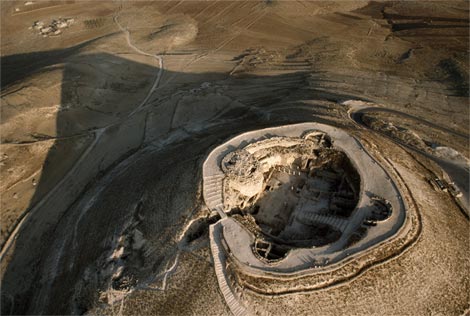
I had always thought the biblical phrase to “move a mountain” was a metaphor.  Then I went to Israel and studied the “fifth gospel”.  Have you ever heard of the Herodium?  Probably not.  It is a man-made structure built a little before the time of Christ.  This mountain was made by the Romans as an outpost, military vantage point, and also a winter retreat for Herod.  It was an underground fortress, nine levels in total.  It was an engineering marvel. (Pictured above)

It was also a mountain, literally.  Taking many years to make, it was made by the determination of Roman architects, engineers, and by the hands of many slaves, who carried buckets of dirt for years to make this pile of soil which eventually became a mountain.

While it is not mentioned by name in the Bible, there are Roman documents explaining its construction, and even recounting the many years it took to do this project, and the skepticism of the people as to whether it would ever be built.  Many thought it was impossible.  They lacked the faith to envision such marvels.

When you are walking from Bethany to Jerusalem, through Bethpage, the Herodium is visible to the south.  I imagine that as Jesus was cursing the fig tree and explaining, “If you have faith and do not doubt, you can say to this mountain, be moved.”  This was no reference to telekinetic powers.  This was Jesus actually pointing at the Herodium saying, “If you had faith like the Romans, you could do this.”  What an insult!

This was a low blow.  Jesus had just gotten done upsetting the Sadducees with his Temple shenanigans.  Now he was upsetting the Zealots and others by paying the Romans a compliment.  He lifts them up and says, “Even the Romans do some things better that we do.”  It is easy to see why a few chapters later he ends up on a cross.

I hope you all get to go to Israel one day.  It was like buying a color TV for the first time, having seen it only in black and white since I was born.  If you are going to Israel with me in January you will see this.  If not, perhaps you will want to join my class in the Fall that will study Jesus and the Land.  It will be like visiting Israel through digital media without actually visiting.  (For more: http://www.fpcokc.org/trips )

-Matt

Connection & Transformation

DSC01270

Num. 20:1-13; Rom. 5:12-21; Matt. 20:29-34

Our Romans passage today makes connections between Adam and Christ – representations of the old and new creations.

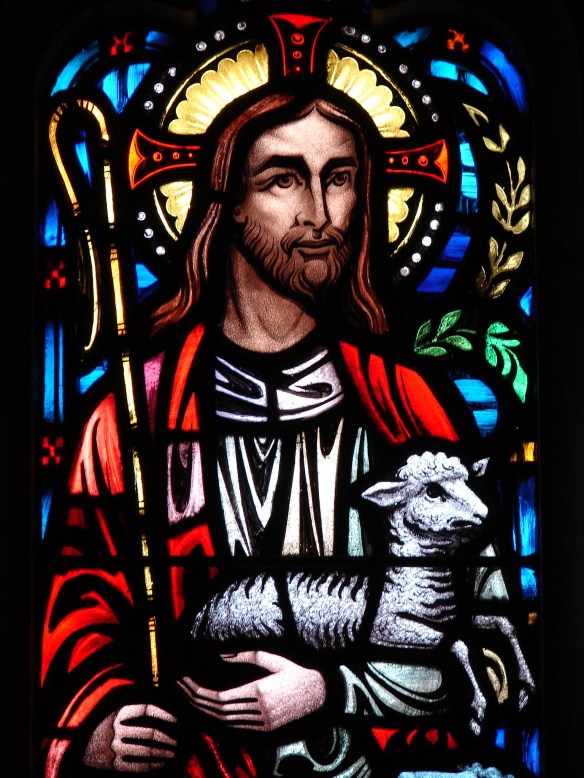
Often in my Stained Glass Window tours at First Presbyterian Church (OKC), I have mentioned the common pairing of old and new covenant themes.  A good example of that in our windows is the 23rd Psalm window, which shows Jesus at the center as the good shepherd.  (In fact it is mistakenly named the Good Shepherd Window in a color booklet we have on all the windows).  Come check it out sometime.  It beautifully depicts the 23rd Psalm.

I got in trouble with the archivist at Willet Stained Glass Studio once when I kept referring to it as the Good Shepherd Window.  “Matt, that is NOT the good shepherd window, because the predominant motif is the 23rd Psalm.  It is everywhere!  You gotta start calling it the 23rd Psalm Window.  Oh by the way, you have a Good Shepherd Window, but it is downstairs in the narthex screen where Jesus is saying ‘I am the good shepherd.’”  It’s a rough life when you have so many windows you get them all confused, and have to rename them.  73 Willet windows.  Wow, we are spoiled.

It’s easy to see the confusion.  “The Lord is my shepherd” – an Old Testament theme imaging Yahweh as a shepherd of the people.  In our eyes, the Lord is Jesus, the Word made flesh.  Often this is how stained glass experts do things: tying Old and New Testament covenants, which occur often numerous times in each window.

Paul is not the only one to make connections between Adam and Christ – in the gospel reading, Jesus heals two blind men.  They call from the crowd – only to be hushed by them.  They shout all the more.  Jesus hears them, and in his compassion, asks what they want, and heals them.  He represents the inbreaking of the new kingdom on earth, the new Adam, from which countless generations spring forth.

Not so ironically, Jesus does not produce physical offspring, for his legacy is one of love and spirit.  In setting the tone for his ministry through deeds of power and miracles of mercy he functions as a new Adam, whose legacy is in “spiritual offspring”.  These two blind men follow him.  For all we know, they could be some of the people mentioned in Acts.  New Adam indeed.

Christ’s offspring exercise their dominion not through subduing the earth, but releasing themselves from it, and sharing an abundance of grace.  Grace pours out through the power of Christ into our lives, and that through God himself we find life, and find it abundantly.

Now let’s go share this amazing news!  If fact, please do.  Click LIKE, share this with friends on social media.  Spread the word of our awesome windows at First Pres. Spread the word of the abundant life that you can find there among the people in mission and service.  Spread the word best you can.  Radiate Christ’s beauty.  Ready…go!

-Matt

Top 10 Reasons Belhar Works For Me

ZZ321407AD

Last night at the 222nd General Assembly, the Presbyterian Church took the final step in approving the Belhar Confession.  It is a wonderful document that came out of the anti-apartheid movement in South Africa that takes a stand against racism, injustice, and disunity.  It calls the Church to action as God’s instrument of reconciliation.

It now joins 11 other documents to become our 12th in the Book of Confessions. (Hey, I need to order a new Book of Confessions!).   You know some of the others: Apostles’ Creed, Nicene Creed, Westminster Confession, a Brief Statement of Faith (OK, some of you may not know that last one).

Getting to the point of having a new confession is not easy!  After a super-majority of the presbyteries approved Belhar over the last couple years – much like the process of getting a new amendment in our US Constitution – the last hurdle was a second vote of the General Assembly.  Yesterday this confession finally “went live” after many years of discernment, deliberation, and votes.

Here is why I am excited about Belhar:

  1. It is the first non-European document in our Book of Confessions since the Apostles’ and Nicene Creed.
  2. It is a newer document, written in 1982, allowing God to speak again to us through new voices.
  3. Belhar is humble.  It witnesses to some not-so-wonderful history in South African churches, and radiates and preaches to today – a witness for the greater Church.  This confession, growing out of the church’s practice of apartheid and exclusionary practices of the church’s worship in South Africa, witnesses to how injustice emerged from distorted understandings of the sacraments and the unity of the church.
  4. Belhar confronts racism (which isn’t an issue at all in America.  D’Oh!)
  5. Belhar is a conversation starter about how you see injustices in your community or own life.
  6. It is a cry of hope – and we need to learn how to cry out to God, instead of whining and complaining
  7. It takes a stand – which the Church needs to do an awful lot more of today
  8. It’s an ecumenical bridge, adopted by other Reformed Churches, and could help us celebrate similarities instead of always focusing on differences (which we PCUSA people seem so apt to do).
  9. It is flexible and wonderful for worship!  See the Belhar Study Guide for ideas.
  10. It is prophetic – calling for social reconciliation and renewal

In our US culture reeling from the never-ending supply of mass shootings most recently Orlando, still seeking justice and transformation surrounding the quagmire that still is Ferguson, the Trayvon Martin tragedy, and any other number of injustices in our culture that seems to accept guns as the norm, Belhar echoes out to us!

Into this culture so politically divided, where mistrust, division, rancor, and where disunity seems to be celebrated, Belhar quietly calls the Church to action.

Into this culture which seems obsessed with its gun culture and is all too lackadaisical with violence, demonstrated and proven by the overly dismissive “thoughts and prayers” motif that riddles social media after every violent act, Belhar cries out!  (I hate that stupid phrase btw – “thoughts and prayers” – which is really a signal of utter surrender and inaction, and which my friend John Pavlovitz recently called it the “social media cliché du jour from those wishing to appear moved without actually moving, those who want to feel good about feeling bad without any real response.”)  To that culture, Belhar doesn’t allow us to sanitize the injustice anymore.  It forces a mirror in front of the church’s eyes and says, “And what are you going to do about it?”

I love Belhar.  And I hope over the next few years, it will grow on me even more – that God will shape me and challenge me through this document.  My prayer is that the same happens for you too.

-Matt

To check out the Belhar Confession or the Study Guide put out a few years ago, check out:

Click to access Confession_of_Belhar.pdf

Click to access belharstudyguide1.pdf

Blossoming

tree-215970_960_720

Num. 17:1-11; Rom. 5:1-11; Matt. 20:17-28

Each of our readings today is a blossoming – a flourishing of God’s power.

In Number’s, Aaron’s rod actually buds, produces blossoms, and bears ripe almonds. Twelve staffs are given, one for each ancestral house.  Names from each house are written on them.  Moses places the staffs before the Lord in the tent of the covenant.  The next day Moses finds that Aaron’s rod has sprouted buds.

Whether this is telling us that Aaron and the house of Levi are chosen above the rest for ritual, or whether this simply indicates Aaron’s power in the Lord, and his leadership potential, it is unclear.

Whatever it means, it is a rarely encountered passage, as it does not appear in the Sunday lectionary cycle.  This is my struggle with the weekly Sunday lectionary.  You can spend a lifetime in the church and never hear most of Scripture.  It is one of the reasons I write these reflections, as I believe it is my duty as a minister to help plant the seeds of God’s message of salvation among us.  The daily sustenance of Scripture can be so powerful and helpful.

Another kind of blossoming occurs in Matthew.  Jesus foretells his death.  The mother of James and John comes with a request that Jesus is not able to fulfill, telling them, “Whoever wishes to be great among you must be your servant.”  He then shows signs of this blossoming of power in servanthood by healing two blind men.

Paul’s blossoming argument about justification is a continuation of beautifully weaved words around justification as seeds of hope and peace.  He offers us a difficult yet reassuring passage.  Through our justification, he tells us, not only do we have access to the grace of God, but now are able to boast in our sufferings, “…knowing that suffering produces endurance, and endurance produces character, and character produces hope, and hope does not disappoint us, because God’s love has been poured into our hearts through the Holy Spirit that has been given to us.”

My prayer is that hope, peace, understanding, and goodwill continue to blossom forth in your life with whatever passage touches your soul.  Into this crazy world, with our political news spinning out-of-control-crazy almost every day, guns everywhere, the never-ending news about yet another mass shootings, along with the hopeless and tragic state of educational funding or lack thereof – into this world God’s Word comes with hope for this troubled world.  Of course this Word demands our action.  But it is a start – a movement – a blossoming of grace.

-Matt

Gun Apologists, Save Your “Thoughts and Prayers” — john pavlovitz

Well, another week here in the Land of the Free. That means another mass shooting and another round of funerals for our brothers and sisters taken in the middle of radiant, beautiful lives. And once again, all gun apologists can offer grieving families are three words to compound their pain; three words certain to do little to comfort them, and even…

via Gun Apologists, Save Your “Thoughts and Prayers” — john pavlovitz

All Means All

justitia-421805_960_720

Num. 16:36-50; Rom. 4:13-25; Matt. 20:1-16

Grace abounds.  Particularly in our Romans passage and Matthew’s telling of the Laborers in the Vineyard we see this.

Paul talks about it by continuing to assert that God’s promise is realized through faith, not the law.  “For the law brings wrath; but where there is no law, neither is there violation.  For this reason it depends on faith, in order that the promise may rest on grace….”

In Jesus’ parable grace is realized through the actions of the owner of vineyard.  Frankly it is all over, for God’s full “yes” is extended even to those who do not deserve a full wage.  But think about the owner for a minute, who is prompted to hire more workers simply because he sees them “standing idle in the marketplace.”  He hires them not because he needs more workers, but simply because he sees workers who need work.  This is a terrible businessman!  But this is a wonderful symbol of God’s grace.  In God’s kingdom all have a place, and all find contentment.  In God’s kingdom we aren’t driven by good business practices, but a practice of love, abundance, and grace.

This is a regular theme of the New Testament that grace supercedes the law, and one that continues to get kick back from religious leaders in all corners of the Church.  It is just too much to think about Love and Grace trumping rules.  And yet I see a church that is consumed by laws and condemnation lately.  We have a lot of “no’s” for a world that is looking to us for God’s “yes”.

For Paul, the struggle was over circumcision – Gentile versus Jew.  Today it is about marriage equality, inclusion, and who should be ordained.  Paul took a bold stand that righteousness is primarily about faith, not circumcision.  It was a struggle over outward forms versus inward realities.  His ideas weren’t going to win without a fight, a fight that consumed the early church for the better part of a century.

I wonder how Paul would answer these questions.  Or Jesus.  Some of my friends don’t like Paul (oh that is putting it mildly – they hate the guy) because they see him as anti-women, backward, and antiquated.  But I see him breaking down the walls of his time – boundaries of law.  This is the man who declared in Christ there was no male nor female.  So don’t be so sure, my progressive friends, that Paul wouldn’t agree with you 100% about the ordination of all.

Paul struggled mightily to have Gentiles included in this new congregation of Christians, and now we too struggle – struggle to include gays and lesbians as full members of the community of faith.  (My goodness, do you mean ALL MEANS ALL?)  This is nothing new to the PCUSA.  But my Methodist brothers and sisters are having convulsions of polity – struggling toward inclusion and a more faithful reading of Holy Scripture.

Once again we have traded in the radical nature of the Gospel of Love for the comfort and safety of draconian rules.  (And after all, things like Levitical laws are easy and seductive, black and white, simple).  We have failed to articulate the deep and driving forces of the Gospel, which live into a more gray world, and which lay a foundation for full inclusion of women in leadership and gays and lesbians at the table.

Nothing has changed.  It is the same Church as for Paul.  Will our community be one of law, or one where there is a new law of faith and love?  Will our community be one that throws out rules completely or reads all rules through the lens of Scripture?  Will our community get stuck proof-texting, or reading the entire blueprint of scripture that clearly laws out that All Means All?

My response comes easy.

-Matt