So the last will be first, and the first will be last. Matthew 20:16 When I was a child, the leaders in our Mainline Church were – for the most part – successful professionals: the professors and lawyers, the business people and doctors. They faithfully pledged a portion of their incomes towards the ministry of […]
Repent

Prov. 15:16-33; 1 Tim. 1:18-2:8; Matt. 12:33-42
Sometimes it is easy to miss how Jesus insults the Pharisees. With 2000 years of cultural divide, it is easy to miss. Today in Matthew we discover Jesus invoking the name of Jonah, who is being demanded a sign from the scribes and Pharisees. Jesus says, “No sign will be given…except the sign of the prophet Jonah. For just as Jonah was three days and three nights in the belly of the sea monster, so for three days and three nights the Son of Man will be in the heart of the earth.”
To speak of Jonah is to really rub the Pharisees raw. Jesus was perplexed at how the words of the Pharisees did not match their actions. He warned them, called them names, and spoke of the day of judgment. Now he turns to Jonah, whose half-hearted preaching turned an entire city to repent. To repent at the words of Jonah is one thing. To not even see you need repentance is another. This is a cutting insult.
Then Jesus goes even further! “Something greater than Jonah is here,” he says, and later stating “something greater than Solomon is here!” He obviously doesn’t mean the Pharisees. It appears he is referring to himself.
It is no wonder the teachers of the Law turned against him. He threatened their authority and questioned their authenticity. It’s easy to demonize the Pharisees and mock their hearts of stone. But we know the whole story – we have seen him die on a cross and rise again. The Pharisees are simply reminders to us of the difficulty and strength it will take to believe and follow Christ.
Today we are not in the midst of easy times either. Challenges are all around us. Being a Christian is arguably harder today that it has been in recent history. If you turn on the television sometimes what is being sold as “Christianity” looks anything but. We must struggle every day for our words and deeds to match.
We do not need to relive the suffering of Christ for the gospel to come alive in our lives. But our spirits need to intersect with the faithfulness of the cross and challenge us to move from the cross to greater horizons. This is a daily struggle – a daily calling.
Press on.
-Matt
Taking on Demons

Prov. 10:1-12; 1 Tim. 1:1-17; Matt. 12:22-32
It was just a few days ago the Church celebrated the Pentecost. We witnessed the extraordinary events of the Church coming together – forming out of a few followers in disarray after the chaos of the resurrection – unity coming out of the chaos.
Today’s passage in Matthew witnesses to the same Spirit. “Every kingdom divided against itself is laid waste, and no city or house divided against itself will stand.” We see in the midst of these words, Jesus healing a demoniac who was blind and mute.
As Jesus cures the blind and heals the lame, we see the extraordinary nature of the Church forming. God’s kingdom, it turns out, is about the wholeness of the people, and the poor and helpless being lifted up. It is a world where all are seen as equal, and where justice and righteousness reign over bigotry and narrow-mindedness. In many ways, Jesus doles out free healthcare.
The world we see through the lens of the Gospel, and through our post-Pentecostal eyes, is one of extraordinary grace – pouring out over the whole world, and saving the lost.
This is not the world that many churches are preaching about. Frankly it scares the heck out of some of them. But God’s grace is like that. It dumbfounded the Pharisees, and it dumbfounds us still. On Sunday, some of you mentioned my last Morning Reflection. Most were extremely positive. A few of you were saying things like, “Wow, that was almost too political!” And while I appreciate and understand that angle, I hope we never shelve our faith Monday to Saturday, with only Sunday-like convictions. God calls us to proclaim Christ at all times, speak out for the wholeness of people and lifting up the poor and the afflicted. So you will have to bear with me as I wrestle with our Oklahoma political context, which in my eyes does not always comport with the Gospel. Let’s keep talking!
Ultimately that Gospel is grace that pours out to the whole world, saving those thought to be lost. We can all agree on that, right!?
Can it really be that God cares for all, even the least among us? Can God care that much? Can the unity God calls us to through the radical transformation of the gospel really be for all? Does the extraordinary opportunity for healing present in the gospels extend beyond those who we think? You betcha!
-Matt
Fallin Apart

Prov. 8:1-21; 2 John 1-13; Matt. 12:1-14
Yesterday was quite a day for Oklahomans. The bridge collapse at May and NW Expressway is just a few blocks from my house. I had traveled under the bridge just 18 minutes prior to the collapse. Then there is our beloved Legislature, who can’t pass a bill that will pass constitutional muster to save their souls. Yesterday’s embarrassment was the bill that criminalizes abortion, making it a felony for the physicians. Today there will be some equally useless trans bathroom legislation. Our State is a model of inefficiency and crony capitalism.
Don’t get me wrong – I would consider myself pro-life in many, many ways. But today Governor Fallin will almost assuredly sign yesterday’s crap into law, in a pathetic show of political grandstanding, knowing she will cost Oklahomans millions of additional dollars in court fights, only to end up where we started, with no laws that protect children or aid in their education, care, or upbringing. There will be no protection for the unborn either.
Some might argue these legislators are standing up for what they think is right, but the reality is there is a right way to stand up for the rights of unborn children and there is a wrong way. The medical doctors I speak to tell me this is the wrong way. This is just more garbage legislation from a garbage legislature.
To these legislators I would say, if you want to get the “conversation going” don’t use our expensive, overrun courts for it. They are busy cleaning up the mess from you all defunding education and every other program that protects the needy, afflicted, and vulnerable among us. It is your policies that have led to all these abortions, with women feeling they have no other options. Get the conversation going in your synagogues and churches, and win over the heart of the people. Help support and value these young women who are facing the hardest decision of their lives. Don’t throw them to the wolves of compassionless draconian ideology and pepper it with punitive threats. Gimme a break.
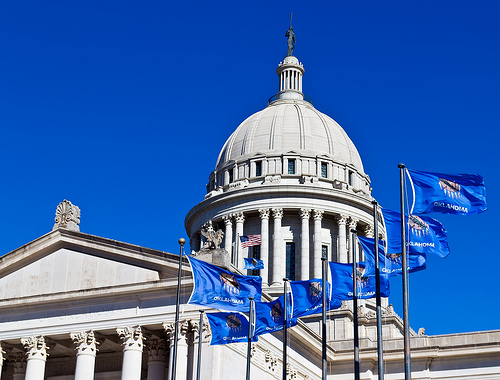
This is what we do in Oklahoma – we break laws (in this case fiscal discipline, common decency, and compassion) for no other reason than political gain, votes, and grandstanding.
What’s ironic is that I turn to our scripture today and see Jesus breaking a law. But every time Jesus breaks commandments, he does it for more than just show – but for a good reason. He reinterprets the law. Today his disciples break the Sabbath, and Jesus runs to their defense. He uses it, not to justify their behavior, but to declare that scripture is not as black and white as the Oklahoma legislators (oops, I mean the Pharisees) would like. He also goes on to cast the Law in a different light, declaring that “…the Son of man is lord of the Sabbath.”
Then he himself breaks the Sabbath by curing a man with a withered hand. His bold initiatives get him in trouble and help cast the trajectory of the Gospels. Political grandstanding? The argument could be made. Now the Pharisees have some ammunition and “went out and conspired against him, how to destroy him.”
Jesus helps plumb the depths of the law – its intricacies and its purpose. Oh how I wish he would show up and explain the issues of our day to our beloved legislators.
It is obvious Jesus understands the trajectory of the Wisdom literature and is a well-read rabbi. We talked about Wisdom literature earlier in the week, remember? Jesus is making more than just a point about compassion or hunger on the Sabbath, but a bold statement about interpretation of Scripture. He is declaring that righteousness and integrity are essential components. Wisdom is subjective and lives in reality. Situations must be interpreted in the light of scripture. This is why we have preaching in today’s churches! We interpret the law for our day. It is not that scripture changes, but as the situation does, and we must come back to scripture time and time again, seeking God’s truth in each situation.
This is not the law falling apart as some “all-or-nothing, black and white” thinkers might declare this blog to be. He is saying compassion is more important. He is saying with the Sabbath argument, “Hey what about the hunger! Isn’t that a sin too!?” He argues that by focusing only on the result (i.e. breaking a law) but ignoring why we are breaking the law (i.e. hunger) we have failed to understand the law altogether. He went all the way to the cross for his interpretation of Scripture.
I am thankful for Jesus who reveals to us a Compassionate God who wants us, above all else, to be fed and whole in his sight, and for all to have the adequate resources they need for life to flourish.
-Matt
The Invitation

Prov. 7:1-27; 1 John 5:13-21; Matt. 11:25-30
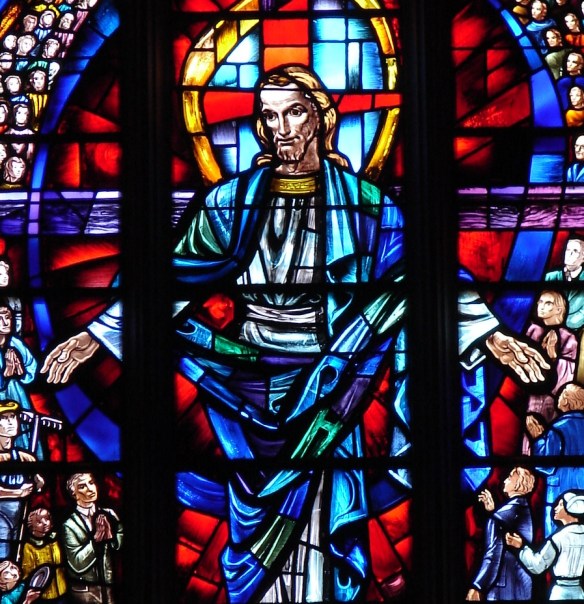
If you have been on one of my Cathedral Window tours at First Pres. you know that one of the scriptures you will hear me quote is “Come to me, all you that are weary and are carrying heavy burdens, and I will give you rest.” (pictured above)
Wrapped up in the imagery of the front window in the Sanctuary, there are many symbols which tie the front window to Jesus’ Invitation to “Come to me,” so much so that it has been called the Invitation Window.
The last couple days in these Morning Reflections, I have been exploring the use of Wisdom, which continue today in Matthew. The context of his words “Come to me” are said in the midst of Jesus explaining that God’s Word has been hidden from some, and that Wisdom resides with those who dwell in him, who dwells in the Father. He is providing a picture of personified Wisdom. This is a common biblical theme.
And then the powerful image: “Take my yoke upon you, and learn from me; for I am gentle and humble in heart, and you will find rest for your souls. For my yoke is easy, and my burden is light.” This, too, is a common theme found elsewhere in scripture, and often used as a rabbinic metaphor to understand the difficulty in following Torah, but yet the great freedom that comes with it as well.
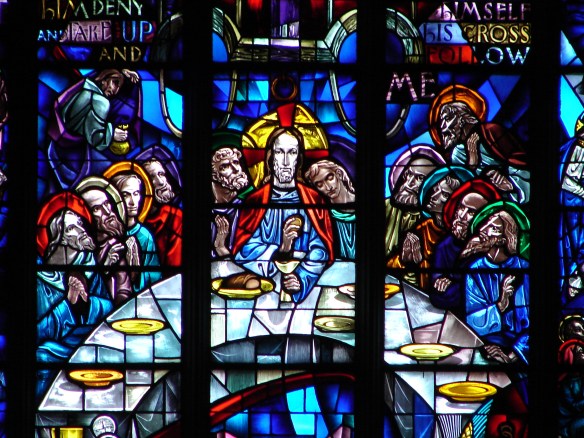
In our Great Invitation Window, at the feet of Jesus, whose arms are wide open welcoming the people to come to him, is the picture of a yoke fit for two oxen. Below it is a manifestation of the yoke that reminds us of a light burden – that of the Lord’s Supper, another piece of the powerful invitation theme.
At the table the mystery is complete, confounding those who do not understand. This is part of the trajectory of Jesus’ teaching on wisdom – that of mystery. He begins today’s passage with “I thank you, Father, Lord of heaven and earth, because you have hidden these things from the wise and the intelligent and have revealed them to infants.” It may seem strange to our Western ears to be giving thanks to God for NOT understanding, but that is precisely what Jesus does.

His ministry is not meant to be fully understood, but to be authentic to the mystery and awesomeness of God. The cross and the table are two major conundrums that may never be fully understood. So it is with God, who is holy, sacred, and whose greatness can never be matched or touched. Jesus gives thanks for this, and declares that in him is rest from the conundrum.
The next Window Tour will be Sunday, May 29th at 12:15 and is called Ordinary Time. It will explore the miracles and parables of Jesus, along with other themes of spiritual growth that we encounter in this long, green liturgical season of summer and early fall. http://www.fpcokc.org/ordinary-time
-Matt
Wisdom

Prov. 4:1-27; 1 John 4:7-21; Matt. 11:7-15
Our reading from Proverbs today is one of the delightful passages on Wisdom, who is here portrayed as Woman Wisdom. Complete with female imagery, Wisdom is something more than something to keep and guard, but something to “hold on to” and “embrace”. Wisdom is both a lover and guardian.
I remember back to one of my seminary classes: Wisdom Literature: Job, Ecclesiastes, and Proverbs. It was a revelation of God’s goodness to be in fresh, new ways. So many want to paint life as black and white, when it is often anything but. Today’s issues of abortion, genetics, war, same-sex marriage, and trans rights are examples that moral and spiritual decisions are not often clear cut, with arguments on both sides, often with Scripture as the basis of each side’s argument. So who is right?
Along comes Wisdom. She promises more than just an embrace of understanding or a new revelation of wisdom. It becomes clear that Wisdom is a path. Proverbs is a good example, where from one chapter to another scripture seems to contradict itself. But that is the whole point: the wise person knows when to use which proverb for which occasion. It is not that truth is fluid. Contexts are fluid, and situations change, and the wise person knows how and when to apply which wisdom teaching. The longer one walks down the path of Wisdom with the Lord, the more clearly one can see which is applicable when.
This art has been long forgotten by our post-Enlightenment mindset, which values truth as if it is a scientific hypothesis meant to be proven.
Wisdom is the missing link.
My prayer is that we can rediscover the Wisdom Literature for what it is: a textbook for how to think and live into the mystery of God – how to seek God’s assistance in the midst of doubt and struggle.
-Matt
Love That is Shared

Prov. 3:11-20; 1 John 3:18-4:6; Matt. 11:1-6
Love binds us together. Paul, the Gospel writers, and others in the New Testament proclaim that central character of the Law in today’s readings: that of love. Jesus summarized the Law with “Love God, and love thy neighbor as thyself.” 1 John picks up on the trajectory of love as it binds us together as believers.
“Little children, let us love, not in word or speech, but in truth and action.” It is easy to say, “I love you,” but much more believable when those words are paired up with a hug or a kiss. So too it is with the community of faithful. It is easy to say, “We love the people of Oklahoma City, or the people in our neighborhood, or the poor at the homeless shelter.” But it is so much more impactful and believable when it is paired with more than just words, but action.
Later 1 John continues: “All who obey his commandments abide in him, and he abides in them. And by this we know that he abides in us, by the Spirit that he has given us.” To abide in love is the heart of the Christian message. It is what Jesus did on this earth. It is what he declares for us to do as well.
That being said, love is not easy. And dare I say that it is easy to love family, friends, and those close to us. That is the easier side of love. The real challenge is loving those people who don’t want to be loved, or who despise you.
The world lives by different standards that often sound akin to “Love your family, and your country, but hate everyone else.” That is not the way of Jesus Christ. Instead we are called to love our enemy. As we abide in Christ, we discover some interesting challenges for us in the world.
From the Beatitudes to Revelation, we see God’s extravagant love, poured out for the whole world, freely offered, and bountifully given. That love is not meant to be squandered, but shared with equal abundance, until the whole world is rejoicing in the magnificent gifts of the One who died for us all.
He not only shows us the way to love, but offers love himself. He is all of these: the Lover, the Beloved, and the Loving.
It is this challenge and this grace into which we live.
-Matt