Take Up Your Mat

e444defbd49f8d8c9afcf0a01bf50c8d_w600

Gen. 39:1-23; 1 Cor. 2:14-3:15; Mark 2:1-12

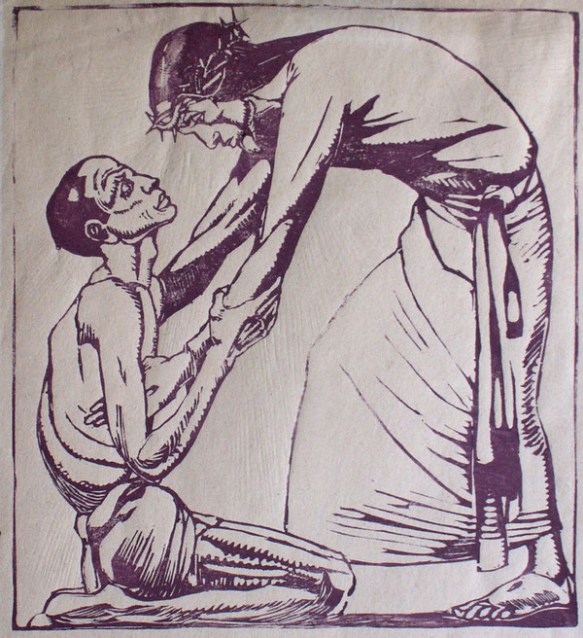
Today Jesus heals a paralytic.

I have the joy and privilege of sharing Bible stories like this to the First Presbyterian School, and a number of years ago I shared this story and it became a story I will never forget.  Many of you have heard me tell this story before, but I simply cannot resist telling it again.

I was in charge of the weekday Chapel Service I have with the school.  This was the lectionary story, so I brought my prop, as I had every time I told this story.  I brought my mat.  I laid it out, and said, “Jesus is going to heal a couple of people today.  Who wants to go first!?”  Of course nearly all the hands shot up. Who wouldn’t want to go!?

As our courageous first volunteer came forward, I explained quietly to Bobby the two cues he needed: one to pretend he couldn’t move, and the other which would set him free.  As this little boy climbed on the mat, he immediately froze, because we had talked about what paralyzed meant.

He was good.  Frozen in time.  Unresponsive.  Stiff as a board.  Way beyond my prompting, he was playing the part!  And he looked up at me with the most pitiful look, like, “Come save me from this prison.”  His eyes bulged, and his pupils dilated.  I retold a part of the story and then, right on cue, miraculously he came to life!

Without prompting, he grabbed the mat and went tearing out the Chapel door!  It was great!  Teachers yelled for him to stop and come back, but in his exuberance he made it out of the chapel and into the hall.  He was healed, and excited, and off to tell others!  It was just a perfect embodiment of that story.

There was a part of me that didn’t want to stop him.  He was on the loose.  Just like God.  Just like the power and authority of Christ.  Spreading.  Moving.  Breathing.  Unbridled.

Behind the exuberance of our preschooler, the story of the paralytic has some deeper meaning. Jesus goes home in Capernaum for a few days.  Word gets out and many want to come see Jesus, some to get healed.  Many gather around him, and there is no room.  So some friends of the paralytic climb on the roof, dig through it, and lower him down in. (There’s nothing like a bunch of strangers digging their way through your roof!)  Jesus gets some flack from the scribes about his saying to the man, “Your sins are forgiven.”  So he goes on, “Which is easier, to say to the paralytic ‘Your sins are forgiven,’ or to say, ‘Stand up and take your mat and walk’?

Jesus heals him.  He stands up, takes his mat, and goes out before all of them.

My favorite part about the Mark story is in its brevity.  He moves the story along, so that we are amazed by the sudden nature of the miracle.  Also, those in attendance are “amazed and glorified God, saying, ‘We have never seen anything like this!’”

The “shock and awe” value of this miracle is not the overwhelming confidence of Jesus or even the healing power itself, but in the nature of the correlation of healing and being forgiven.  As the Spirit of God breaks forth in Mark, first in the Jesus’ baptism, and now in his healing works, we get a sense that God has some surprises in store.  The best is yet to come.

Power and authority collide in a cosmic struggle against evil.   Demons lurk in the shadows.  Here sin lurks.  Each is taken in hand and dealt with by the Son of Man.

I find great comfort in knowing that God’s cosmic struggle led to an overwhelming setting free of the Spirit.  And I am thankful I get to spend my days with those who have caught that Spirit, like that young preschooler.  It is one of amazing power and freedom – even free enough to take us out the door with our mat, and run to tell people how great it is to be alive.

-Matt
Finding the Cure

DSC01425Gen. 37:25-36; 1 Cor. 2:1-13; Mark 1:29-45

The Gospels are filled with stories of Jesus healing lepers, blind men, and even raising from the dead.  Much has been made of these over the years, especially the purpose of the miracles, or even the validity of their claim.  In our post-modern world, it is normal to ask: Did Jesus really heal these people?  Did this really happen?

To me that is the wrong question.  When you look beyond the text and into the historical and literary context of the story, it makes much more sense and holds much more power than simply “is it fact or fiction.”  Stories can hold truth or power without being seen as literal.  So to me it doesn’t not matter whether or not it actually happened.  I am more interested in what the miracle is telling me.

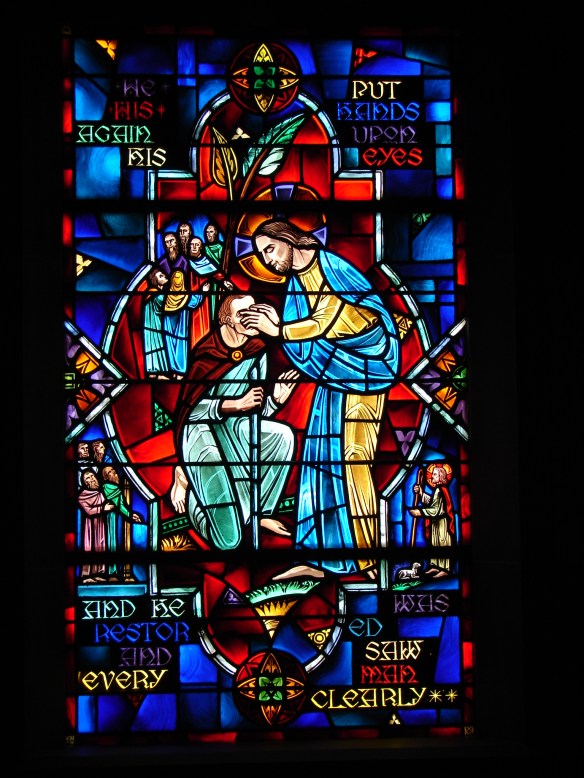
It is clear that Jesus was a rabble rouser. He was one who transcended boundaries. Think about it!  Think about today’s story in Mark where Jesus heals a leper.  This was written in a time when touching a leper was clearly out of line.  Jesus is breaking the law.  More importantly, Jesus doesn’t care.  He is more interested in transcending or even breaking boundaries, prejudices, antiquated religious traditions, and obsolete customs.

He chooses to embrace this afflicted man.  He touches the untouchable.  Time after time Jesus does this.  He welcomes sinners, invites tax collectors to be among his inner circle of disciples, and absolves women who committed adultery.

He is not interested in judging.  He is interested in welcoming, forgiving, and healing tired souls.

Oh how the church of today needs the same healing touch.  Oh how desperately we need to be cured of our prejudices, of our sexism, our ageism, our homophobia, our fear of Muslims or simply our discomfort with the “different”.  We need to be cured of our hatred, propensity to violence, and our temptation to listen to those who shout the loudest and play off our fear of those different than we.

This story is not about Jesus curing someone of leprosy, but of our need to be cured of ourselves.

He is also a model of behavior, and how we need to embrace the untouchables in our society.  It is not enough to welcome them into our churches, but to embrace them as equals.  That is a whole different level of hospitality.  This is why the church grew.  It is how the 21st Century Church will grow. But we need Jesus to touch us again.

What’s the real power in this story?  Jesus doesn’t just heal.  These people become converts.  They see the world in a different way.  When are we going to get around to seeing the Gospel – the good news for us?

We follow a radical.  He welcomes and embraces all.  Sinners, lepers – all.  No exceptions.  He treats everyone he meets with dignity and respect, and calls us as well to break down walls of prejudice, fear, and hate.

He calls us to live beyond our own comfort zone, and practice radical welcome, embracing others as equals.  He calls us beyond ourselves.

-Matt

At the Crossroads

directory-466935_960_720Gen. 37:1-11; 1 Cor. 1:1-19; Mark 1:1-13

Beginnings mark our passages today.  The last major section of Genesis begin.  Joseph and his brothers: today we hear of the 17 year old Joseph, who as a shepherd, has a dramatic dream about him reigning over his brothers.  They are naturally not amused, and plot his demise.

The gospel of Mark begins today.  It’s my favorite gospel, not because of its brevity, but because of its quirky details which paint a stunning and imaginative picture of God’s grace.  Unlike the other gospels, “the good news of Jesus Christ, the Son of God” does not begin with a birth narrative or with the beginning of time, but rather with John the Baptist proclaiming in the wilderness.

Like a good journalist, he paints a picture with quotes, memorable details, and keeps it brief.  There is talk of a baptism of fire.  Only 13 verses in and Jesus is already tempted in the wilderness.  Mark moves it along, which sows the seeds of expectancy and mystery.

Dreams and expectancy fill our passages.  With dreams come decisions.  The characters in our stories all stand at the beginning of their journeys.  And with beginnings come crossroads – for more is around the corner.

Such it is with each of our Lenten journeys too.  We know that in these penitential days the centering aspect of these 40 days will take us to the foot of the cross, but in the meantime there are choices to be made along the journey.  Crossroads are like that.  Life is full of choices.  Choose carefully.  Choose love. Choose hope.

-Matt

Complexity, Chaos, and the Essence of Life

complex-664440_960_720Ezek. 18:1-4,25-32; Phil. 4:1-9; John 17:9-19

I am not going to lie to you, the Ezekiel passage for today is downright weird.  Did you know that in some Jewish traditions, it is forbidden for those under 30 to read this book?  You will see why today.

Ezekiel is complex, combines elements of priest and prophet, and at times it is difficult to see where he is going.  It requires knowing some context, some history, and downright feeling lucky at times.  But as they used to say at seminary, “If you are going to read the difficult passage, you MUST preach on it.  Don’t act as if you didn’t just read the slaughter of innocents or the near-sacrifice of Isaac.”  So on to the weird!

As we pick up our passage today, Ezekiel has recounted themes of the attack and siege of Jerusalem.  “How long will we be punished?” the people are probably asking.  In OT lingo, covenants work both ways – the promise, but also the curse.  Ezekiel is addressing the idea of covenantal punishment, with generation after generation paying retribution for sins of the past.

We understand things today in a different light.  Part of that is because of what Ezekiel says today!  It is a new way breaking forth.  Ezekiel declares that individual retribution is now in order – that “only the person who sins…shall die.”

Despite the grim omens in today’s passage, to the people of this time, this individual retribution was quite a sigh of relief.  This was good news!  The days of… “me paying for the sins of my parents and grandparents” are over.

Think about how this idea morphed even further with Jesus’ death.  That whole construct of “the one who sins shall die” gets thrown out, for he was without sin.  God has reordered our understanding, and now we see sin and death just for what it is: an awful reality of our broken world, and we refuse to assign parts to God in it at all, as it should be. What we discover is a God who never gives up on us.

John’s passage also begs for some context too.  “I am asking on their behalf; I am not asking on behalf of the world, but on behalf of those whom you gave me, because they are yours.”  I got so confused – I had to read the entire passage.  Come to find out this is Jesus praying to the Father.

This is Jesus’ final prayer before the crucifixion – a final intercession for humanity.  I find the themes he chooses to be fascinating: “I do not belong to the world;”  “Sanctify them in the truth; your word is the truth;”  And finally, “I ask…that they may all be one.”

This last plea I find interesting, especially in these days of division in the church.  Jesus’ words come LOUD AND CLEAR to a church in perpetual state of fragmentation, denominationalism, and rampant individualism.  And I am left wondering why we don’t read this passage more often.  Perhaps it because deep down inside, we don’t want to hear this message.  We like our individualism.

Of course the divisions we have today are hiccups compared to the cataclysmic events of the early church.  But this doesn’t mean we shouldn’t work and pray for oneness.

Some of the last words Jesus spoke on this planet in his earthly form: “But now I am coming to you, and I speak these things in the world so that they may have my joy made complete in themselves.”

I hope as we work for oneness, peace, and reconciliation in this time of Lenten renewal that we can also find this joy – a joy that comes from being brought into one with Christ, just as he was one with the Father.  Out of chaos – Light!

-Matt


Habakkuk to the Rescue: My Prayer & Praise

doctor-1015624_960_720Hab. 3:1-10(11-15)16-18; Phil. 3:12-21; John 17:1-8

The Prayer of Habakkuk comes to us today.  This book has always been a mystery to me.  We don’t know much about who this prophet is, leading to many diverse understandings of who he is and what religious traditions he comes from.

Habakkuk is somewhat unusual as The Prophets go, because it contains no prophecy directed to Israel.  Instead it is a dialogue between the prophet and God.  We also discover that Habakkuk is a Presbyterian!  “O Lord, I have heard of your renown, and I stand in awe, O Lord of your work.”  Here is someone who holds the sovereignty of God above all else.

I must admit, I am not always as confident and trusting.  He trusts God to a T, and believes that God will take care of things in his own time.

“God stopped and shook the earth; he looked and made the nations tremble.”  And then later in verse 16: “I hear, and I tremble within; my lips quiver at the sound…. I wait quietly for the day of calamity.”

I wish I could be so confident.  I see areas of our church and our nation that are dysfunctional, such as the dreadful healthcare system in this country, and my patience grows thin.  And while the ACA has helped millions more folk get basic healthcare, I still feel humiliated as a USAmerican when I see the statistics of healthcare outcomes and how we are last or next to last in 20+ categories when compared to other industrialized nations.  I am further humiliated by our philosophical stance on healthcare – treated as a commodity.  We live in the one country (of those top 30) that does not view healthcare as a basic human good necessary for thriving, instead basically viewing it as a commodity.  Forget about whether it is a right or not.  It is a basic human need.  Period.

I want things fixed, and I want them fixed yesterday!

Habakkuk does not take a back seat to his concerns, but offers them to God first and foremost.  I wish I could give things over to God so easily.  Over and over again, this is his mantra: God, the Lord, is my strength.

And yet, my anger wells up at the system.  We pay more per capita than any other industrialized nation, and yet we have these miserable outcomes?  Some Americans pride themselves as having the “best healthcare,” but that is simply not true anymore.  John’s Hopkin’s tracks major healthcare outcomes of the top 30 countries (through the Commonwealth Fund), and we are at the bottom or near the bottom in nearly every category they have.  Of course these outcomes are only one level of my anger.  Most of it comes from the fact that we allow PROFITEERING on a basic human need.  How awful.

Sometimes it is difficult for me to believe that God really has the kind of power that Habakkuk describes so vividly.  Is this just his poetic exaggeration?  The color of a hymn gone wild?  Do you believe in a God that can shake the nations and the people?

I want to believe.  I want to believe that our world can find peace, and that nations will turn their attention to the poor, the afflicted, the oppressed, the sick – struck in awe by the God who shakes them into understanding.  I dream of a day when all the people will be fed, when all have a roof over their head, when all will have clean water and clean air and access to affordable healthcare, and they can all read.

Despite the world’s problems, I am ready to join with Habakkuk in praise, because I have experienced the joyous gift of Christ among us.  I have seen the joy of Christ break through on this world.  And so I press on, praying I can be part of the miraculous transformation that is needed ahead.

-Matt

Outward Rites and Inward Reality

10346514_10153030669288904_5520552109318526548_n

Picture by Mickie Smith, Ash Wed service 2014

Amos 5:6-15; Heb. 12:1-14; Luke 18:9-14

Ash Wednesday certainly snuck up on us, didn’t it!  With Easter coming so early this year, that also means counting back 40+ days, Lent begins quite early too.  I was reminded of the famous words that echo on Bourbon Street at midnight – “CLEAR THE STREETS….MARDI GRAS IS OVER.”  For Bourbon Street, used to partying all night, a midnight curfew is certainly a shock, especially to out-of-towners who just got to that party a few hours ago.  But this is what Ash Wednesday is – a sudden shift.

Today, the sudden shift to a more spiritual, disciplined life has begun.

Ash Wednesday: our readings not surprisingly take a sudden turn and we find ourselves in Jonah, one of my favorite books.  Jonah is almost comical when you understand how he grudgingly goes to Nineveh, and with only a few half-hearted words becomes an agent of transformation for that town.  It is a powerful story.  The king and the town follow this up with action, including sitting in ashes.  Outward rites reflect the inward reality.

I will talk more about ashes and their connection to Lent tonight at our service.  5:30 dinner, 6:30 Worship with the Imposition of Ashes. I hope to see you all there!

Luke’s passage is of Jesus telling the story of the Pharisee and tax collector, one who stands where all can see him saying, “God, thank you that I am not like other people….”  The tax collector was standing far off, not even looking up to heaven, beating his breast and saying, “Have mercy on me a sinner.”

Repentance and humility are key themes for Lent.  It is clear that God wants us to take seriously our actions and do the best we can.  Yes, grace abounds, but that does not exempt us from serious introspection and a genuine turnaround in the areas of our lives that need it.  Outward rites to assist the inward desires.

This is the essence of Ash Wednesday.  And so as we take this day to seriously consider any Lenten discipline that may aid us in repentance and humility, self-sacrifice and introspection, may we look to the people of Nineveh or to the tax collector, both who come to understand inwardly and outwardly that change for them is important.

-Matt

The Politics of the Bible

traffic-sign-799166_960_720
Prov. 30:1-4,24-33; Phil. 3:1-11; John 18:28-38

The Politics of the Bible

The election cycle is in full swing, and this year’s presidential race is certainly entertaining.  That is a sad commentary, though, isn’t it?  To describe our own political system as “entertaining” seems to be a humiliating admission on our sad reality.  It all seems too weird for words sometimes.  It is more like a political clown car than serious candidates for president.

What is even more fascinating is how some “news” channels get stuck covering the charades like they are actual news.  Gone are the days when we only check in with the political sphere when something actually happens, like an actual election or the passage of a bill.  Instead of news these days, we get soap opera, stupidity, personality-driven sap and entertainment.  Where’s the news?

A trial of someone’s life is at stake in the gospel of John, however.  It is real news.  Life or death.  Jesus stands before Pilate, and unlike the portrayal of Pilate in the Synoptic gospels, here Pilate takes on the aura of a philosopher.  He gracefully receives Jesus, giving him every courtesy.  Instead his focus seems to be on ridiculing the Jewish authority and harassing the Jews into accepting Jesus as the true king.

Pilate asks one of the most deep questions in all of scripture.  After an exchange in which Jesus does not claim the title of a king, but instead claims he testifies to the truth, Pilate asks, “What is truth?”

Immediately after this question, Pilate goes to the temple authorities and says, “I find no case against him.  But you have a custom that I release someone for you at the Passover.  Do you want me to release for you the King of the Jews?”  They shouted in reply, “Not this man, but Barabbas!”  Barabbas was a bandit.

In John’s version, Pilate seems impressed with Jesus.  Perhaps he thinks that the Jews should anoint him king, but knowing full well they won’t, he washes his hands of it, forcing the Jews into an untenable situation – choosing a guilty man over an innocent one.

I wonder what the political pundits and talking heads would have said about the outcome of Jesus’ trial.  I wonder who would take the side of Pilate, who although weak was politically savvy.  Would anyone take Jesus’ side?  He was arguably not politically savvy at all, but even Pilate knew that Jesus was the only one who was right.

I suppose part of the story is that we simply do not know all that went on.  One important ingredient that we do know is that Jesus’ own people rejected him.  It happened to the prophets, and to Noah, and to many others.  It continues with the theme of the World Upside Down that we see so prominently in the Bible.

Well, Lent is almost upon us.  Today is Fat Tuesday – Mardi Gras.  We take a sudden shift tomorrow, spending a season with the question, “What is truth?” and trying to simplify our lives and through prayer, fasting, and almsgiving – come to understand the mystery of Jesus’ final week.

May the kindergarten nature of our political world take a back seat to the reality of our lives, and may the reality of Lent dwell upon us.

My prayer for you is that your Lent grounds you more deeply in your faith, grounds you in the importance in life, and that the distractions of this world and the roller coaster of life not take you away from the awesome, transformative love that is offered through Christ Jesus.

-Matt