Unknown's avatar

About Matt Meinke

Presbyterian minister | Presbytery Leader @MaumeeVP | MSN Candidate & Aspiring RN | Adjunct professor | Leadership consultant | Organizational Development | OU, Thunder, Packer fan

Chaos or True Rest

spiral-1167623_960_720

Ecclus. 43:23-33; Rev. 16:1-11; Luke 13:10-17

Many of us are simply praying for a fair election and the rule of law after this is all over.   The threat of chaos is also witnessed by many of the bystanders in our Luke reading today.  Will there be chaos? Or will this be a true rest for our souls?

Jesus breaks the Fourth Commandment today in dramatic fashion.  He heals a crippled woman on the Sabbath, a clear violation of scripture.  And what does he do?  He goes on to rebuke those who try to rebuke him.  “Does not each of you on the Sabbath untie his ox or his donkey from the manger, and lead it away to give it water?  And ought not this woman… be set free from this bondage on the Sabbath day?”

His opponents were put to shame and the crowd rejoiced at all the wonderful things that he was doing.

How on earth can this be right?  How is it that we follow a savior who is a law-breaker.  Precisely because of the reason Jesus gave!  This is a world intended for us to enjoy and celebrate, and this woman could not do that in her condition.  Is it too much for the Son of God, who is Lord of the Sabbath, to do this simple act of healing.

What is also interesting is that in this act, Jesus does not give us the green light to break the Sabbath as well.  He makes it clear that it is he who is doing this.  Elsewhere in Scripture he declares the Sabbath is made for people, not people for the Sabbath.  But that still does not mean he is throwing it out.

And yet, that is exactly what our culture has decided to do.  Most of us work seven days a week (at least as the Old Testament defines “work”).  Ministers almost always work on Saturday and Sunday.    I know very few of us who refrain from all housework, all work, and all shopping on the Sabbath.  Our day of rest has conveniently become a “day of catch-up”.  That’s what Friday day is in Jewish culture.

I believe Jesus is calling this crippled woman into a deeper call to the Sabbath.  She was preoccupied with her condition.  She was unable to rest on the Sabbath, or ever.  Jesus was providing an avenue for her to rest, and rest completely.

And so Jesus calls us.  Now, let’s go, and let us take the Sabbath seriously.  And in doing so, may we encounter the gracious acts of God in our lives, and be bathed in the richness of God’s love for us, and how he intends for us to celebrate and enjoy being in his presence.  May we come to know that God set us free from the bondage and judgment of the law, and requires us to take the love we share with God and others seriously.

-Matt

Gossip? Wisdom? Or Just Loose Tongues?

smartphone-569076_960_720

Ecclus. 19:4-17; Rev. 11:1-14; Luke 11:14-26

Stories have power.  Stories have the power to transform.  This can be both good and bad.  Sometimes there comes remarkable transformation – other times a story can taint a relationship by gossip or unnecessary banter.

This is the topic of today’s wisdom from Ecclesiasticus, listed as Sirach in many of your Bibles.  It is coming from the wisdom tradition, this from the Wisdom of Jesus Son of Sirach.

It warns against the dangers of what it calls “loose talk”.  “One who trusts others too quickly has a shallow mind, and one who sins does wrong to oneself….Never repeat a conversation, and you will lose nothing at all.  With a friend or foe do not report it, and unless it would be a sin for you, do not reveal it.”

This is a much different way than many of us live.  We live in an age of constant story.  Things are told instantly on Facebook, Snapchat, Instagram, and Twitter, whether they are helpful or not for us to know.  We are bombarded with details of friend’s lives.  Some might see this as an exciting new “information highway”, but to Sirach it might be considered the “loose tongue highway.”

Don’t get me wrong, one of the keys to health for a congregation, or a relationship, or a successful business, is “open information”.  It builds trust in a system and can transform organizations and relationships for the better.  But there is a line.  Information is only useful so far as it is useful to this end.

We know this.  We know the line.  But in what avenues of our lives do we forget?  This is where the Wisdom literature is so helpful.  It is a reminder for us to be cognizant of that line.  It helps us to walk into each situation and have those internal tapes processing the situation, asking, “Is this one of those situations we talked about this morning?  How far should I take this story?  When does it become gossip?”

Today wisdom comes to us:  How can I be better in my relationships?  Click on the link above if you do not have the book of Sirach in your Bible, read the entire text and ask yourself, “What kind of loose talk could I clean up in my own life this day?”

-Matt

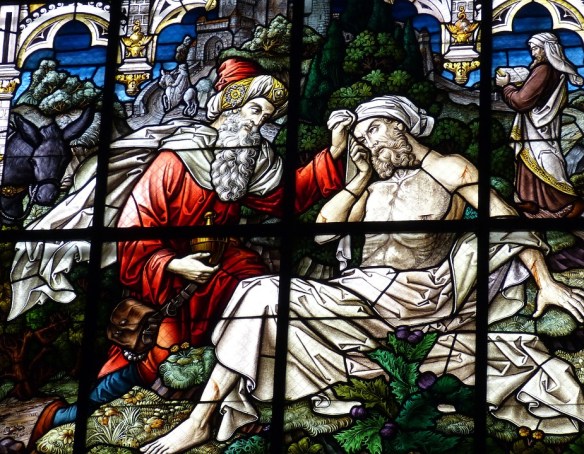
The Good Samaritan

window-700770_960_720

Ecclus. 10:1-18; Rev. 9:1-12; Luke 10:25-37

Did you know that Jesus’ parables are not unique?  Jesus was just telling the same well-known stories that other rabbis at the time were telling at the time.  What characterized his parables was that he was changing the ending – ending them funny.  I had a Jewish professor in Israel who said that Jesus wasn’t necessarily ending the stories “wrong”, but more accurately that people of the time perceived that all of Jesus’ stories ended “wrong”.  He argued that the reason we were still talking about his parables was this precise point.  Jesus kept mixing up the well-known, expected, “correct” endings, and in doing so was reinterpreting how the law was supposed to be used.  He was, according to my Jewish professor, one of the great rabbis of the time, seen in his stories alone!

The parable of the Good Samaritan is an excellent example of this.  The man at the side of the road, who had been stripped and beaten…he is passed by a priest, and then a Levite.  Each comes to him and passes by on the other side of the road.  Then a Samaritan comes by, and moved with pity, bandages his wounds and cares for him.

So who did right?  Well naturally the first two!!!!  By passing by on the other side, they were remaining ritually pure for Temple worship.  Both were heading to Jerusalem, not to pray, but to lead in worship.  So the people in that day would have had this thought in their mind: “The greatest good for the greatest number of people.”

Jesus shocks the crowd when he changes the typical ending around.  He states that the third person did right.  The Samaritan.  Perhaps there were people in the crowd scratching their heads.  “Wait a minute,” they might have been thinking, “we’ve heard this story before and that’s not how it ends!”  Or, “This poor stupid Samaritan aces himself out of worship by doing this act.  He becomes ritually unclean and has to remain outside of the community for 30 days for this daring feat of helping one person.  What an idiot!”

Jesus says “No, think again!”

When the lawyer answers Jesus’ question of “Who did right?” by saying “The one who showed mercy,” Jesus says, “Go and do likewise.”

Those of us who know the Jesus’ story, know that it is not just his parables that “end wrong.”  Our entire story has a wacky ending.  Our King doesn’t ride triumphantly into Jerusalem and lead an army to destroy the Romans, as everyone hoped the Messiah would.  Instead, he rides into Jerusalem, gets himself arrested, gets crucified, and dies on a cross.

Oh wait, that is not how our story ends.  Jesus shocks the crowd again.  Instead he shows mercy to the crowd, and dies on their behalf, conquers sin and death, and on the third day rises again.

I am starting to like these wacky endings!

-Matt

If you are interested in hearing more about the modern day Samaritans and Israel today, check out my final class on Jesus and the Land this Sunday: http://www.fpcokc.org/israel-class

Yeast-like Discipleship

peacock-414391_960_720

Jonah 1:17-2:10; Acts 27:9-26; Luke 9:1-17

Our gospel reading for today is a pivotal one in the trajectory of the ministry of Jesus.  He calls the twelve together and explains to them that they now have authority over all the demons and to cure diseases.  He sends them out to proclaim the kingdom of God and to heal.  They are to take nothing on their journey.  No staff.  No bag.  No bread.  No money.

Interestingly enough, the next vignette is of the feeding of the five thousand.  It is as if to say, “God will provide.”  It is also reminding us that, like yeast, the kingdom of heaven is growing and spreading – wildly, in all directions.

Sometimes I wonder what that would be like – to do ministry with no preparation for the journey.  Just go wander out and start.  Take no food.  Take no money.  Just trust in God to provide.

It is almost unfathomable for us.  Of course, we aren’t the twelve.  I don’t see us “casting demons out” on a daily basis at First Pres.  At least we wouldn’t put it that way anymore.  We have different ways of articulating ministry these days, don’t we?

But I wonder what we can learn from this yeast-like approach to ministry.  What does it mean to trust in God as we proclaim the kingdom of God?  How does the feeding of the five thousand take form in our time and situation?

“Give us today our daily bread.”  It isn’t, “Give us today a silo of wheat so we can last through the winter” but “daily bread”.

I know personally I carry these same burdens in life – an obsession with material possession, like so many USAmericans.  A good example of this?  I am a home owner.  I have responsibilities in my job, and at home.  And so the convenient excuses begin: “I can’t just up and go, Jesus.  I have too many responsibilities!”

Or can I?  In this postmodern and technological culture, the questions still come: How are we called to move beyond ourselves?  Now that the church has already spread to the corners of the globe our call may look a bit different – but in so many ways it is still the same.  How are we spreading the good news?  What is the most effective way to do that for each of us?

-Matt

The Flip Side of Following God

mystery-1713299_960_720

Jonah 1:1-17a; Acts 26:24-27:8; Luke 8:40-56

Today’s Old Testament passage is the beginning of Jonah.  This strange story has a central character that is almost like a caricature of a biblical prophet, one who is a man of faith, but, like Job, struggles desperately to make sense of God’s actions.  I am not sure what the writer had in mind when he wrote this, but I am always left seeing part of my life intersect with Jonah’s.

It was just recently the Theology on Tap group was talking with Pastor John about vocation and “calls.” What God is calling each of us to.  Like many of us, Jonah resists his initial call from God.  “But Jonah set out to flee to Tarshish from the presence of the Lord.  He went down to Joppa and found a ship going to Tarshish; so he paid his fare and went on board….”

Once in the midst of the journey, a mighty storm came upon them, so bad it was threatening to break them up.  The sailors decide to cast lots to figure out who is responsible for this mess.  The problem is not that Jonah worships his Hebrew God, but that he is fleeing from his God.  “What is this you have done!” they reply.

God had an interesting way of hunting Jonah down.  What is remarkable is that in the midst of this conflict, Jonah makes some converts.  He is the least bit interested in spreading his religion.  He is running from it!  And yet, when the sailors get wind of his “turn”, THEY pray to the Lord, asking for mercy.  And only on Jonah’s suggestion do they throw him overboard.

After Jonah is off the boat, they continue praying and making sacrifices to the Lord, and making vows.

Jonah is one of those prophets who, time and time again, does little or nothing for God’s sake, and yet he has remarkable results.  It is strange evangelism to say the least.

If that is the case, this is a Presbyterian story!  Everything seems preordained here – and Jonah cannot derail it.  God is in charge.  The sovereign One is directing and maneuvering, despite Jonah’s lackluster responses.  As the sailors come to believe, and as we will find others later in the book come to belief, it is not human action which causes it, but God’s action.

For me, I love the story of Jonah.  It is a reminder for me that if Jonah can follow God, so can I.  The storms of this life ultimately cannot get me.  And more than that, I don’t need to be perfect in this life; I just need to give it my best.  As a struggling perfectionist, this is the best news I can get today!

-Matt

Money is Not the True Power

dollar-941246_960_720

Micah 3:1-8; Acts 24:1-23; Luke 7:36-50

The stories of Jesus’ grace and compassion are growing in Luke.  This is one of the reasons I love Luke.  Today is the dramatic story of the sinful woman who comes to anoint Jesus’ feet with expensive ointment and is forgiven of her sin.

You know the story: Jesus goes to eat with a Pharisee; word having spread, this woman brings her alabaster jar with expensive ointment and falls down to wash Jesus’ feet.  She does this washing with her hair.  The Pharisee, knowing his Scripture, knows that this is completely out of line, and that even if Jesus is a mere prophet, he has been made unclean by her touching.

Jesus does what he normally does – he tells a story.  “A certain creditor had two debtors; one owed 500 denarii, and the other 50.  When they could not pay, he canceled the debts for both of them.  Now which of them will love him more?”  The Pharisee answers rightly, with the one with the greater debt.

Then Jesus does something extraordinary.  He declares her sins forgiven.  “But those who were at the table with him began to say among themselves, ‘Who is this who even forgives sins?’  And he said to the woman, ‘Your faith has saved you; go in peace.’”

With words like “creditor” and “debt” it is easy to understand why this reading jumped out for me today.  We are a country obsessed with money.  Financial planning is big in this country and always come into play, because people love their money so much in this country they spend money they don’t have.

We offer Financial Peace University at the church and I know that despite some positive economic days recently, I know that people are still hurting.   I know that many people have “negative wealth” and debt rages on in USAmerica. In the midst of all this speaks Jesus, who declares more than the power to fix debt – but the power to forgive sins.

This passage is a grand reminder to us that our God stands over the creation – over our tattered healthcare system and our empty pocketbooks.  Our God is more focused on this woman with an alabaster jar, whose name we do not even know.

But I guarantee, our God knows her name.  And God knows each of ours.  And God cares for each of us deeply.  We too can stand strong, believing the words of Jesus, “Your faith has saved you; go in peace.”

Do not fear, for God has provided a host of marvelous things, and will continue to provide for us.  What we come to understand in Jesus’ ministry is that fear and worry are not central components, but togetherness and hope in a God who will see us through.

-Matt

Blessing the Future

JamiePup2.jpg

Micah 2:1-13; Acts 23:23-35; Luke 7:18-35

As I picked up our gospel reading today I thought back to the Blessing of Animals on Sunday.  In Luke, we see the birth of evangelistic spirit amidst this small band of Jesus’ followers.

The Blessing of Animals, and especially the new Blessing of Stuffed Animals that morning in worship, was a great opportunity to “be the church” beyond our walls.  The weather was gorgeous; the animals all seemed to have a good time; fun was had by all.  But with stuffed animals, there was a whole new excitement amidst our youngest of worshippers.

The best part was that morning, when I got to visit with two young boys, one a member who brought his neighborhood friend.  This friend had never set foot at First Pres.  Neither of them were particularly into stuffed animals, but it became apparent that neither of them had been so excited about church in a while – gleefully telling me about their stuffed animals and how excited they were to come to church.  Mom nodded.

This was the joy of the day!  By the end, both felt at home.

In today’s passage in Luke, some messengers from John the Baptist come to Jesus to see if he is the Messiah, and ask him point blank.  His response is strange and doesn’t seem to answer the question, “Go and tell John what you have seen and heard.”

This is evangelism!  Jesus is not running around saying, “I am the Messiah.  Follow me!”  He is not saying, “Did you accept me into your heart?”  He is saying simply, “Tell others what you have seen – whatever that may be.”  In this case Jesus had been giving the blind their sight, the lame to walk, the deaf their hearing.

It is easy as a minister to get disappointed.  After the afternoon Blessing of Animals, which had good attendance mind you, my general reaction: “Great!  Glad you came.  Tell your friends all about us!” all the while thinking, “Geesh, we could have had TWICE as many people from the neighborhood and I still wouldn’t have been happy.  I was hoping this would be more outreach to people I didn’t know!”

But then I got to thinking about that morning and those two young boys.  My heart restored to gleeful status.  One has to start somewhere.  That young neighborhood visitor felt loved, and included, even sharing his thoughts through a big scary microphone to a church full of people.  Not easy leading in worship!  And he was unphased – a part of the tapestry of God’s grace that day.

So I declare our Blessing of Animals a HUGE success.  Wholeheartedly!  It is a wonderful ministry of outreach in so many ways, and I got to see a cross-section of the congregation I hadn’t seen in a while.  Jaime Slade did an amazing job putting it together, and I know that God’s spirit was there in our midst – working – maneuvering – planting seeds of grace.

And that is it, isn’t it?  We are not called to save the world.  We are called to “Go tell others about what is happening…for you…for me.”  We spread the word as those early disciples did.  We do so in sometimes unexpected and unorthodox ways, inviting, nurturing, blessing, welcoming the fullness of people into our midst.

I know we weren’t doing miracles like giving the blind their sight back.  But something happened.  And as we ate together in the courtyard with some much-needed snacks for people and snacks for dogs, I saw something extraordinary – it wasn’t just a joy-filled crowd – it was a crowd that had already been touched by Jesus – healed and blessed and filled with hope.

-Matt