Mardi Gras

photo-1511966810412-da306869684e

Prov. 30:1-4,24-33Phil. 3:1-11John 18:28-38

Get your partying in now.  Today is Mardi Gras!

Today is also a good time to reflect on our Proverbs passage. Proverbs sits as a part of the Wisdom Literature, which I have referenced in the last couple sermons, but not a usual topic for Presbyterians.

The Wisdom Literature of Israel is complex and rich.  Its main goal, in my estimation, is to give a cross-section of sayings for the plethora of human experiences.  If you have been reading Proverbs slowly and deliberately, you may have realized that some contradict one other.  The wise person knows which to apply at each certain time.  Thus is the dilemma for the reader of Wisdom Literature.  You gotta know it all for it to be any use!

Today we near the end of Proverbs.  It provides comforting words to those of us who feel we have just begun our journey into wisdom.

Today’s reading also helps frame Mardi Gras—that despite our foolishness and foibles, we are merely God’s creatures.  And it frames our celebration as part of the human journey.  We may not know all the secrets of life, but we are merely human, and celebrating our journey with God along the way to perfection.

“I have not learned wisdom, nor have I knowledge of the holy ones.”  The writer is saying, “That’s OK… it’s OK to fall short and not have grasped the breadth of all of these sayings.”

Verse 4:   “Who has ascended to heaven and come down?  Who has gathered the wind in the hollow of the hand…?  What is the person’s name?  And what is the name of the person’s child?  Surely you know!”

This may perhaps be in the form of a riddle, a riddle that perhaps no one can answer.  At least I can feel smart knowing that no one knows it!  This verse brings me comfort!  Others have argued that the answer to this riddle is “God.”

I personally believe this may also be a way to put the know-it-alls in their place.  Provide me with his name, and his children’s name, knowing full well there is no such person.  Of course then God comes to earth, his child who is literally the know-it-all Messiah.  Perhaps there is something along these lines too.

It is important to treat the Israel Wisdom Literature in the context in which they were written.  This passage is not meant to befuddle, but to put us in our place, coming to know the source of all wisdom, the Lord, our God.

So today let us celebrate our journey with God, and rest in the one who holds all the secrets to life.

-Matt

Humble Pie

sculpture-2760974_960_720

Prov. 27:1-6,10-12Phil. 2:1-13John 18:15-18,25-27

Humility is a tough lesson to learn.  It is perhaps one of the toughest to learn in a culture that values domination and achievement.

Humility is the order of the day in all three of our readings today.  In Proverbs: “A stone is heavy, and sand is weighty, but a fool’s provocation is heavier than both.”    In John, just as Jesus stands before the High Priest Caiaphas in his humble state, Peter denies Jesus three times.  Philippians also dwells on the topic.

Philippians second chapter is one of ultimate humility.  It is the famous Christ hymn, riddled with pre-Pauline thought, that is most likely borrowed by Paul for his later arguments about obedience into Christ Jesus.  Material from the earliest Christian tradition, well before the gospels were written and even before Paul’s letters, often focus on Jesus’ obedience and character of humility, the same characteristics of slaves.

This follows right to the cross, where resurrection is thought of as an obedience to the Master’s will, rather than a destruction of evil forces.  In this sense, it is God’s power that is important.  “[he] emptied himself, taking the form of a slave, being born in human likeness.  And being found in human form he humbled himself and became obedient to the point of death – even death on a cross.”

Paul goes on to talk about Christ being exalted, which is where the rubber hits the road – for Paul picks up on this ancient hymn with his own thoughts – that “it is God who is at work in you, enabling you both to will and to work for his good pleasure.”

Not only do we experience the benefits of Christ’s humility, nor do we simply ride the wave of it, but we are able to join in his self-emptying and his humility, becoming servants ourselves.  This is a good thing to Paul!  In it, the whole body is lifted up.

For Paul the world is turned upside down by Christ.  To obey is a joy.  To serve is not a burden, but the ultimate gift.  And this is the irony of the Christian life.  Ultimately love of neighbor doesn’t make sense to those who do not understand the cross.  It is more understandable to stomp all over people to get ahead – but we Christians revel at being at the back of the line, emptying ourselves so that others may be glorified.

-Matt

Jacob’s Ladder

photo-1473447101976-72b3e75fde3e

Gen. 27:46-28:4,10-22Rom. 13:1-14John 8:33-47

Jacob senses he is in a bind today.  So do Isaac and Rebekah.  Plans are made for Jacob to escape Esau’s fury.  He is sent outside the land of Canaan to find a wife – to the house of Laban, Rebekah’s sister.

Isaac once again blesses Jacob, which Esau comes to know.  The wedge between these two brothers grows deeper and deeper.  Esau’s anger becomes like poison.

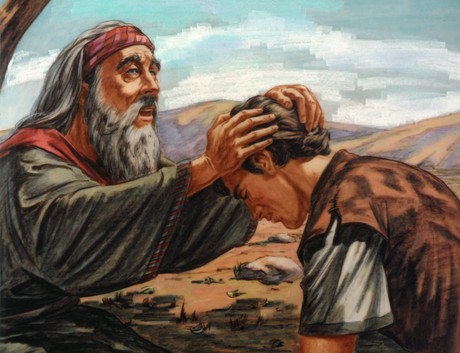
Then God comes to Jacob in a dream – his first vision from God – of a ladder set up on the earth, reaching toward heaven, with the angels ascending and descending.  The Lord stood by and declares a similar promise to Jacob that God gave to his father and grandfather: land and progeny.

The whole sequence of events, in fact the whole cycle of Jacob is one of progeny, of blessing through generativity.  God chooses life, and chooses to move in mysterious ways, bending or breaking human rules.  We see God’s wisdom in hindsight. Who would have wanted angry Esau to rule the people?  God saw that coming.

In today’s world, stories like this seem antiquated and odd.  But if one is going to talk about a God of life and a God of blessing, what better way to see that than spilling forth from generation to generation.  With twists and turns, somehow God’s grace marches on, eventually getting all the way to us.

May God’s grace march on, through the struggles and travails of life, and show us the way – a way of blessing and abundance even though we may not see it yet.


-Matt

Jacob and Esau

460x353

Gen. 27:30-45; Rom. 12:9-21John 8:21-32

Jacob steals the birthright from Esau today.  Verse 30: “As soon as Isaac had finished blessing Jacob… his brother Esau came in from his hunting.”

Jacob prepares a savory meal, so that Isaac may bless him.  In his confusion, Isaac asks, “Who are you?”  Ultimately, the jig is up!  Isaac and Esau realize they have been deceived by Jacob.

This story is trickery, and what is frustrating about it is that God seems to bless that too!  I want to scream from a mountain, “Just take it back, Isaac!  Take back the blessing!  Jacob lied!  He betrayed you!  Don’t leave him with blessing!  Leave him with a curse!”

But no.  There are some things that can’t be recalled.  When it happens, it happens.  Nothing can recall it.  Part of the story’s message is that: Nothing can change the facts of the past.  Words go out like arrows and cannot return.  This is the power of blessing (and of curse).

What a dark story of betrayal, lying, and conspiracy.  As we know, this will inevitably lead to suffering and alienation.  Terrible consequences will split this family apart.

As a chaplain, I saw first-hand the power of blessing.  Each of us carries with us the power to bless or curse, to accept or deny those who come in our path.  I reminded the Deacons of this at our retreat this past month, “When you walk into a hospital room, you are no longer just that person’s friend, but a representative of Almighty God, and of the church.  You carry with you the powerful story of the church – to bless, to heal, to comfort.”

Certainly we know the standard of blessing and acceptance that Jesus set.  And when I walk into a hospital room, or into a community event, or into a store, encountering strangers, I have to remind myself: God has given me the power to love and bless, or turn from this person.  The burden is on.

Are our families any different?  Is being part of the family of God – our church family – any different?  This is the faulty human vessel that God is using to show God’s intention for blessing.  At times it seems messier than we might imagine.  God even uses crooked people and devious ways to bring about the divine blessing.  In fact, none of us are perfect.  We are all trying our best (well most of us).

Jacob and Esau isn’t the kind of story or the kind of people we think of when we imagine the righteous people of God.  But this is what God uses.  This is God’s story.  This is the way God brings new blessing to the earth.  A PG-13 version at least.  The squeamish and scrupulous better change channels.

And the imperfection of blessings is our birthright as well.  So it is to be human.

-Matt

Underdogs

underdog

Gen. 25:19-34Heb. 13:1-16John 7:37-52

Another Superbowl, and another underdog wins.  It was an exciting Superbowl to say the least, despite my not really caring about either team.  My Packers and Saints were no where to be found.  But it was a good day, because so often, these NFL games are over by half time.  It got me thinking about how the Bible is filled with underdogs winning.  Today’s passage from Genesis is no exception.

In leading up to today’s OT passage, Abraham has been commanded to sacrifice Isaac, and saved at the last minute.  Sarah has died.  Abraham has died.  Isaac and Rebekah have found each other in love.

Today recounts the birth and youth of Esau and Jacob.  If you know the story of these two brothers, you know it is wrought with struggle and conflict.  It begins in the womb!  A foreshadow of things to come.

Esau comes out all red and like a hairy mantle.  Jacob comes out gripping his heel, already trying to jump ahead, which as we know, he does.

As Esau sells his birthright for a little food, I wonder: Perhaps it is best that God chose the younger brother.  Esau is not exactly the sharpest knife in the drawer.

For me, it is passages like this one that provide some relief.  The customs of the day dictated that the eldest son inherit all, and rule over his younger siblings.  For humans, primogeniture is the standard.  But not for God.  Time and time again in scripture, God chooses otherwise.  It isn’t that God is unpredictable and strange, but careful and thoughtful, not bound by rules and human constraints.  This is the gospel already breaking forth!

Certainly in the John passage we see this articulated first hand.  Jesus says, “Let anyone who is thirsty come to me, and let the one who believes in my drink….Out of the believer’s heart shall flow rivers of living water.”  John makes a startling theological interpretation, stating that, “there was no Spirit, because Jesus was not yet glorified.”  The Spirit is breaking forth, and he looks as someone who knows the end of the story and says, “Ah ha!  The fullness of time!  The Spirit has broken forth and God is on the loose!”

God is on the loose.  That’s a bit scary to think about!  God is not constrained to an ark anymore, but out amongst us, doing deeds beyond our comprehension.  God is turning human standards on their head, and often found siding with the underdog.  This is remarkable news—the best news I could get this morning—even better than a 4th Quarter comeback or a Superbowl win for a team with a backup quarterback and that many thought didn’t have a chance.

-Matt

Hope Amidst Despair

sunrise

Gen. 21:1-21Heb. 11:13-22John 6:41-51

Everyday in ministry I meet people who are beaten down by this life.  And I refuse to believe in a God who punishes them for succumbing to the pressures and troubles of this world.  Amidst the despair, the disappointments, the crushing defeat life sometimes doles out, God’s love and providential care reigns supreme.

Today’s reading in Hebrews touches on this element of faith.  We hear about those who have died in the faith without hearing the promises of God.  It is a day when God’s grace explodes into the afterlife.  We are told that while they are strangers and foreigners that “God is not ashamed to be called their God; indeed, he has prepared a city for them.”

It is a city where desolation and despair disappear.  It is a city of  wonder, amazement, and hope, where the abundant love of God overflows.

I believe this image of the city is a metaphor of God’s gracious welcome, that extends well beyond those who had Abraham’s faith, but for all those who are lost in the sea of God’s love.

All of us have experienced sadness and despair.  The world is full of it.  The question is always what are we going to do with that disappointment, difficulty, and sometimes desolation.  Is God in there somewhere?  At rock bottom, do we find a savior, or an empty pit?

We believe in a God that has prepared a place for us – even those who have never heard the mention of Christ.  This is a God of abundant love – a God who never leaves us.  So rest in that, and trust that God will find you, even if you can’t seem to find him.

-Matt

Breaking Bread

File Jan 28, 8 06 39 PM.jpeg

Gen. 19:1-17(18-23)24-29Heb. 11:1-12John 6:27-40

“I am the bread of life.  Whoever comes to me will never be hungry, and whoever believes in me will never be thirsty.”  So it comes to us from Jesus in the gospel of John.

I just heard these words read at the Installation of LaVonne Alexander yesterday, as Pastor of the Columbian Memorial Presbyterian Church in Colony, Oklahoma.  Yes, it was a busy day of driving and I am still recovering from being gone for 16 hours straight.

John has many “I AM” statements for Jesus: I am the resurrection and the life.  I am the living water.  I am the light of the world.  I am the Good Shepherd.  But being the bread of life is even more intimate and essential, for one does not live without bread.

While we didn’t celebrate communion at the Installation, there were many aspects of being tied to the Bread of Life.  Just as we are bound together through the mystery of the table, so we are bound in service to God.  Christ becomes a part of us just as the bread integrates with our body and soul.  The bread then becomes living bread, moving out into the world.

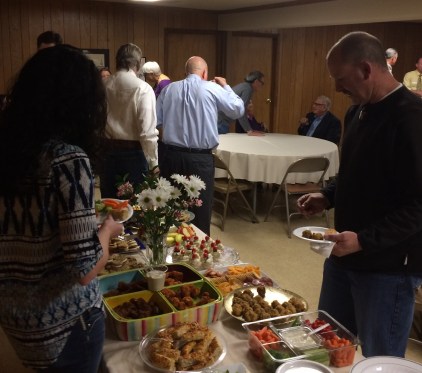
In many ways this is the experience whenever we break bread together.  The reception afterward, for instance, was a great representation of God being the Bread of Life for us.  File Jan 29, 7 09 47 AMHere we were, ministers and congregants from all over the presbytery – “One Church in 47 locations” as I put it.  And yet here we are, drawn together in table fellowship, experiencing the unity of the table and the bonds of fellowship – all brothers and sisters in Christ, united in purpose, united in love.

So maybe we did celebrate communion together!  We just didn’t have it during Worship.


If we take the gospel of John as a whole, we come to understand that the one who claims all these “I am” statements is also the one who claims that he is in the Father and the Father in him.  We also learn that he is in us, just as we are in him.

This mystical union is a fancy way of talking about the Holy Spirit and the body of Christ.  If Jesus is the bread of life, then we become the bread of life in the post-Pentecost days.  We become the hands of Christ.  We become the mechanism for daily sustenance to the hungering world around us.

-Matt