New Directions

arrow-945271_960_720.png

Judges 18:1-15Acts 8:1-13John 5:30-47

Is God calling us in new directions?  This is the question before a lot of our churches these days, as they struggle with aging buildings and membership.  These questions are front and center in our Acts passage today.

Acts is one of my more favorite books.  It is a book of excitement and uncontrollable growth.  It seems that God cannot be contained, and in many ways it continues a theme that had begun at the tomb: that God is on the loose.

In Acts 8 we encounter Saul, who we all know will become Paul and become one of the great leaders of the church.  But for now, Saul is in overdrive when it comes to persecution.  He not only approved of killing Stephen (and capital punishment is against Jewish law), but he is going from house to house, dragging out men, women, and children and sending them to prison.

And what is their offense?  The only crime they have committed is being Christian.

It is hard for us to imagine this kind of persecution.  I would hardly describe America as a Christian nation, but there is certainly enough religious freedom that I do not feel any trepidation about practicing my religion or going to church at any time of day or night.

There is a small tidbit of history that may go unnoticed to the untrained eye.  The simple words, “Philip preached in Samaria” are coded.  Many of us are conditioned to focus on the verb and read “Philip PREACHED in Samaria,” when most likely people of that day were reading this as: “Can you believe Philip preached in SAMARIA!?”  The Jews and Samaritans had long-standing animosity.  Remember the questions that were raised when Jesus spoke to a Samaritan woman?  These are a people that don’t get along.  So this marks an important step in the church’s growth.

Where are our current day “Samaria”s – those places that are seen as off-limits for some Christians, but are the exact places we need to be?

People were amazed at Philip doing this and preaching in SAMARIA.  One of these men was Simon, who had previously practiced magic, but listened and declared “This man is the power of God that is called Great!”

It is somewhat amazing that these persecutions backfire for Saul and the other persecutors.  They were seeking to stamp out Christianity.  But what does their persecution do?  It spreads the gospel message even further.

Today we see persecution of other kinds in our churches.  It tends to center around gay marriage, immigration, and the poor.  I find the persecution go well beyond politics, and to every which way in the argument.  This all raises questions for us as the Church.  Where should we be?  What should we be doing?  How should we “do” church?  These are questions for every presbytery to wrestle with – and arguably every church.

Acts raises questions for every Christian too.  Is God taking us in new directions?  Where in our lives have we been complacent or stalled?  How is God calling us forth into the unknown or into the uncomfortable?  Are we called to preach like Peter or Philip?  Are we called to acts of mercy or acts of judgment?

Whatever we are called to, we are called to GO, for God’s spirit is on the loose.  And where we go really is not up to us…it is up to God.  I happen to believe God is taking us in new directions, and God knows it will be a bumpy ride for the church.  But God wants us to grow up.

-Matt

The Complexity of Life

maze-2264_1280

Judges 14:1-19Acts 6:15-7:16John 4:27-42

I have a close friend who grew up in a church where hell, fire, and brimstone was the order of the day.  It did no good for him.  It just scared him away from church and from God.  Not surprisingly he left the church long ago.

There was a time where I was angry at these simpletons who stood in the pulpits of his church.  Now I have let that go, because I see the human condition.

It is a natural tendency of humanity, I think – to paint the world as black and white.  We put people into categories, and behaviors.  There is right and wrong.  There is good and evil.  It makes us feel in control.  It helps us to cope with a world out of control.

But eventually we grow up, and we realize these categories of right and wrong are not quite so simple or straightforward.  From divorce to climate change, we realize the depth of human emotion and the complexity of our needs and wants are way deeper than a simple blame game and painting one party as wrong, as we claim victory.

But it is in our nature to want to see things simple.  We like categories.  We like things organized and simple.  So we lie to ourselves.

Jesus knows and understands the complexity of life.  It shows in today’s gospel reading.  He comes and challenges our presuppositions and stereotypes about God and God’s people.  He wants us to broaden our minds.  In many ways, John’s gospel today deals with who is in and who is out.

Remember the story of Jesus and the Woman at Samaria?  The disciples discover Jesus has been speaking to a WOMAN, and they are HORRIFIED.  They urge him to eat something, and he speaks esoterically about having food they do not know about.  He talks about gathering fruit for eternal life, the sower and reaper rejoicing together, and those who have labored entering into their labor.  It is a strange response to say the least.   Then the Samaritans show up and declare to the woman that they no longer believe because of what she said, but because they have heard for themselves.

Jesus understands his work to include the harvest of all people.  “Sowers” and “reapers” usually work months apart, with one planting grain, the other reaping the benefits of its growth.  Here it appears here that the harvest has already come.

In today’s Gospel reading we are encouraged to wrestle with the complexity.  And they lift up Jesus as a living embodiment of the complexity of God’s goodness and grace.

These miracles in John do more than stir controversy about “who’s in and who’s out” or breaking rules on the Sabbath.  They focus on the person and power of Jesus.  They illuminate a savior who is utterly unconcerned with the way things “used to be” or even the way things “should be.”  He is concerned only with showing God’s glory in the world, and helping people to see a harvest that goes beyond the walls, beyond the rules, and beyond their imagination.

Could it be he is alluding to a day where all are drawn to the love of God?  Where no one is left out?  Where all are wrapped so tightly in the love of God that no one can escape?  Some might say, “Say it ain’t so!”  Others of us say, “Yes!  Exactly!  This is the Good News we have been talking about!”

-Matt

Risking For What Is Right

cross-3080144_1280

Judges 4:4-23Acts 1:15-26Matt. 27:55-66

There is a common thread in all three of our readings today: God can work great things through ordinary people.

In Judges, one of my favorite stories in the Old Testament, is the story of Jael.  She is one sassy, sneaky person!  Jael, the wife of Heber, ends up killing Sisera, the commander of the bad guys.  She does this by luring him into her tent (well actually he TELLS her she will host him).  But in the process of hosting him, drives a tent peg through him, and kills him.  She then goes out of her tent and finds the good army leaders and says, “Hey I got the guy.”  What an understatement!  She nailed the general of the army! Literally.

It is a story of courage and bravery and standing in the face of sexism, power, and authority that is not of God.  She leads to a military victory for the Israelites.  I believe her greatness goes beyond a military victory, though.  Jael’s greatness is not in her violence act, but in the way she stands up for her people, putting her own life at risk.

In Acts, Matthias is chosen by casting lots to be the 12th disciple, with Judas’ seat being empty.  We know nothing about Matthias really, and he seems to disappear off the grid fairly soon in Christian history.  For me he represents the “everyman”.

Then we have the account of Jesus after his death on the cross.  Joseph of Arimathea comes to request the body of Jesus.  Being rich, he is able to provide a proper burial.  Again, another relatively unknown person in Scripture, obviously a committed follower of Jesus, who steps up when it is time to stick his own neck out and risk.

This is the call to all of us.  To risk.  To stick our necks out, even if it might be cut off for the sake of the good news.  Joseph, Matthias, and Jael all put themselves second, to serve Christ or Israel.  This call to action is in fact the mission of the Church.

We have a lot in our world today that demands risk.  We MUST go against the ridiculousness of hate and division that is afoot in our country these days.

I love the phrase in our Book of Order, one of the two parts of our Constitution in the Presbyterian Church that says, “The Church is called to undertake this mission even at the risk of losing its life, trusting in God alone as the author and giver of life, sharing the gospel, and doing those deeds in the world that point beyond themselves to the new reality in Christ.” (G-3.0400)

How wonderful it is to be in a denomination that focuses that intensely on mission, looking beyond ourselves, even to the point of our dying.

In the midst of church disagreements over racism or over LGBTQIA+ issues, I often hear the argument “it is upsetting” for some churches to talk about this.  That is the weakest argument ever, and an argument that holds no water.  We were never promised that the Christian life would be all hunky dory.  We are called to listen to God’s voice and act appropriately on his calling.  And while we work to build up the peace and unity of the church, we cannot shy away from things of disagreement, if it is what we believe Scripture is leading us to believe.

Conflict is never resolved by hiding in a hole.  It only gets worse.  My work on the Committee on Ministry has taught me that.  Conflict that stews is conflict that erupts much worse than it started.

Peter and Paul had their disagreements, and they modeled for us how to work them out – to face them head on with courage.

In risking – in possibly losing our lives – in daring to follow God in new ways, only then will we also find victory and hope.  Jael found a new hope in her risk.  And so can we, no matter the issue.

-Matt

Women in Leadership

executive-516331_1280

Joshua 24:16-33Rom. 16:1-16Matt. 27:24-31

From time to time on the floors of presbyteries, we have to endure the age-old debate of women in ministry.  And I will be completely honest – I am SO OVER that debate.  While I am still willing to chime in on gay marriage or divestment issues, I cannot even muster the energy to speak about women’s ordination anymore.  I am thinking, “That was 70 years ago!  Are we still having this debate?”  I mentally check out in many ways.

Today, in Romans, is Paul attesting to the ancient roots of women in leadership for Christianity.  (Yes, it’s true.  Some people think Paul is anti-women.  Well, it turns out, he offers conflicting info, or different advice to different churches.  More on that later.)

Paul is nearing the end of his letter to the Christians in Rome, and greets his personal friends and former associates.  At the top of the list is the minister of the church and two of the key movers and shakers, all three of which are women.  First there is Phoebe, the minister of the church at Cenchreae.  He goes on to say “help her in whatever she may require of you.”  So much for “women are not to be in leadership over men” (as the list goes on it is apparent there are many men in the church as well).

Then there are Priscilla and Aquila, who “risked their necks for my life”.  We are not sure what this means, but appearing elsewhere in scripture it is obvious they are instrumental in the daily operations of the church.

I find it odd that Paul sets the tone for women in leadership, as did Jesus, and that somehow so many churches got lost along the way.  The Roman Catholic church remains firm in that women are not to be priests.  A few of their bishops have ordained women, against the pope’s directives, only to have their own ordination questioned.  One of my friends, a long time Southern Baptist minister and also a woman, no longer has her ordination recognized by the Southern Baptist Convention.  Few remember these days when Baptists used to ordain women.  But they did.  The anti-women craze came later, surprisingly.  Today it rears its ugly head again from time to time.  It astonishes and amazes me.

Four people have greatly influenced my call to ministry.  The Holy Spirit has spoken strongly through them.  Two of the four of those people are women ministers.  So it is hard for me to believe that scripture is wrong when it elevates women or when Paul speaks of women in leadership roles over men.  It is hard to discount Paul when he says “In Christ there is neither male nor female” and speaks of the variety of spiritual gifts and the need to use them.

It is true that in another of Paul’s letters, for that specific place it was best for women not to be in leadership over men.  But it seems odd to me to ignore the passages where they are, jumping to conclusions that women should never be in leadership, when in scripture they clearly are.  Context appears to be everything.

People who argue that women should never be in leadership, also talk about how they want us to “focus on God’s Word” more.  But what they fail to realize is what the scriptures principally teach.  They are failing to focus on God’s Word, instead focusing on just a couple of God’s Words that fit in with their agenda.  They also are guilty of dismissing all those places in scripture that talk about the Holy Spirit, and how Peter had a revelation on the roof about a new code of being in compliance with Scripture.  They also fail to remember a similar tactic to theirs about women was used to justify slavery.

Please pardon my soap box, but I felt it must be said, especially because of the nature of the church lately – to be stuck on spin cycle about a couple of hot button issues.  It is like we are playing the same song over and over again, stuck on REPEAT or REPEAT SHUFFLE, and dismissing the workings of the Holy Spirit.

I will conclude by saying that as a whole, Paul’s passage for us today in Romans is a wonderful example of the church in harmony.  At the end he states, “Greet one another with a holy kiss.”  We all know he had disagreements with many of these people.  But at the end of the day, they are all family, reconciled to each other, committed to Christ’s mission in the world, and committed to recognizing each others’ spiritual gifts.

I am thankful that the sun is breaking through the clouds in these areas, for the church of today is hungry and needing a renaissance in this area.

-Matt

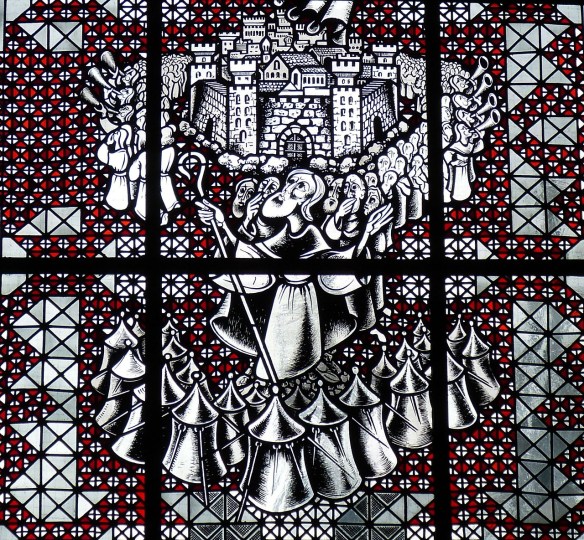
Joshua, Walls, Jericho

church-2662047_1280.jpg

Joshua 9:3-21Rom. 15:1-13Matt. 26:69-75

“Joshua fit the battle…the battle of Jericho.  Joshua fit the battle…the battle of Jericho….and the walls come tumblin’ down.”   (Maybe you know the song and started singing along.)

OK, breaking news.  The walls didn’t really come tumblin’ down.

Our OT lesson today reveals that even amidst trickery and denials, God’s will prevails.  OK, double trick, if you want to look at it simply and not for the deeper God’s truth that is revealed.

If you remember the story, the Gibeonites save themselves through trickery, wearing worn-out sacks, clothes, and sandals, and convinced the Israelites they were from a far away country.  They live amongst the Israelites and avoid disaster.

It is a bizarre story that reminds me of the stories told to me a while back when I was in Jericho.  There I stood at some archaeological ruins, looking at the excavations that go back 1000s of years, and seeing the walls of Jericho from Joshua’s time which obviously not fallen, wondering about the truth of scripture.  Did the Israelites really win these great battles, destroy villages, and conquer the native people?

Later in my studies I came to realize that “victory” in the biblical texts is often meant with hyperbole, irony, or metaphor.  For Joshua and the gang, the “victory” the Israelites achieved was not always by these fantastical stories of destruction, but often by “breeding out the enemy”.  What better way to disrupt the native Canaanite people than by love?  There is the irony.

This reality infuriates biblical literalists.  But is it the archaeological evidence that disrupts their version of truth?  Or is it that the archaeological evidence supports the notion that “winning by love” was often how Israel won its battles, not how the foreigners deceived the Israelites into not being destroyed?

Don’t fall into their trap!

The walls did come tumblin’ down.  Walls of hostility.  Walls of division.  Walls that separated blood lines.  All of them came tumblin’ down.

When we discover the archaeological truth, we come to discover and unlock the deep biblical truth of God’s love.  Let go of your intellectual disconnect!  Shelve your training in grade school in the scientific method and look for truth in the story!  When you do, the reality of God’s truth is revealed:  Either way the facts fall, this was becoming the Promised Land for the Israelites.  People were finding a home.  Love won the day!  All were living in harmony.

I love how rich and deep in meaning Scripture is.  No wonder people have been reading it for centuries.  If it was blah, we would have been bored with it millennia ago – but instead it is complex, with twists and turns almost beyond comprehension.

Don’t shy away from the seeming “untruths” of scripture.  Embrace them, for they are with a little study, in fact, great and profound truths of God’s unfailing love.

-Matt

Joshua’s Good Example

34821330751_600bf57857_b

Joshua 8:30-35Rom. 14:13-23Matt. 26:57-68

Joshua takes over where Moses left off.  The hopes and dreams of Moses, wandering through the desert for 40 years, are finally being realized, although the challenge looks a lot different than when it was a far off dream.

Joshua is a fascinating character in the Bible.  If you aren’t familiar with Joshua, I invite you to seek out a Bible and spend a bit of time reading that portion.  There are so many opportunities for us to see our lives through biblical characters.  Joshua is one of them.

Joshua has a different set of challenges than did Moses.  Having led the people to the Promised Land, and having now captured Ai, Joshua demonstrates an essential component of their new life: worship.  He builds an altar to the Lord “just as Moses the servant of the Lord had commanded the Israelites.”  Not only is this a fulfillment of the law of Moses, but a direction the people have been going long before the law was given: Worship and Sacrifice.  It is a renewal of covenant that began at Abraham, and again at Passover.

Where do you need renewal in your life?

How often have you sought change, but found the changing daily landscape different from what you first endeavored to find?

Joshua becomes a fine example for the weary sojourner.

Joshua leads by example.  He helps build this “altar of unhewn stones, which no iron tool has been used”.  Then in the presence of the people, he writes on the stone a copy of the law of Moses.  Granted it may have been key inscriptions, but it sets the standard.  It is as if he is communicating: “This will be the centerpiece of our life together, he is declaring.  This is the place worship has.  This is the place teaching has over us, and just as God taught me, I now teach you.”

In the midst of the challenges to complete my doctorate in congregational development, I often thought of Joshua for guidance.  I see the vision of Moses up there writing down the law.  But then Joshua is tasked with the hard part – making it come to reality.  Have you ever tried to change a system?  Challenge the status quo?

Above all Joshua sets a good example.  Trying to change a system when the leader at the top isn’t on board is about the most impossible thing in congregational development.  So this is why we look to Joshua.  Joshua models that new direction.  Joshua is a potentially effective leader because of his actions.

One of my on-again off-again struggles in the church today is our overuse and over-focus on interims.  Somehow we mistakenly think that when we are without a permanent leader it’s a good time to change a system.  Good luck!  Sometimes the best thing we can do in terms of organizational development is get the right person in the right place and begin some long-term changes.  Joshua does that.  He sets the tone for excellence – not as someone from the outside coming in, but a claiming of his own authority and leadership, and moving into a bold new future.  By teaching and modeling he is setting the pace for how things will be run from henceforth.

I doubt Joshua had it easy.  Living into the footsteps of Moses is not a challenge I would be up for.  But he does it with pose and with purpose.  He leads knowing that honoring God is the most important, and that God is the true leader of this bunch of lost sheep, and we best focus on what is central that God would have us do.

-Matt

Be Ready

running-498257_1280

Joshua 7:1-13Rom. 13:8-14Matt. 26:36-46

The Old Testament is complex and lengthy, but the New Testament is surprisingly straight forward, arguably with only one or two themes: Love one another.  Love God.  Some could say it is like a broken record, with everything surrounding this theme.

Yesterday in my sermon I made the argument that it is all about GRACE and LOVE.  That’s about it.

In Romans 13: “Owe no one anything, except to love one another.”  Paul then declares that a number of the Ten Commandments can be summarized in the words, “Love your neighbor as yourself.”  Paul then goes on to make an urgent appeal to always be ready.

With images of light and darkness, and the metaphor of changing clothes, Paul urges we replace our vices with virtues – “put on the armor of light”.  We must focus on the now – be ready for the now.

A good complement to Paul’s discourse is found in our Joshua reading.  In Joshua, the beginning of the story of the takeover of Ai unfolds.  It also focuses on the sin of Israel, and accounts for the deep struggling of the people.  This is not some grand punishment that roles down on high though.  It is the consequence of the people not loving one another.  They spend their time squabbling with one another and have lost their focus.  It is no wonder they are not the most effective army.  They have gone from “an army of one” to an army of self-absorbed nut cases.

In both readings we must be ready for battle in a sense.  I find it to be a wonderful image that has lost favor in many Christian circles these days because it isn’t politically correct enough.  But the fact is that scripture is often rooted in battle imagery and there is no way around it.  One must always be ready to engage someone in love, armed and prepared.  This is the irony of that image – the battle is not against some giant foe, but against oneself.  Battles are hard.  They require courage and fortitude.  So does love.  But I am sure we can do it – with Christ on our side.

In other words, BE READY.

BE READY TO LOVE.

I hope that these Morning Reflections have helped you fall in love with scripture once again, fall in love with God more deeply, realize God’s love for you more deeply, and fall in love with a morning routine of contemplation.

-Matt