Multiply

Tabgha1

Gen. 17:15-27Heb. 10:11-25John 6:1-15


John’s text for today recounts the feeding of the 5,000.  It is a story spilling over with God’s grace and abundance.  God’s blessing seems to go a little too far for the disciples’ tastes.  The boy with five loaves and two fish is called upon.  God’s grace spills forth and more fragments and crumbs are collected than we began with.

I have been to a church right off the shores of the Sea of Galilee called The Church of the Multiplication of the Loaves and Fishes.  To me this was always an exceedingly long name for a church.  I really don’t wanna be the pastor that church because I don’t want to put that on my letterhead.  But what a good representation of the abundance!

In the floor of this church is a mosaic from the 2nd Century representing the five loaves and two fish.  Since the beginning of Christianity this has been seen as a significant symbol of Christ’s work on earth.  Perhaps it is because, at least in my mind, it ties in with his death as well.  In order for us to have nourishment, things must die – grain, grapes, fish, olives – you name it.  Christ came to give life abundantly.  In that lurks death.

In all his miracles and healings, Jesus represents the beginnings of the kingdom breaking forth.

The paradox of Christianity is that in death, Christ gained life, destroying the cycle.  Who is really being fed in this story?  As it turns out, all of us are thrust into the feeding, forced to encounter God’s extravagant abundance and inbreaking kingdom.

-Matt

What’s In a Name?

name

Gen. 16:15-17:14Heb. 10:1-10John 5:30-47

Have you ever heard your name called in a loud, crowded room and been surprised you knew you were being called?  With a common name like Matt, often I have been surprised I could not just pick out my name over the cacophony of sound, but knew it was a familiar voice looking for THIS Matt.

I have also had times when people call me by name, engage me in deep conversation, only for me to finally confess, “Have we met? Do I know you?”  The answer is often “No, but I have heard you speak out in public.  I feel like I know you.  I don’t think we ever met.”  I suppose this is a hazard of my profession, but this happens more often than you might think.  Sometimes I wonder if I am losing my mind half way into these conversations.

These examples remind me of the power of a name.  To know someone’s name, especially in ancient Hebrew culture, meant to have power over one.  God goes further with Abram – actually renaming him.  It taps into the deep reality of his identity.  “Abram” means “Ab (a divine name) is holy” whereas “Abraham” means “Father of a multitude.”

Abraham has just been blessed with a son, Ishmael, finally at 86 years old.  Then at 99 God comes to him and reveals that Abram will not just be blessed with more ancestors than there are stars, but that he will be the father of many nations.

The covenant with Abraham is abundance and progeny.  As a sign of that covenant circumcision is given.  “So shall my covenant be in your flesh an everlasting covenant.”

While I have never quite made the connection as to the importance of this kind of sign, what it represents to me is that abundance and blessing are exhibited in the physical world with Yahweh, not just in the spiritual realm.  Our God is not a god who sits enthroned above, utterly disconnected from our daily lives, but infiltrates even the most intimate aspects of our lives together.  We are bound together with God, and with one another, and we are claimed as God’s own forever.

This is what baptism means for the Christian, when we are claimed as Christ’s own forever.  And unlike circumcision, the dividing walls of gender fall by the way side.  God’s welcome opens to all.  It is why baptism is called the “new circumcision” by Paul.

As you head out into the world today, be assured that we follow a God who has called each of us by name, who loves each one of us, and claims us as his own.  You might also want to call out to those you love, NAME THEM, and tell them you love them.

-Matt

Turn Around

401483_10150470275441782_1611326245_n

Gen. 16:1-14Heb. 9:15-28John 5:19-29

When I began this year, I was convinced 2018 was going to be better than 2017.  It hasn’t turned out that way for many of us.  Already death has touched some of our families.  Heartbreak looms after Christmas for many others.  Between job stresses, family struggles, and illness for so many, it is hard to believe we are hanging on and hanging together as a presbytery.  And yet the struggle for life continues, and new life and hope does ultimately come.  It just doesn’t feel like it yet for a lot of us.

The ability to turn from a troubled past, or turn from difficulty and embrace a new future is something that is hard to do.  One of the key ingredients for any Christian to move forward into a new life is revealed in our passage from Hebrews today: forgiveness.

First we hear of Christ as the mediator of a new covenant, “that redeems them from the transgressions under the first covenant.”  Then the writer of Hebrews explains things in terms we don’t hear in our churches much these days: in terms of blood.

“‘This is the blood of the covenant that God has ordained for you.’  And in the same way he sprinkled with the blood both the tent and all the vessels used in worship.  Indeed, under the law almost everything is purified with blood, and without the shedding of blood there is no forgiveness of sins.”

All this blood talk may seem a bit strange!  And it is!  We must always remind ourselves of the prominence of the Temple in the lives of the first readers of these texts, and the Temple’s (over-reliance) on blood sacrifices.  Their whole theology is around blood, and blood = life.

So we encounter deeply mystical metaphors like: We are a people washed in the blood, and we have come out clean on the other side.  And while it sounds a lot like the cup of salvation we pass around at the Lord’s Supper, we are talking about the crucifixion here – the blood that was poured out for the salvation of the earth.  It is only after this event we can truly come to understand love, and forgiveness, and a new covenant.

In a mysterious and strange way, God brought us closer to him through this event.  It is not that God is a sadist, killing his own child, but that God himself took on the role of sacrifice, atoning and blessing us, just as the ram did for Abraham and Isaac, or the lambs on the Day of Atonement, or the doves of the Temple Mount.

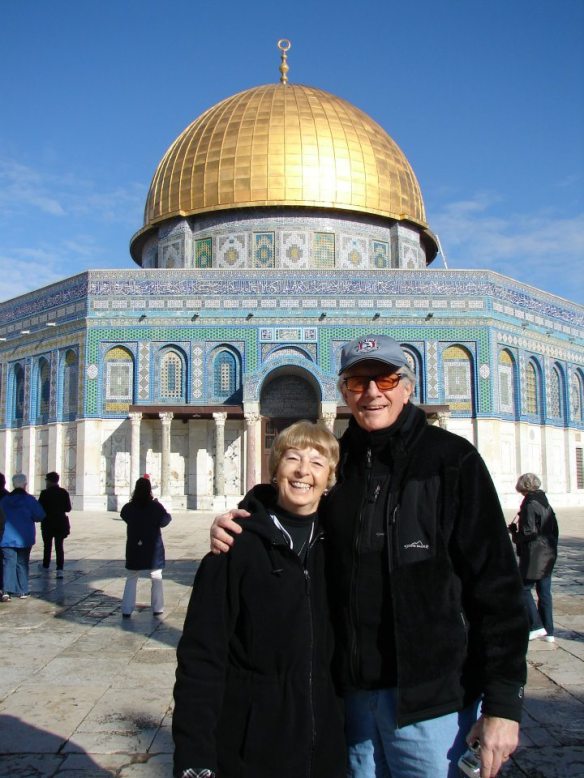
Every one of my groups to Israel has stood on the Temple Mount with me!  We visit this holy place, where for centuries Jews offered their sacrifices up to God, including Mary who offered her two turtle doves in presenting Jesus as the Temple.  This is also the site where Abraham almost sacrificed Isaac, sacrificing a ram instead.  In the picture above you can see Brian and Martha Pat Upp, who traveled with me to Oberammergau one year, and to Israel the next.  Rest in peace, Martha Pat.

I have been known to blow the Shofar (ram’s horn) that I acquired in Israel for a children’s sermon on a week we talk about forgiveness.  Blowing the Shofar was a call to prayer and to a life of sacrifice.  Every pilgrimage to the Temple Mount was a call to turn your life around.

In the sacrifices, the people turned from their wicked ways and renewed their covenant with God.  They “got back on track” as it were.  In the same way, as Christians, God is clearly saying to us is that in order to experience new life, we must have a new lease on life, free from the bondage of sin.  In Christ God has said, “Go ahead.  You are free now!  Live like it!”  Like Isaac on the mountaintop, you have experienced a divine intervention.  God has provided for the needed sacrifice already, so that you can move forward.

May God continue to radiate in your lives, remind you of the redemption that is at hand, and may you go in peace.

-Matt

Changing Lives

bible-1058296_1280

Gen. 15:1-11,17-21Heb. 9:1-14John 5:1-18

What a joy to turn to the Gospel reading and have it be one of the places I have actually been while in Israel!  It comes to life when you have stood there.  If you have never been to Israel, you really should go with me sometime.  I lead trips there all the time.  Next up is the Mediterranean Cruise to Italy, Greece, and Turkey following Paul’s journeys, but Israel will come up soon.  www.mattmeinke.com/trips

Today is the healing of the blind man by the pool of Bethsaida.  When our group was there, we actually stood at the edge of the archaeological excavations of the pool of Bethsaida, so this story comes to life in a special way for me.

Part of the story is that Jesus heals on the Sabbath.  And it is a somewhat unfamiliar text to many, as it only appears in the Gospel of John and doesn’t get much attention from the yearly lectionary cycle.

Jesus went up to Jerusalem, by the Sheep Gate, to the pool named Beth-zatha.  The blind, the lame, and the paralyzed lie there, hoping to be made well.  Although the pool is mainly drinking water for flocks of sheep who come in the Sheep Gate, there is evidently some mystery surrounding the healing properties of the water, especially when the waters are stirred up.

Jesus, who would have had to pick him up and put him in the water, a clear violation of Sabbath rules, chooses to simply say, “Stand up, take your mat and walk.”  Even before the water is stirred up, the man is healed.  He takes his mat and began to walk.

Carrying his mat is a violation of the Sabbath, and the Jewish authorities point this out.  He responds, “The man who made me well said to me, ‘Take up your mat and walk.’”  They want to know the identity of the man who healed, but Jesus had disappeared in the crowd.  But they find out who he is.

This convoluted story about Sabbath breaking is challenging.  Of course one of the first things to point out is that all this laboring, including the performing of a miracle, is breaking the Sabbath.  And I don’t know about you, but I thought Jesus was going to weasel out of it by saying, “My Father is still working….and he can do whatever he wants!”  Instead, he fed the fire of their persecution, pleading guilty to it, saying, “My Father is still working, and I also am working.”

Jesus is not concerned about breaking the Sabbath, but revealing who he is, and who God is.

He is also interested in changing lives.

It is easy to understand why all this authority gets him in trouble.  But the story reveals even more.  Why was Jesus hanging out at the dirty, smelly Pool of Beth-zatha?  What do the disciples have to do with herding sheep?  Did they come for the medicinal properties of the water?  Perhaps he came especially to see the people there.

Jesus seems to be playing with fire when it comes to the Jewish authorities.  He is taking the role of Judge and Advocate.  By performing these miracles, especially in the most unlikely of places, he is sending a clear message to the Jewish authorities: “God is not playing by the rules of the temple here.  And there is no stopping it.”  He is changing lives by defaulting to grace and healing and welcome and restoration.

This bold, abrasive message gets him killed.  And yet, all the while, revealing the Word made Flesh.  The Gospel of John is a unique picture of Jesus, but one that I see as essential.

He portrays a somewhat bumpy ride to the cross – actually more of a roller coaster ride – but as Lent approaches and the difficulty of life comes more into focus, I cherish the stories of John which call for an extra dose of faith in a God who has the power to heal and change lives.

-Matt

3, 2, 1…Connect

Tower_of_babel

Gen. 11:1-9Heb. 6:13-20John 4:1-15

Genesis is chuck full of wonderful themes and intrigue.  The theme of “the Fall” is one of them.  It goes well beyond the story of Adam and Eve, but permeates the whole book.  Certainly we see in each of our lives how easily frayed our relationships can become, both from God and from each other.  It is easy to relate to Genesis.

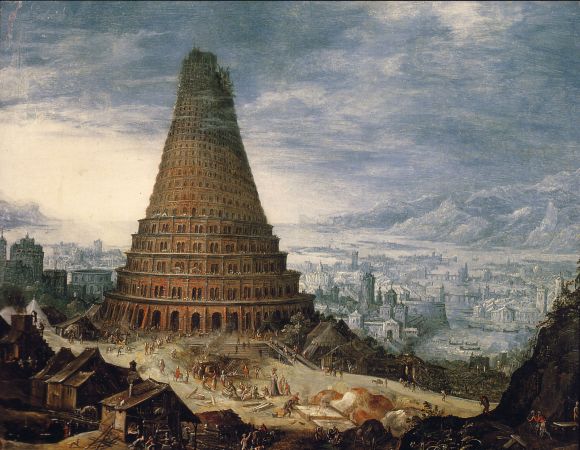
Today’s story of the Tower of Babel certainly fits into that theme.  As the story goes, the whole earth had one language and the same words.  Human pride gets in the way, and the punishment is that language and speech are jumbled.  Before the “fall” was about humans falling away from God; now they are falling away from each other.

As the human population grew, the fray only continued.  People became divided politically, socially, and economically.  That divide continues until today.

I am fascinated by our smartphones and how these little devices are revolutionizing our communications.  We stand at the precipice of a fascinating age of connectivity, never seen before in human history, which I suspect will not end.  What an exciting opportunity for the church – to once again reclaim its Pentecostal message that exhibits oneness and community in the body of Christ.

Just the other day I was talking online with a Coptic priest serving a number of churches in Ethiopian.  How exciting.  It takes mission and evangelism to a whole new level when we can have live interactive discussions with people around the world at any moment.

We are a Christian community stand in opposition to the Tower of Babel – beyond to the other side of its complementary story of the Pentecostal fire where those who spoke different languages began to understand one another.

The question is “What will we do with our time and how will God use us?”

-Matt

A Rainbow Promise

rainbow-christmas-2893686_1280

Gen. 9:1-17Heb. 5:7-14John 3:16-21

I just signed a new covenant with First Pres., Duncan.  The presbytery is also having to wrestle with my contract/covenant with them as well, as the longer this interim time marches on the more unrealistic my limited hours are.  Then I turned to the readings this morning, and more talk of covenants – BIG ONES with God and God’s people.

The covenant with Noah is laid out today.  It comes with a rainbow promise by story’s end.

There are a lot of covenants in the Bible.  The first ones that come to mind are the covenants with Noah and Abraham.  There is also the Sinai covenant.  Covenants come in many forms, sometimes agreements between God and human, other times between human and human.

The Noahide covenant is a bridge forward and backward.  God says to Noah and his sons, “Be fruitful and multiply, and fill the earth.”  This is yet another creation narrative, in a sense.  God’s goodness spills forth, once again, and we too are invited to step out of our arks and renew our own covenant, one that extends to each other, to the earth, and to God.

By the end, the rainbow stands not simply as a promise not to destroy the earth, but as a sign of the goodness of God, the invitation to be in covenant with God, be fruitful and multiply and share life and love with all those around us.

At Sinai God makes covenant with the chosen people, and encourages them not to make covenants with the foreigners in the land of Canaan.  This covenant today is a precursor to that, helping lay out the plans of God, to fill the earth with his love and the community of Israel.  The intention is to have the whole earth spread with the name of the Lord.  Sound familiar?  It is the very promise that Paul and others were carrying forward as they brought the good news to the Gentiles.

The writer of Hebrews has offered solid food but his hearers are only able to digest milk.  John says there is light and darkness in the world.  Sometimes you get darkness.  When you do, dust off your sandals and move ahead.

It’s still all about God and God’s loving embrace of all the world.

To live in glory, truth, and love in the present life is a joy and a freedom.  In Christ we have another covenant – a covenant of love set before you were born.  And we are drawn into that love that was set forth at the Noahide covenant, and led to share light and love, at all times remembering the rainbow of God’s love.

-Matt

Lift Up My Soul

photo-1438890513707-bf5799d2e14b

Gen. 8:6-22Heb. 4:14-5:6John 2:23-3:15

The scene in our Genesis passage today is most certainly one filled with hope but also anxiety.  After 40 days on the ark Noah anxiously sends out the raven and then the dove three times.  The second time the dove comes back with an olive leaf, a symbol of peace and flourishing life.  The third time the dove does not come back, evidently finding a place to nest, or deciding the ark was a smelly mess anyway, not wanting to return!

The dove provides us with a symbol of renewal and hope.

The Psalmist too is looking for guidance and deliverance (Ps 25 is the psalm for the day, btw).  It is unclear specifically what is the problem is.  This unspecified trouble comes with it specific remedies though: reasons for God’s gracious response and goodness.   The Psalmist claims obedience, offering to “lift up my soul” and saying to God, “In you I trust, do not let me be put to shame; do not let my enemies exult over me.”

“My eyes are ever toward the LORD.”  These words of dedication and trust in God’s grace are unwavering.  Without knowing what problem he was experiencing, the Psalmist lays out the road ahead, “Consider my affliction and my trouble, and forgive all my sins.”

What I enjoy about the story of the Ark, as well as the Psalms, is that they stand in the face of our culture of mistrust.  Here are two beautiful examples of deliverance and trust.

Today is the funeral for my buddy Martha Pat Upp.  If there was anyone at FPCOKC who put their trust in God it was certainly Martha Pat.  She was also a faithful reader of my Morning Reflections when I started these things, and a big fan.  And through the turbulence of life, she trucked on, faithful and sure as ever that God was at the helm and with her eyes fixed on God and God’s direction.

The movement from the ark back to dry land is almost like experiencing another creation narrative, with slow deliberate transformations and growth.  The earth first accepts animals, like the dove nesting, and when it is ready, in due time, Noah and the gang hit dry land.

We all know that ark was smelly.  I mean, come on.  But yet, I read the story of the Ark and I sense a cleansing, and a spirit of purity and grace.  God accepts Noah in his limitations, and works miraculous grace.

And this is where the Psalmist stands in grace as well.  God’s “Yes” is greater than our “No’s.”

Halleluiah!

-Matt