More Guns! More Guns! That’ll Fix It, Right?

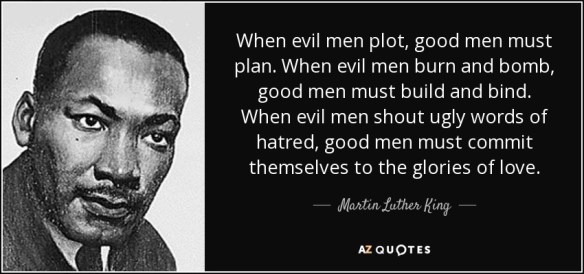
quote-when-evil-men-plot-good-men-must-plan-when-evil-men-burn-and-bomb-good-men-must-build-martin-luther-king-53-60-03

Deut. 31:7-13,24-32:4; Rom 10:1-13; Matt. 24:15-31

“Everyone who calls on the name of the Lord shall be saved,” says Paul in our Romans passage.

I hear these words and I cannot help but think of the ongoing violence that is America – its culture of violence and racism, the atrocities in Dallas and Baton Rouge last night as the latest incarnation of it.  Every day is filled with violence.  We have become numb.  “Just another day of senseless gun violence,” as we shrug our shoulders in hopelessness.

By now my prayer is that our country has finally turned the page on apathy – that long gone are the days of “our thoughts and prayers go with the victims.”  It is now clear that every Christian is not simply called to pray, but called to action.  My prayer is that action begins NOW.

These words from Paul have quite a different context than all the swirling thoughts of my mind.  People in Paul’s time were arguing that the Gentiles were not saved.  He was responding to that with words of inclusion and grace.  Paul was arguing that God’s grace had opened up, and that restrictions like circumcision and following the law were no longer in order, that salvation had spread to unfathomable circles.

Our context is different.  For us salvation is “salvation from ourselves.”  We need to be washed clean of the culture of gun violence, hatred, and racism.  We need to have rage well up in us to call us peaceloving Christians to action.  We need to be covered in the blood of the victims in order to begin to see straight.  That will certainly awake us to action.

I am tired of hearing about the 2nd Amendment.  Anyone with a brain knows this is not what the founders of our country intended.  But what do we do?  As Americans most of us are committed to God’s Word, but equally committed to the US Constitution.  What’s more is that we rely on our courts to adapt our antique documents like the Bill of Rights to our modern, technological challenges.  We trust our judiciary to sort all this out: what’s a right and what needs restriction.  The problem is that we are left with that awkward, irresolvable phrasing of the 2nd Amendment: “A well regulated Militia, being necessary to the security of a free State, the right of the people to keep and bear Arms, shall not be infringed.”

The responses vary.  My NRA card-carrying, pro-gun-rights readers are asking: “What part of ‘shall not be infringed’ do you not understand?” Others ask: “What part of ‘a well regulated Militia’ do you not understand?”

While I am not a Constitutional Law expert, nor do I want this Morning Reflection to become a history lesson, it is worth mentioning that best I can tell for most of our history, the 2nd Amendment seemed almost irrelevant, maybe in part to the ambiguity I laid out above. For most of our history, many American towns and states regulated guns and that was that.  But in the 1980s something changed.  People began to look at the 2nd Amendment differently, and the right to bear arms for self-defense emerged.

And now we are bearing the fruit of all that.  As mass shootings dwindled in Australia after the voluntary collection of guns, and as Canadians continue to have more guns than Americans but yet have far fewer incidents of gun violence, our culture of violence flourishes with police shootings and police being shot.  My black friends fear being pulled over by the police, a fear I may never fully understand.

A few things are clear: 1) Prayer is no longer enough to combat violence.  2) Taking away the guns is not enough.  3) Fixing our culture of violence will take more than prayer in schools or a reclaiming of God in classrooms.  It will mean something much deeper, like teaching our children to value life.  4) We cannot do this without help from above.

What does it mean to call on the Lord, as Paul encourages?  To put one’s trust in, to count on, or to look to.  For us it means more than a simple “get out of hell free” card.  Paul is arguing that the flood gates of grace are open.  We desperately need the flood gates of grace to open in other ways as we call on God.

Now is the time for Christians to stand up and proclaim some good news to hurting America – that salvation is at hand – salvation from ourselves.  Now is the time to lay aside our worship of guns and the false hope that more guns will save us, and turn to the God of New Life.  Now is also the time to call one another to action.

You are probably sensing the direction God is calling me to.  We have tried arming ourselves to the hilt and it didn’t work.  Perhaps now is the time to collect up as many guns as we can and have a smelting party.  Only then can the glories of love be revealed.   Only when our hands are free of weapons can we embrace one another.  Only then can we build and bind one another in love’s ferocious embrace.  Enough is enough, my friends.

-Matt

 

Shoot Now, Ask ?s Later I Guess

38-1239261_960_720

Deut. 3:18-28; Rom. 9:19-33; Matt. 24:1-14

Coming in the Fall, the Thursday Noon Bible study will be focusing on the Gospel of Matthew.  It is a difficult and strange gospel to decipher.  Beginning with things like the Sermon on the Mount, it grows increasingly “violent” as it unfolds.  Today we are nearing the end of the book, and hearing about the destruction of the Temple, signs of the end of the age, persecutions, death and destruction – including corpses and vultures.

Enchanting right?

As I wake up to this violent world (and I think we went one whole day without a mass shooting –  oooo, I think we set a record!!!), I wake up to news of another police shooting – a black man in Minneapolis being pulled over for a broken tail light, and ultimately being shot to death.  While I don’t know the details, evidently while he was producing his license and registration he also mentioned to the officer he had a gun in the car and a license to carry it, and was shot four times while still in his car with his young daughter in the backseat. He later died.

The insane amount of violence in this country makes me want to pass the offering plate requesting to collect EVERY gun in this country, including those that officers carry.  I’d prefer to issue stun guns instead.  Why on earth everyone feels the need to have lethal force on them at all times is beyond me.  So I wake up to that news and wonder how much more violence I can take.  Matthew, and Jesus’ combative words seem to fall on deaf ears.  Like I need another violent tale!

What I needed to quickly remind myself of was that Matthew is not where we hear predictions about the violent end of the world, but a gospel in which we enter the strange, symbolic world of apocalyptic literature.  We speak of the “second coming.”  What I needed to remember is that this chapter is really about the ultimate victory of God.  These words sound like comfort to the 1st Century ear. Really.

It is with this cautionary tale, I encourage you to embrace the end of the Matthew’s gospel.  Don’t look and see violence.  That is not what is happening.  It is a story about hope told through a story of violence.  It would be like me retelling the story of “Philando Castile: Driving in Minneapolis While Being Black” and having the brutal and violent tale end with combating racism, hatred, and violence all together.  The story of apocalyptic literature is like this – using violence as an instrument to declare an ultimate embrace, and peace at the last, where God reaches out on a hurting world and washes us all clean.

We are in desperate need of this as a people – to feel the release from this doomed world, and glimpse the life beyond that God offers us, one free of violence and discord of all kinds.  As we turn to the God of Israel we may hear frighteningly familiar tales of God & Violence, but we can rest assured that God calls us beyond it all to a day when all find forgiveness, peace, and hope at the table together.

-Matt

Why Christians Need to Stop Praying — john pavlovitz

I’m so tired of Christian prayers. I imagine God is too. I’m quite certain the people we so readily say that we’re praying for are tired of them: Praying for hungry people instead of skipping our second latte of the day and buying them lunch. Praying for a friend battling depression instead of sitting with them……

via Why Christians Need to Stop Praying — john pavlovitz

Recount

hand-859508_960_720

Deut. 1:1-18; Rom. 9:1-18; Matt. 23:27-39

Are you a list person?  I am.  Recently I have been gearing up for a vacation and the to-do lists always seem to grow.  You would think without a week of work the lists would dwindle, but no.  Preparing for a house-sitter means one of the things on my to-do list is to make the house-sitter a to-do list!  How crazy am I?  To me it feels completely natural.  After all, who can remember all these details?  And so if I am feeling a bit overwhelmed by the details, I start writing them down, figuring someone else will definitely need them.  Do you know what I mean?

Then I opened to our reading from Deuteronomy.  Similar kind of thing!  Reminders, lists, recounting.

If you have ever read the Bible cover to cover, when you get to Deuteronomy here is a perfectly normal reaction, “Didn’t I just read this?  The tabernacle is so many cubits by so many cubits….yeah I know.  Didn’t I just read this?  The Ten Commandments….again?  Am I accidentally re-reading?  Did I accidentally flip backward?  Have I read this?”  Deuteronomy is somewhat redundant – a rehash of Exodus – but for a reason.

Deuteronomy starts out by going back and reflecting on the post-Horeb epoch of the Israelite people.  This is the core of their story.  They have the Law now.  They know what they are to do.  They have their marching orders, and Moses wants to retell the story and remind people – perhaps highlight – some important parts of the story.

He recounts the choosing of leaders, the rebellion and defeat.  It is a time to start over, and to wash the slate clean.  And how important is it to have this institutional memory?  Very important!  For it shapes the very identity of the people for the time to come.  By story’s end, they are in the Promised Land.  It is as if Moses is saying, “Lest we forget who we are, and how we got here, and how thankful to God we need to be, let me tell you the story again!”

I find Deuteronomy fascinating.  It is more than a retelling, but a reshaping of the story.  I see details I missed the first time.

And so I entrust to you our new summer trajectory – Deuteronomy.  May you discover the covenant of God with the Israelite people once again – or for the very first time.  May you look with new eyes and extraordinary grace the God has poured out on his people, and continues to pour out on us today – a transformation and salvation of a people who were once lost and wandering, but now have been found.

-Matt

God with Us

castles-616573_960_720

Num. 35:1-3,9-15,30-34; Rom. 8:31-39; Matt. 23:13-26

After a wonderful 4th, we get back in the saddle.  And today we have a fascinating conglomeration of readings.  Matthew is evocative and weird.  Woe to you, Scribes and Pharisees!  Jesus gets pretty bombastic, even goes so far as to call them “children of hell”.  It is not a passage you will hear read on Sunday morning.

Romans, on the other hand, is breathtaking in its beauty, cadence, almost poetic in nature.  “Who is in a position to condemn?  It is Christ Jesus….  For I am convinced that neither death, nor life, nor angels, nor rulers, nor things present, nor things to come, nor powers, nor height, nor depth, nor anything else in all creation, will be able to separate us from the love of God in Christ Jesus our Lord.

The Romans passage is one often read at funerals, and one that sums up the Christian journey.  Heaven and earth may not seem to match, with terrible sufferings occurring down here.  It is easy to feel separated or even isolated from God and Christ’s purposes.  Nevertheless, Paul assures us that nothing can stand between the love of God and his people.

These words come as a great reminder to us.  Despite the problems of life, we must remember that God walks with us, and nothing can separate us from the fullness of his love.  Despite conflict, heartache, pain, and death, God is with us.

I hope you enjoy these odd and colorful readings today.  Remember to simply click through on any of the blue links to read them online.


-Matt

The Wedding Banquet

wedding-785355_960_720

Num. 23:11-26; Rom. 8:1-11; Matt. 22:1-14

The Parable of the Wedding Banquet can be troubling and confusing.  If you have encountered the last few chapters of Matthew before you share in the confoundedness.  There is a sudden harshness to these judgment oracles.  Please click the link and read it yourself first!

Best I can tell this is a symbolic picture of Matthew’s church.  Each one of Matthew’s readers can probably recognize their own face as they are gathered at the son’s wedding banquet – those who were invited, those invited late, the gathering of the good and bad.  And they are jammed into this churchly banquet hall, both good and bad.

Near the end we hear a traditional Jewish saying – “many are called, but few are chosen”.  Like yesterday’s reflection about “never getting there”, this is not meant to be read literally, but means “God wants everybody at the party, but not everyone wants to come or knows how to behave once they get there.”

Usually parables have a disconnect with reality.  This certainly fits the bill, with much of this not making sense.  Some are cajoled in off the street unexpectedly and then judged for not being ready?  Huh?  There is certainly an underlay of a judgement oracle urging us as Christians to discern who we are and how we live.  Jesus wants us to be different, act different, feel different.

Do we come to the church with a sense of awe and wonder?  How are we joyful or prepared to belong to the church?  Are we coming as children of the kingdom, or strutting our stuff expecting results?  The “what’s in it for me” culture certainly has taken over the church of North America and it is why we are dying.  The church has never been about what’s in it for me, but a place where awe and wonder meet up with those who are humble and open recipients of massive grace.

Only then will we get to Happy Hour.

-Matt


You Will Never Make It

law-1063249_960_720 (1)

Num. 22:41-23:12; Rom. 7:13-25; Matt. 21:33-46


One of the most troubling passages in all of scripture comes to us today.  All of Matthew 21 is troubling.  It is a series of judgment oracles, with thinly veiled allegories, astonishing violence, curses, and is reminiscent of Isaiah’s description of the actions of a vineyard owner (Isa. 5:1-2), which let’s say doesn’t end pretty.

It appears that Jesus loses his cool again in the gospel of Matthew and all but curses the Pharisees.  He has been so incensed by the Pharisees he tells the story of the wicked tenants.  The vineyard is leased to these tenants who drive away and kill all those who come from the landowner to collect.  Then the landowner sends his son.  So they killed him too.

Jesus warns the vineyard will be given over other tenants, and have the wicked tenants die a most miserable death.  “When the chief priests and the Pharisees heard his parables, they realized that he was speaking about them.  They wanted to arrest him, but they feared the crowds, because they regarded him as a prophet.”

The parable of the wicked tenants is about the disobedience of the people, especially their leaders, and the consequent turn of God toward new leaders.  But this doesn’t let anyone off the hook.  The new leaders begin the parable all over again, and now those people are response to God for the harvest of the vineyard.

How easy it is to become stuck in the “curse” of this parable.  I see it in some of our churches today.  They become so consumed with maintaining the status quo they forget about the mission of Christ, and the spreading of the gospel to the neighborhood.  They become consumed with God’s “No”s because it is easier than focusing on Christ’s work in the world, both then and now.  These are the churches who distract themselves with theological fights of who is “in” and who is “out”, focusing on other’s behaviors rather than their own failure to follow their own special vocation – that of outreach to the community around them.

It is often the churches who struggle with evangelism that end up trapped in “curse” mode.  They become an institution of homogeny and the different-ness of the neighborhood community that surrounds them is frightening.  I call it the Holy City syndrome.  Ironically in trying to create a Holy City, folks often find the exact opposite.  One doesn’t have to look far into history – from Branch Davidian compounds to Trump campaigns.

But when God’s “Yes” trumps the “No”s of our world, and the doors of the church are flung open wide, and homogeny is not the goal but the curse, then we discover the true Holy City, the City of God where the stranger, the homeless, and the afflicted find a home.

Thinking about our story yesterday, it is not an accident that Balaam and Jesus were somewhat outsiders.  Readings like these weave the themes of curse and acceptance – what is acceptable and what is helpful.

I read this passage much like much how we might say to a troubled boy scout who is acting out, dragging his feet, and misbehaving, “At this rate, you will never make Eagle Scout.”  The goal is not to threaten, but to change behavior.  Some kids hear, “You will never make Eagle Scout.”  But what was really meant was, “If you don’t change your behavior here, you are never going to make Eagle and I really want you to WAKE UP so I am saying this to rattle your cage!!!!”

That doesn’t take away the jarring nature of this passage.  But ultimately, it is obvious from Jesus’ ministry that the walls are crumbling, and those who thought they were in are going to be out.  A change of behavior is necessary.  And acceptance is awaiting us, but until then we have some work to do.  Let’s get to it.

-Matt