Unknown's avatar

About Matt Meinke

Presbyterian minister | Presbytery Leader @MaumeeVP | MSN Candidate & Aspiring RN | Adjunct professor | Leadership consultant | Organizational Development | OU, Thunder, Packer fan

Revelation: The Bible’s Most Confusing Book

eye-691269_1280

Ecclus. 38:24-34Rev. 14:1-13Luke 12:49-59

About once a month, I have a student from some university call looking to interview me on my religious views, what Presbyterians believe, or some such questions.   Do you all get these calls too?

A recent call went something like this: This well-meaning student launched right off with his first question, “Do you believe the church you pastor is the one referred to in Revelation as being sealed (i.e. the 144,000)?”  Maybe it was a question from his professor.  Perhaps he is just on the prowl for a certain answer, to explore certain church traditions.  But I felt like the question itself was already a fundamental misunderstanding of the book of Revelation.  And here is what I mean:

Those who believe that every word in the Bible is literally true are in deep trouble today.

144,000 stand with the Lamb on Mount Zion and approach the throne.  The 144,000 sing a new song before the throne, and no one else can learn the song except those.  These are those who have been redeemed from the earth.  “It is these who have not defiled themselves with women, for they are virgins….”

It is a fantastical vision.  And I’m not saying it can’t happen.  The question is why would I think it is not full of symbol and hidden meaning, much like the rest of the Bible?  (I didn’t take Jesus literally when he said “take up this mountain and fling it into the sea” or “pluck out your eye if it causes you to sin”.  Not many pirates among us.  We really do need to look with better eyes than that.)

I remember many years ago some Jehovah Witnesses came knocking on my door.  One of their first statements to be was, “Do you want to be one of the 144,000 that are saved?”  These days you don’t hear them ask this question, now that their numbers have exceeded 144,000.  Their biblical ethic seemed inadequate, so they ditched that emphasis in favor of another ethic.  To complicate matters for those who want to revise the number, but still take the rest of the passage literally: There will be no women in this number saved.  And of the men, none of them have ever had sex.  These are the unmarried and completely chaste.  Leave anyone out?  I probably left most of my readers out.

So what are we to make of this?  How are we to read Revelation?  First, we need to give ourselves permission to not always take the Bible literally, but to read it for its deeper meanings.  (I hardly think that the kingdom of heaven is JUST like Jesus said – an actual mustard seed.  Of course there are metaphors!)

Next, we need to explore the images and metaphors of this passage.  How are we to take these dramatic pictures of the throne, and visions of salvation of the world?  What is behind these images that represent the faithful picture of salvation?

Additionally, we need to understand that in Revelation, numerology is important.  7 is a holy number.  7 times 77, something that Jesus used in reference to “how many times one should forgive,” is considered not to be 539, but meaning more along the lines of “forgive a WHOLE LOTTA times”.  It is a number too big to count.  In the same manner, 40 days in the wilderness, or raining for “40 days and 40 nights” is code for “a long, long time.”  40 years in the wilderness is an “unfathomable amount of time,” so large we all lost track of how long it really was.

And so here, our number 144,000, ties in with the disciples.  The number of disciples grew from 12, to 12 times 12, and that grew 1,000 times!  The writer of Revelation is saying, “The number of those saved is too large to be counted, but it will stem from those who heard and understood the Word.”

Rarely do I see Revelation speaking literally.  It is a dramatic portrait of God at work to conclude creation.  That which was begun in Genesis, and fell victim to sin, is cleaned up.  Another way to say it is, “In the end, nothing can resist the power of God.”

This ultimately is great reassurance, especially to a readership that was under persecution.  To hear that beyond their daily lives, God was in control and God had a plan, was great reassurance.  The same was true of many of the African slaves, who when the going got tough, their theology and songs focused more on the afterlife, redemption, and freedom from this world’s pain.

It is no wonder that we turn to Revelation at funerals and dark times.  They are reassurance of God’s sovereignty, and our desire to be allegiant to the Lamb and bow before the throne.

-Matt
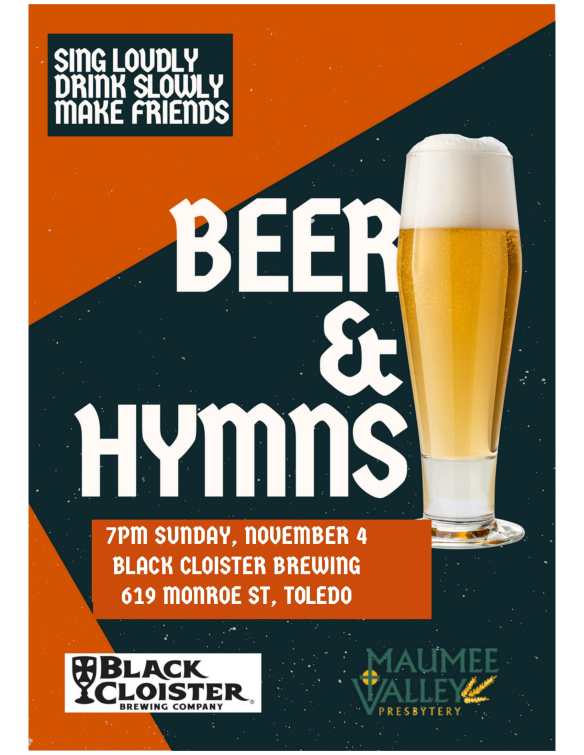
Beer & Hymns

Beer-Hymns-Nov-4-1

I have begun as the new General Presbyter for Maumee Valley Presbytery.  One of the joys of this new position is fostering healthy relationships in this region – between ministers, leaders, churches, denominationally – wherever.

Some in Christian circles might question fellowship like “Beer and Hymns” that seems to center around alcohol consumption.  But to focus on that is to miss the point.  Martin Luther, one of the churches early reformers, was keenly aware of how the church needed to reconnect with the masses and change their ways.  He was also connected to the people, and was a frequent patron of the local pub.  He knew where people hung out, and first and foremost was a priest and a pastor to his flock.

We too live in a world that aches for God, and needs to hear of the redemptive love that Jesus Christ offers.  And so Beer and Hymns comes to Maumee Valley as it does every month.  It is a time to connect with our flocks in a different way – a relaxed almost playful way.

I encourage you to come.

And if you struggle with alcohol, you don’t have to partake.  I, for instance, have developed an allergy to most beer with the genetic modification of grain proteins.  So I may have a cider.  But no beer for me.

It will be a time of singing, fellowship, and some fine malts!  Come hang with your pastor and get to know her or him on a different level.  Make a new friend in another part of the presbytery.

See you at the Black Cloister Brewing Company on Monroe St. in Toledo.  7pm.  Sunday.

-Matt

Mary and Martha

mary martha qi

Ecclus. 11:2-20Rev. 9:13-21Luke 10:38-42

Jesus visits the home of Mary and Martha today.  On the surface it seems like a story of Southern hospitality gone awry.

Martha welcomes Jesus into her home.  Mary, her sister, is busy listening to what he is saying, and so is sitting at the Lord’s feet.  Martha is distracted with many tasks, and comes to him, “Lord, do you not care that my sister has left me to do all the work by myself?  Tell her then to help me.”  Jesus does not do so, but rebukes Martha.

Questions of hospitality come.  Who is going to get this man a drink?  I relate to this story because I, too, like to host friends as they come over.  Being the only person throwing a party can be a struggle: I get them a drink.  I fix an appetizer.  I have to be a host and carry on a conversation with them as well.  I have to sit and welcome them and be at ease.  Yeah, right!

But is that it?  Is that really what Jesus is talking about here?  This is one of those stories that in English loses a little of the story’s bang.  Here a little knowledge of Greek, as well as knowing the cultural norms of the time helps.  There are also a couple code words that meant something in that culture that we totally miss.

One is “many tasks” which literally means “much service”.  Later in Luke he speaks of service quite a bit, and discipleship is defined as service.  The second clue we get is Mary “sitting at the Lord’s feet.”  In our culture this is something the dog would do.  We almost see her in a sub-servant role.  It is not!  Mary is depicted as a disciple!

So when Jesus says, “Mary has chosen the better part” he is saying that being a disciple is more important than anything else at this time.  Jesus is also quite the feminist.  There is no “woman’s work” in this equation.  Jesus raises Mary to the status of a disciple.  Martha is only a worry wart.

Ultimately I don’t see anything in this passage about Southern hospitality.  I see this story as a time to examine one’s own discipleship.  As I welcome people to worship in my big fancy robe, how well am I helping folks to realize there are on equal footing with me and the rest of the church, but at the same time helping them to come and kneel before the master?  I am sensing the answer is in servant leadership and modeling the humility of Mary and Martha, openly questioning and following to the best of their ability.

-Matt

The Good Samaritan Story Comes to Life

2018-10-11 14.09.50.jpg

Ecclus. 10:1-18Rev. 9:1-12Luke 10:25-37

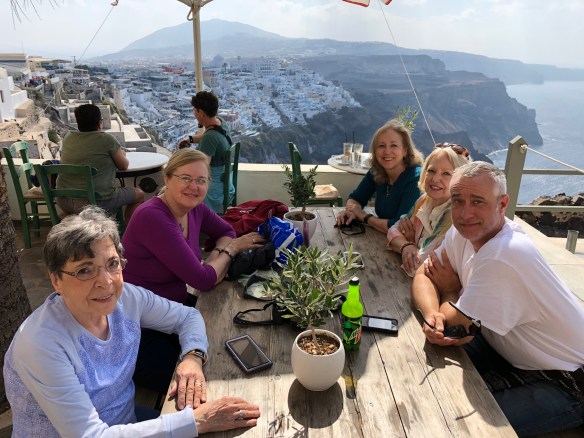
As I descended down the 587 steps from the city center of Fira in Santorini, Greece, I became aware of the vulnerability of the man who was abandoned at the side of the road in the Good Samaritan story.  On the path was me, a few other tourists, and some donkeys, which take people up and down if you are willing to pay.  One donkey took a liking to my OU jacket tied around my waist, broke free from his caretakers, and headed down the hill after me, heeing and hawing the whole way.  I kept moving, his caretakers yelling at him, but to no avail.  We turned and turned down the windy path, him bumping and shoving me.

As I continued my descent I thought, “What am I going to do if this donkey decides he REALLY likes my OU jacket and forcibly takes it, pushing me off the path?  Really?  Who from my group knows where I am?  And who will assist me?  Friend or foe?  Where is his owner btw?”

I was praying for a good Samaritan, or at least a donkey expert.

Did you know that Jesus’ parables were not unique? Jesus was just telling the same stories that other rabbis at the time were telling.

What characterized his parables was that he was changing the ending – ending them funny.  I had a Jewish professor in Israel who said that Jesus wasn’t necessarily ending the stories “wrong”, but more accurately that people of the time perceived that all of Jesus’ stories ended “wrong”.  He argued that the reason we are still talking about his parables is this precise point.  Jesus kept mixing up the well-known, expected, “correct” endings, and in doing so was reinterpreting how the law was supposed to be used.  He was, according to my Jewish professor, one of the great rabbis of the time, seen in his stories alone!

The parable of the Good Samaritan is an excellent example of this.  The man at the side of the road, who had been stripped and beaten…he is passed by a priest, and then a Levite.  Each comes to him and passes by on the other side of the road.  Then a Samaritan comes by, and moved with pity, bandages his wounds and cares for him.

So who did right?  Well naturally the first two!!!!  By passing by on the other side, they were remaining ritually pure for Temple worship.  Both were heading to Jerusalem, not to pray, but to lead in worship.  So the people in that day would have had this thought in their mind: “The greatest good for the greatest number of people.”

Jesus shocks the crowd when he changes the typical ending around.  He states that the third person did right.  The Samaritan.  Perhaps there were people in the crowd scratching their heads.  “Wait a minute,” they might have been thinking, “we’ve heard this story before and that’s not how it ends!”  Or, “This poor stupid Samaritan aces himself out of worship by doing this act.  He becomes ritually unclean and has to remain outside of the community for 30 days for this daring feat of helping one person.  What an idiot!”

Jesus says no.  Think again!

When the lawyer answers Jesus’ question of “Who did right?” by saying “The one who showed mercy,” Jesus says, “Go and do likewise.”

Those of us who know the Jesus’ story, know that it is not just his parables that “end wrong.”  Our entire story has a wacky ending.  Our King doesn’t ride triumphantly into Jerusalem on a donkey and lead an army to destroy the Romans, as everyone hoped the Messiah would.  Instead, he rides into Jerusalem, gets himself arrested, gets crucified, and dies on a cross.

Oh wait, that is not how our story ends.  Jesus shocks the crowd again.  Instead he shows mercy to the crowd, and dies on their behalf, conquers sin and death, and on the third day rises again.

I am starting to like these wacky endings!  I do wonder if that donkey found his way back into everyone’s good graces though too.

-Matt

P.S. I will post a video of these donkeys I took in Santorini on FB, Instagram, and Twitter.  Check it out.  Hysterics!

St. Paul’s Catacombs

saint-paul-catacombs-rabat-malta

Ecclus. 7:4-14Rev. 8:1-13Luke 10:17-24

The power of the kingdom of heaven is growing in our passage from Luke today.  In the midst of miracles and profound confusion about what is happening, Jesus thanks God “…because you have hidden these things from the wise and the intelligent and have revealed them to infants.”

This took me back to our recent experience in St. Paul’s Catacombs.

The catacombs are literally hidden.  It was disorienting and difficult to navigate.  Watch your head!  But in a powerful way the catacombs also attest to this strange and profound nature of the early Christians, who would gather on Sundays to give God thanks, surrounded (ironically) by dead bodies, or gather for elaborate agape feasts communing with the dead.

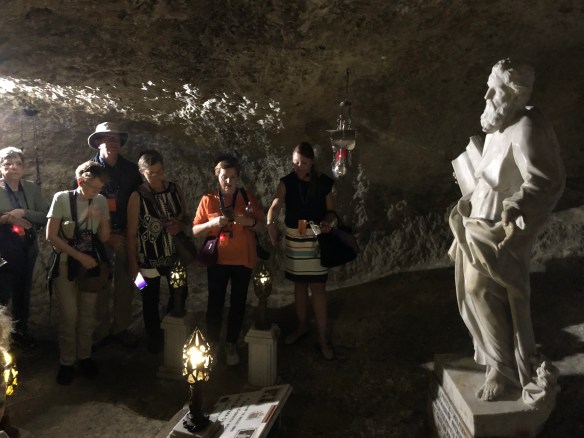
2018-10-08 10.09.35.jpg

We gathered down there to read about Paul’s witness to the early Christians, hear of the tale of him shipwrecking on Malta and being warmly welcomed by the people there.  In the picture above you see Karen and Diane and others from our bus.  It was a tender moment, of not just reading about Paul, but hearing how our guide for the day had been baptized at that very spot, in the catacombs.  This is where her journey with Christ began!  Talk about being tied to history!

Jesus speaks of the world on its head.  I think of the profundity of baptism, or the catacombs themselves.  Not much of this journey makes complete sense.  And yet we follow.  We engage in sometimes simple rituals.  And we preach Christ crucified.

We follow because we believe Jesus is the missing link to understanding.  And he is demanding of us an emptying of self, and taking on him as the missing link of our lives.

Through him the miracles flow and power abounds.  Through him all glory and honor become focused and understandable.

As the kingdom of heaven continues to spread through time and space, it came all the way from places like these dark catacombs to my doorstep, and all the way into my heart.  I have become a recipient of this grace, and now I can become a part of those sent out in our passage to share the good news!  And all that begins now!  This morning!

-Matt

A Great Yield, A Great Time

2018-10-11 12.23.42.jpg

Ecclus. 6:5-17Rev. 7:9-17Luke 10:1-16

“The harvest is plentiful, but the laborers are few.”

The Bible is filled with challenge – to live better lives, to live into LOVE, to stretch and challenge oneself in terms of following God.  And that is one way to read this passage: “There is a lot to do, but only a few who will do it.”

But there is another way to read this, in the light of the agrarian society in which Jesus lived, surrounded by farmers, shepherds, and people tied to the land used to harvests:  “There are only a handful of farmers, but LOOK AT THE MIRACULOUS BOUNTY they are able to produce!”

Growth in the kingdom sometimes comes easy, other times is a challenge.

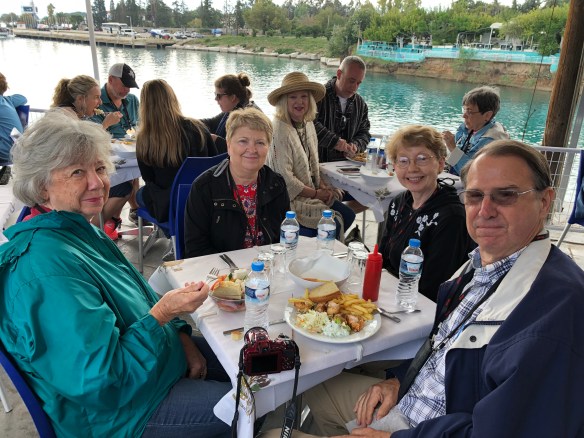
I just got back from the journey of a lifetime.  The Journeys of Paul, with the help of Royal Caribbean, Dr. Jaime Clark-Soles, and the fellowship of folks from Covenant Presbyterian Church, FPCOKC, First Pres in Duncan, as well as my mother, her friend Liisa, Jean Nelson’s sister Mary, and a group from Educational Opportunities that was eager to learn about Paul and walk in his steps.

Of course we had time for a lot of fellowship, floating around on a large cruise ship.  There was time to learn, yes.  But there was time to cut loose, speak plainly with one another, and grow in the faith.  Some of the more remarkable conversations I had came with some of our younger clergy, discovering these lands for the first time, and seeing their own strengths in ministry play out as they served along side fellow pilgrims they did not know.

I am thankful for times of rest and relaxation, and times of growth in the kingdom when you perhaps least expect it.

It was a great yield.

2018-10-12 12.29.54.jpg

2018-10-15 12.08.41.jpg

-Matt

Fighting to the Death for Truth

justitia-2597016_960_720

Ecclus. 4:20-5:7Rev. 7:1-8Luke 9:51-62

Beware of evil.  Do not refrain from speaking at the proper moment.  Do not subject yourself to a fool, or show partiality to a ruler.  Fight to the death for the truth, and the Lord God will fight for you.

So states some of our Wisdom literature reading from the OT today.

Oh how this hits close to home.

As a people who have had to endure one of the most foolish administrations to date in the great history of our nation, it is a daily battle of when to speak and when to keep silent.

This is doubly challenging as a pastor.  I do not want to take sides politically.  But I also realize my silence violates scripture when the actions of one, or many, add to the sin of our land.

We are called to speak, not to be reckless in our speech, but also not sluggish in our deeds.  Wisdom and justice and peace follow.

This is incredibly important for our ministry in our dark times, when the assault on truth is at an all time high.  As we erode confidence in the sacredness of our own word, we run the risk of descending into anarchy.  The other choice is almost worse, for fascism is right around the corner from eroded truth as well.

One of the aspects of our reading from Sirach today (also called Ecclesiasticus) is forgiveness.  We must have a stance of forgiveness and humility, not afraid to confess our sins.  Let God will sort out the evil doers, our text implores us.

And that is a helpful reminder.  I can only invest so much energy barking at the wind, or working to change a broken system.  At the end of the day I have to fix myself too.

But let us be bold, sisters and brothers:

“Watch for the opportune time, and beware of evil, and do not be ashamed to be yourself.  For there is a shame that leads to sin, and there is a shame that is glory and favour.”

Maybe I should get that tattooed into my flesh.

-Matt